
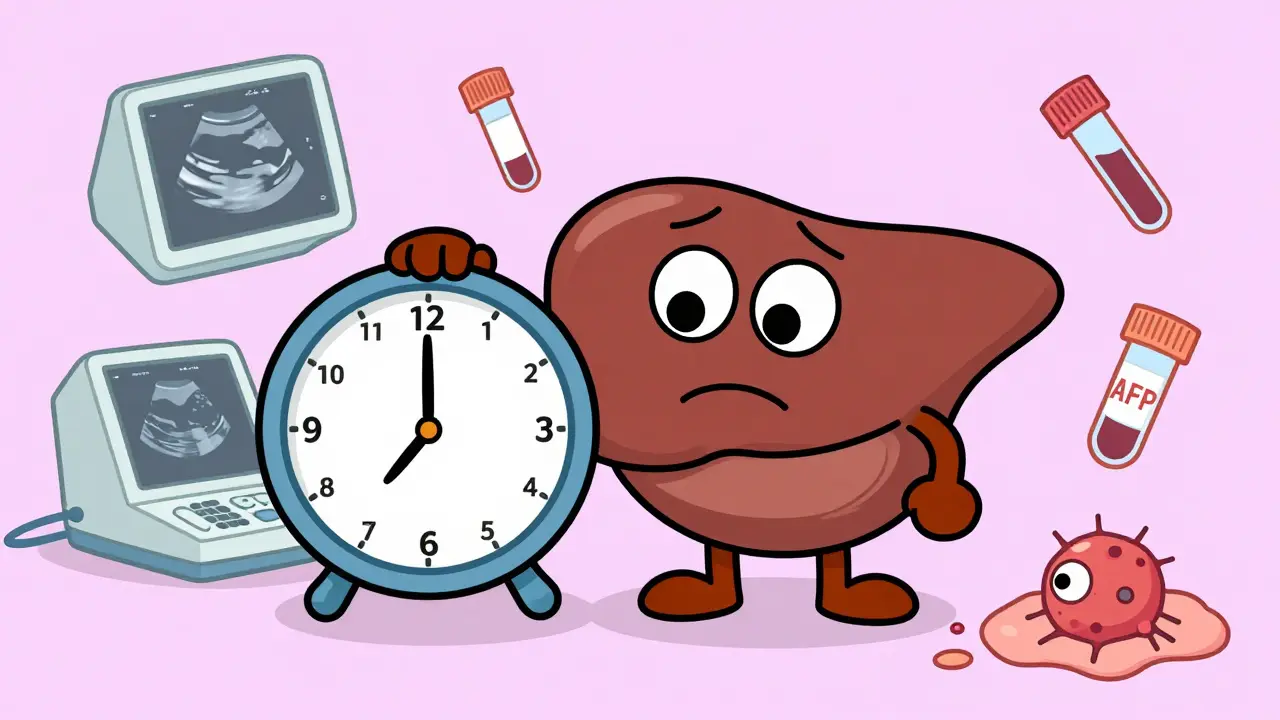
Why Hepatocellular Carcinoma Matters in Cirrhosis
Most people with liver cancer have hepatocellular carcinoma (HCC). It’s not rare-it’s the most common type, making up 75 to 85% of all liver cancers. And here’s the hard truth: over 80% of HCC cases happen in people who already have cirrhosis. That means if you have advanced scarring of the liver, you’re at serious risk. The good news? Catching it early can change everything.
Without screening, most people are diagnosed when the tumor is already large or spread. Survival rates drop to just 10-20%. But if you’re getting regular checks, that number jumps to 50-70%. That’s not a guess-it’s from real studies, like the one in Hepatology in 2015 that showed surveillance added about three months of life for every person screened. And that’s just the start. Early detection means you might still be eligible for treatments that can actually cure you.
How Often Should You Be Screened?
The standard advice from the American Association for the Study of Liver Diseases (AASLD) and the European Association for the Study of the Liver (EASL) is simple: get an ultrasound every six months. That’s not arbitrary. Liver tumors in cirrhotic patients grow about 1 to 2 centimeters every six months. If you wait a year, you could miss the window to act.
Ultrasound is the go-to tool because it’s widely available, safe, and cheap. No radiation, no needles-just a probe on your belly. But it’s not perfect. Small tumors can hide behind scar tissue. That’s why guidelines also mention alpha-fetoprotein (AFP) blood tests. If AFP is above 20 ng/mL, that’s a red flag. It’s not a diagnosis, but it’s a signal to dig deeper.
Some centers are starting to use MRI instead of ultrasound for high-risk patients. MRI sees tumors better, especially small ones. But it’s more expensive and harder to schedule. Right now, ultrasound is still the baseline for most people.
Who Gets Screened-and Who Doesn’t
Not everyone with cirrhosis is treated the same. The AASLD says: screen everyone with Child-Turcotte-Pugh (CTP) Class A or B cirrhosis. That’s most people. But if you’re in Class C-your liver is failing badly-screening usually stops. Why? Because your life expectancy is under two years. Screening won’t help if you’re not going to live long enough to benefit from treatment.
But here’s where things get complicated. The EASL changed the game in 2023. Instead of screening everyone with cirrhosis, they now recommend screening only if your annual risk of HCC is 1.5% or higher. That’s based on your age, gender, liver function, platelet count, and other factors. Some people might have cirrhosis but a risk below 1.5%-like someone with mild non-alcoholic fatty liver disease after successful treatment. For them, skipping screening might make sense.
Meanwhile, in Asia, guidelines are more aggressive. The APASL still recommends screening even for some Class C patients if their liver function is still decent. That’s because hepatitis B is common there, and it causes HCC even in less damaged livers.

What Happens When Something Shows Up?
If your ultrasound finds a lump bigger than 1 cm, or your AFP is high, you don’t wait. You go straight to a contrast-enhanced CT or MRI. That’s the next step. These scans use dye to show how blood flows through the liver. HCC has a very specific pattern: it takes up dye fast and then lets it leak out quickly. Radiologists use a system called LI-RADS to rate what they see. A LI-RADS 5 result means it’s almost certainly HCC.
AI tools are starting to help here. The FDA cleared Medtronic’s LiverAssist in 2022. It flags suspicious areas on ultrasound that human eyes might miss. In studies, it improved detection of small tumors by 18-22%. That’s huge. But it’s not replacing radiologists-it’s helping them.
Treatment Options: From Cure to Control
If HCC is caught early-stage 0 or A-you might still be cured. Options include:
- Radiofrequency ablation (RFA): A needle zaps the tumor with heat. Works best for tumors under 3 cm.
- Surgical resection: Removing the part of the liver with the tumor. Requires good liver function and no major scarring.
- Liver transplant: The gold standard if you’re eligible. You get a new liver, and the cancer is gone. But you need to be on a waiting list, and not everyone qualifies.
For larger tumors or those that have spread slightly, treatments shift from cure to control:
- Transarterial chemoembolization (TACE): Chemo is delivered directly to the tumor through the liver artery, then blocked off so it stays there.
- Targeted drugs: Sorafenib and lenvatinib slow tumor growth by blocking signals that help cancer spread.
- Immunotherapy: Drugs like nivolumab and pembrolizumab help your immune system recognize and attack cancer cells.
And there’s new hope. In 2023, the FDA approved a combo of atezolizumab and bevacizumab for advanced HCC. It’s not a cure, but it’s extending life longer than older drugs did.
Why So Many People Miss Screening
Here’s the ugly part: even though guidelines are clear, most people with cirrhosis aren’t getting screened. In the U.S., only 30-50% of eligible patients are checked regularly. Why?
Primary care doctors often don’t know when to refer. Patients forget appointments. Electronic health records rarely remind doctors to order ultrasounds. One study found that 67% of hepatologists said lack of automated reminders was their biggest barrier. Another 53% said they were just too busy.
There’s also a big gap in equity. White patients get screened at 52% rates. Black patients? 34%. Privately insured? 48%. Medicaid patients? 32%. These aren’t random-they’re systemic.
Even when patients show up, follow-through is a problem. One in three misses their next scan. That’s why some clinics now use patient navigators-real people who call, text, and walk patients through each step. Those programs cut no-show rates from 32% down to 14%.

What’s Coming Next
The future of HCC screening isn’t just ultrasound. It’s moving toward smarter, personalized risk tools. The aMAP score-based on age, gender, albumin, bilirubin, and platelets-can predict risk with 81% accuracy. That’s better than guessing based on cirrhosis alone.
Then there are blood biomarkers. The GALAD score combines AFP, AFP-L3, DCP, age, and gender. It detects early HCC with 85% sensitivity and 90% specificity. That’s nearly as good as imaging. The NIH is funding a big study called HESBA to test 17 new biomarkers. If one works, we might soon be able to screen with a blood test instead of an ultrasound.
Abbreviated MRI protocols are also on the rise. Instead of 30 minutes, they take 5-7 minutes and cost under $400. By 2027, experts predict 30-40% of high-risk patients will get MRI instead of ultrasound. GE and Siemens are already building faster machines for this.
The AASLD is expected to update its guidelines in late 2024. Early drafts suggest they’ll push harder for risk-based screening and possibly approve biomarker panels as part of routine checks.
What You Can Do
If you have cirrhosis:
- Ask your doctor if you’re on a surveillance schedule. Don’t wait for them to bring it up.
- Know your Child-Turcotte-Pugh class. It determines your risk and treatment options.
- Keep your appointments. Missing one scan can mean missing a cure.
- Ask about the GALAD score or other biomarkers. They’re not everywhere yet, but they’re coming.
- If you’re having trouble getting scans, ask for a patient navigator. Many hospitals have them.
And if you’re a caregiver or family member: help them remember. Write it on the calendar. Call ahead. Be the reason they don’t miss it.
Final Thought
Hepatocellular carcinoma doesn’t have to be a death sentence. But it won’t be caught by accident. It needs a system-regular scans, clear follow-up, and the will to stick with it. The tools are here. The science is solid. The only thing missing is action.

shubham rathee
January 21, 2026so they say ultrasound every 6 months but have you seen the waitlist in india? i got mine scheduled for next year and my liver is screaming already
also why is AFP still a thing when we have AI that can spot tumors smaller than a grain of rice?
someone please tell me why we're still using 1990s tech when the future is here
MAHENDRA MEGHWAL
January 22, 2026The scientific rigor presented in this article is commendable. The integration of evidence-based guidelines from AASLD and EASL provides a robust framework for clinical decision-making. It is imperative that healthcare systems prioritize structured surveillance protocols, particularly in resource-limited settings where disparities in access remain pronounced. The emphasis on risk stratification through the aMAP and GALAD scores represents a significant advancement in personalized hepatology.
Sangeeta Isaac
January 23, 2026so basically if you’re rich and white you get a fancy MRI every 6 months and if you’re on medicaid you get a ‘hey did you forget your appointment again?’ text from a robot?
and the AI that spots tumors? yeah it’s 18% better but only if your doc actually opens the software instead of just checking the box
we’re doing everything right except the part where we actually care about people
Melanie Pearson
January 24, 2026This is precisely why American healthcare must be restructured. The fact that a patient's survival hinges on their insurance status, race, or geographic location is not a flaw-it is a moral failure. The U.S. healthcare system is not broken; it was designed this way to benefit pharmaceutical and administrative monopolies. We must dismantle the profit-driven model and implement universal, equitable access to surveillance and treatment.
Rod Wheatley
January 26, 2026DON’T WAIT!! IF YOU HAVE CIRRHOSIS, YOU NEED TO BE ON A SURVEILLANCE SCHEDULE-TODAY! I’VE SEEN TOO MANY PEOPLE MISS THEIR ULTRASOUND AND THEN GET A DIAGNOSIS THAT COULD’VE BEEN CURED!
ASK FOR THE GALAD SCORE! ASK FOR A NAVIGATOR! ASK FOR HELP!
YOUR LIFE ISN’T A TO-DO LIST ITEM-IT’S YOUR FUTURE!
IF YOU’RE A CAREGIVER, BE THE PERSON WHO REMINDS THEM-CALL, TEXT, SHOW UP!
YOU ARE THEIR BEST CHANCE. DON’T LET THEM FALL THROUGH THE CRACKS!
Jerry Rodrigues
January 27, 2026I think the real takeaway here is how much we’ve improved in detection, but how little we’ve improved in delivery. The science is solid, the tools are there, but the system still treats patients like numbers. Maybe the answer isn’t more tests, but more human connection-someone who actually checks in.
Uju Megafu
January 28, 2026this is why i hate how western medicine pretends to care while letting people die on waiting lists
they give you a pamphlet and a smile and then charge you $800 for a scan that’s 3 months late
and don’t even get me started on how they ignore hepatitis B patients in africa-like our lives are just a footnote in some American guideline
we’re not statistics, we’re people who just want to live
Andrew Rinaldi
January 30, 2026It’s interesting how the same technology that can detect a tumor the size of a pea can also be used to track our online behavior, yet we still struggle to get people basic healthcare. Maybe the problem isn’t the tools-it’s what we value. We prioritize efficiency over empathy, profit over presence. If we truly believed everyone deserved a chance, we’d make sure no one missed their scan-not because of cost, not because of bureaucracy, but because we refused to let anyone fall through the cracks.