
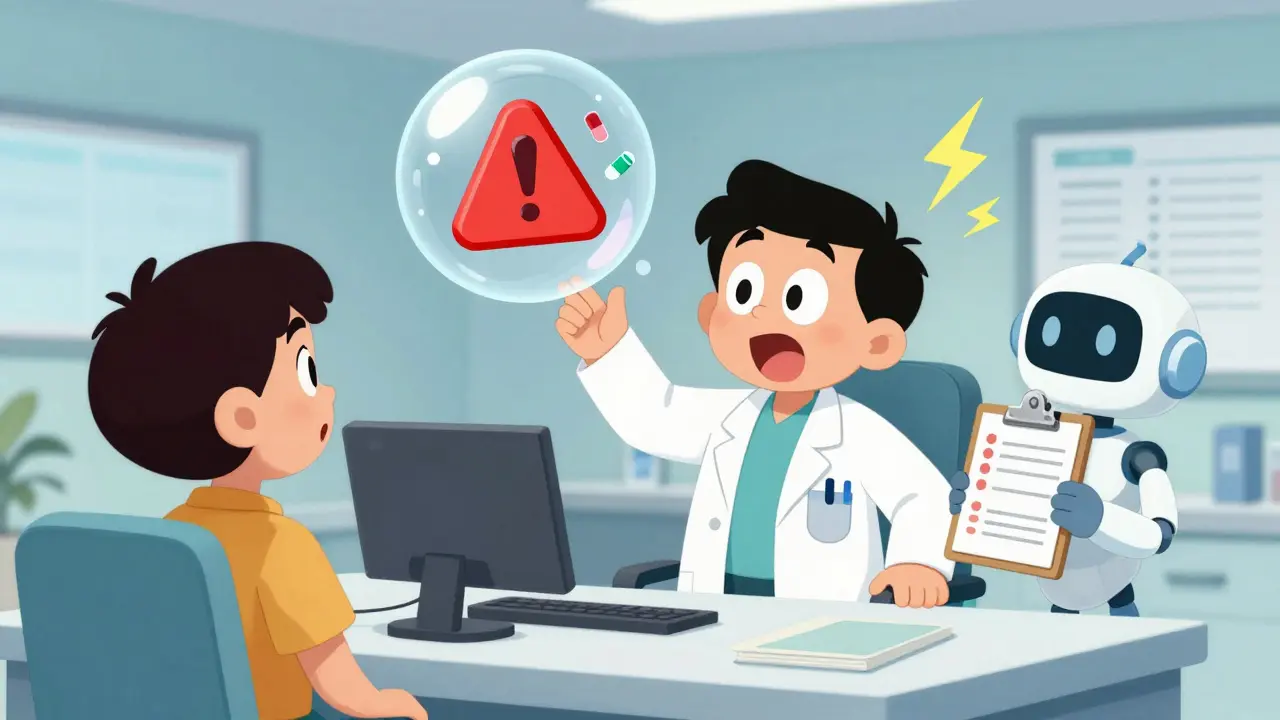
Every time a patient takes a new medication, there’s a risk - not always obvious - that something could go wrong. A rash. A spike in liver enzymes. A dangerous interaction with another drug. Traditional methods of tracking these problems - paper forms, delayed reports, siloed data - are too slow. By the time a pattern emerges, harm has already been done. That’s why modern clinicians are turning to clinician portals and apps for real-time drug safety monitoring. These aren’t just fancy dashboards. They’re active tools that help you catch dangers before they escalate.
What These Tools Actually Do
Clinician portals and safety apps pull data from your electronic health records (EHR), clinical trials, and lab systems to flag potential adverse drug reactions. They don’t replace your judgment. They amplify it. For example, if a patient on warfarin suddenly starts taking a new antibiotic, the system doesn’t just say “possible interaction.” It shows you the exact risk level, the likelihood of bleeding, and what alternatives exist - all in seconds.
Platforms like Cloudbyz, IQVIA, and Medi-Span integrate directly into your daily workflow. You don’t need to log into a separate system. The alerts appear right in the patient chart, next to the medication list. Some even highlight patients who haven’t had follow-up labs in 60 days - a common blind spot in chronic drug therapy.
How to Get Started
Before you click “activate,” ask yourself: What’s your goal? Are you a hospital trying to reduce medication errors? A research team running a clinical trial? A small clinic in a rural area with spotty internet? Your answer determines which tool fits.
- If you’re in a hospital: Look for EHR-integrated tools like Wolters Kluwer’s Medi-Span. It works with Epic and Cerner and gives real-time drug interaction alerts. One 500-bed hospital reported 187 prevented adverse events in six months just from these alerts.
- If you’re in a clinical trial: Cloudbyz’s platform connects directly to your trial data systems. It maps patient data to CDISC standards (SDTM, ADaM) and auto-generates safety reports. One biotech company cut report prep time from three weeks to four days.
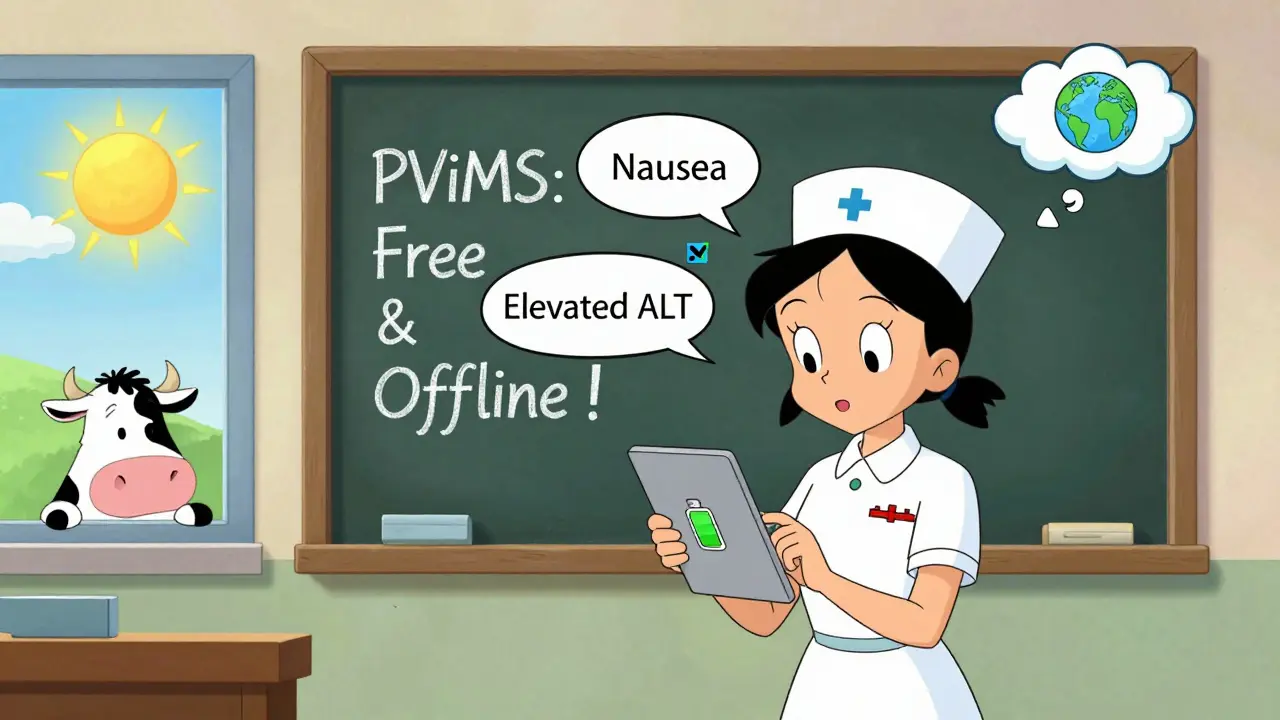
- If you’re in a low-resource setting: PViMS - the free, WHO-backed platform - is built for clinics with unreliable power or internet. It runs on any browser, uses pre-coded MedDRA terms to cut data entry time by 60%, and works offline with sync when connection returns.
What You Need to Know About the Tech
These systems aren’t magic. They rely on clean data. If your EHR has messy notes - “Pt felt funny after pill” - most tools will miss it. Only the most advanced platforms use natural language processing to extract meaning from unstructured text, and even then, accuracy hovers around 70%.
Most portals use HL7 and FHIR standards to talk to other systems. That means if your hospital uses an old EHR that doesn’t support these, integration will be slow - and expensive. Cloudbyz’s setup takes 8-12 weeks. Medi-Span? More like 4-6. PViMS? Just a login and a password.
Don’t overlook compliance. If you’re in the U.S., FDA 21 CFR Part 11 matters. It requires audit trails, electronic signatures, and data integrity checks. Open-source tools like clinDataReview hit 100% compliance - but you need to know R programming to use them. Commercial tools handle this automatically.
Real-World Pitfalls (And How to Avoid Them)
Here’s what actually breaks these systems in practice:
- Alert fatigue: Medi-Span users report too many false positives. If your system flags every minor lab change, clinicians start ignoring it. Solution: Tune thresholds. Work with your vendor to adjust sensitivity based on your patient population.
- Training gaps: A 2024 survey found 87% of users need data literacy to use these tools effectively. If your staff can’t interpret a hazard score or understand what “causality assessment” means, the tool becomes useless. Plan for 80-120 hours of training per user.
- Over-reliance on AI: IQVIA’s AI cuts false positives by 85%, but the FDA found 22% of automated signals in 2023 lacked clinical context. An AI might flag a drug as risky because 5 patients had headaches - but those patients were also recovering from surgery. Always validate with human review.
- Connectivity issues: In Kenya and rural India, PViMS users report daily outages. Have a backup: printed forms, local data collection, and a plan to upload later.
Who Uses These Tools Best?
It’s not just pharmacovigilance officers. The most successful teams are interdisciplinary.
- Clinicians: Use alerts to adjust prescriptions at the point of care. A GP in Melbourne now checks the portal before prescribing NSAIDs to elderly patients - catching 3 kidney risk cases last month alone.
- Pharmacists: Use dashboards to track drug utilization trends. One hospital pharmacy used data from Medi-Span to switch from a high-risk statin to a safer alternative for 120 patients.
- Research staff: Use platforms like clinDataReview to generate FDA-compliant safety reports in minutes, not weeks. No more manual data copying.
- Regulatory teams: Audit trails built into Cloudbyz and IQVIA mean compliance is automatic. No more scrambling before an inspection.
Costs and Accessibility
Price varies wildly:
- Enterprise platforms (Cloudbyz, IQVIA): $150,000-$200,000/year. Worth it if you run trials or manage 10,000+ patients.
- Hospital tools (Medi-Span): $22,500-$78,000/year. Scales with bed count. Best for mid-to-large hospitals.
- Free tools (PViMS): No cost. Donor-funded. Ideal for clinics in LMICs or underfunded public health systems.
- Open-source (clinDataReview): Free to download. But you’ll need a data scientist to maintain it. Labor cost: $50-$100/hour.
Don’t just buy the most expensive one. Ask: Can we integrate it? Can we train our team? Will it work when the power goes out?
The Future: AI, Real-Time, and Human Oversight
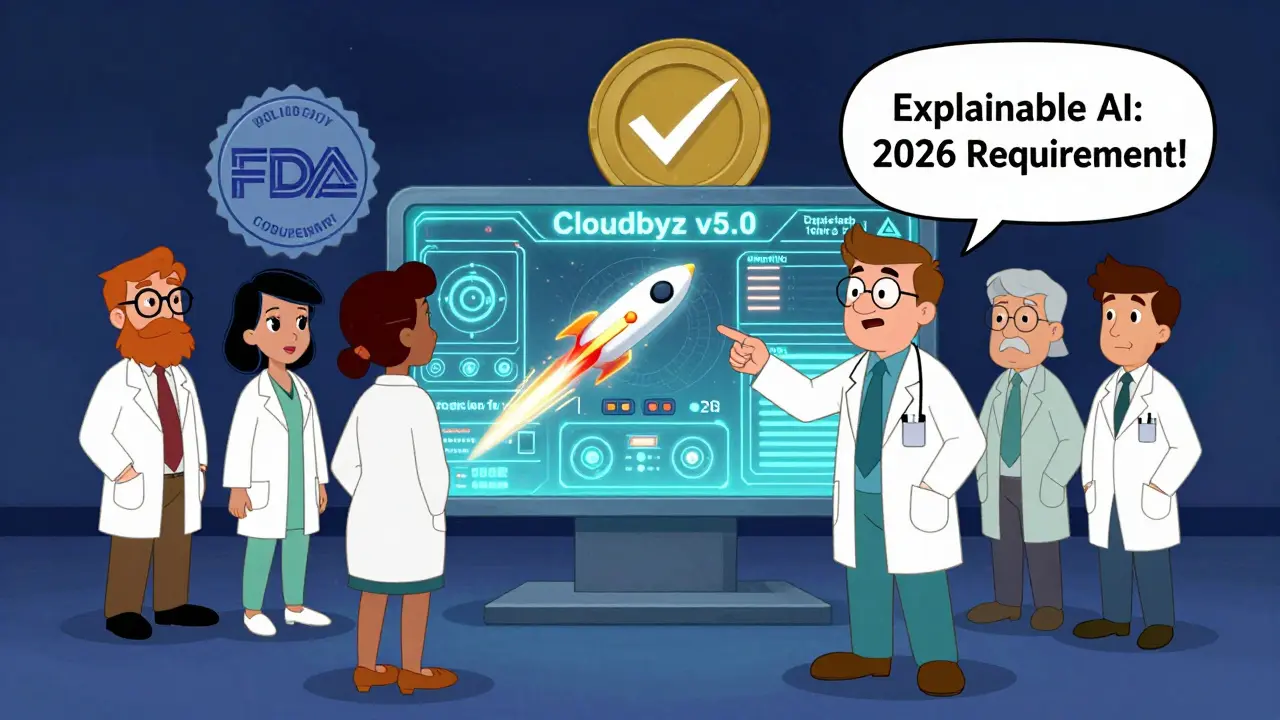
By 2026, the FDA will require AI models in safety tools to be explainable. That means vendors can’t just say “the algorithm flagged this.” They’ll have to show you why - line by line.
Cloudbyz’s new version 5.0 uses machine learning to predict safety signals before they’re even reported. It looks at lab trends, vitals, and even patient-reported symptoms from apps. Early tests show a 40% improvement in early detection.
But here’s the truth: No algorithm replaces a clinician who knows their patient. The most effective safety systems don’t automate decisions - they give you better information to make them.
By 2027, 80% of pharmacovigilance teams will use AI-augmented tools. But human oversight? That’s not going anywhere. Your expertise - your experience, your intuition, your bedside knowledge - is still the final checkpoint.
What to Do Next
Start small. Pick one drug class you’re worried about - maybe anticoagulants or antibiotics. See how many adverse events your team has missed in the last six months. Then, try one tool.
- Request a demo of Medi-Span if you’re in a hospital.
- Ask your clinical trial vendor if they support Cloudbyz integration.
- Download PViMS and test it with a few paper cases - see how fast you can enter and report a reaction.
Don’t wait for perfection. The goal isn’t to eliminate all risk. It’s to catch the big ones - the ones that cause harm - before it’s too late.
Cara C
December 21, 2025Been using Medi-Span for a year now and honestly? It’s saved my butt more than once. I had a patient on warfarin start a new antibiotic, and the alert popped up right in the chart. I switched it before the INR spiked. No drama, no hospitalization. These tools aren’t perfect, but they’re way better than guessing.
Also, the fact that it highlights patients missing labs? Genius. I used to forget to check creatinine on elderly patients on NSAIDs. Now it just shows up. No extra work. Just better care.
Michael Ochieng
December 23, 2025As someone who’s worked in Lagos and now in Atlanta, I can tell you - PViMS is a game-changer for places with spotty power. We used it in a rural clinic in Nigeria. No internet for three days? No problem. We filled out paper forms, then synced when the generator came back on. Took 10 minutes to upload 12 reports.
And yeah, it’s free. No corporate lock-in. WHO didn’t mess around with this one. If your hospital’s spending $200K on a platform that needs fiber optics, you’re doing it wrong.
Dan Adkins
December 24, 2025It is imperative to note that the proliferation of these digital platforms, while ostensibly beneficial, introduces a profound vulnerability in clinical decision-making. The over-reliance on algorithmic outputs, particularly those derived from imperfectly structured EHR data, constitutes a systemic erosion of clinical autonomy.
Furthermore, the assertion that natural language processing achieves 70% accuracy is statistically misleading. In reality, it is an unvalidated heuristic that routinely misclassifies non-standard patient narratives - often with catastrophic consequences. One must question the regulatory oversight permitting such tools to be embedded in workflows without mandatory human-in-the-loop validation protocols.
Additionally, the claim that Cloudbyz reduces report prep time by 85% ignores the latent labor required to audit and correct algorithmic hallucinations - labor that is never accounted for in vendor ROI models.
This is not innovation. It is automation theater.
Erika Putri Aldana
December 24, 2025So you’re telling me I gotta pay $200k so my computer can tell me not to mix blood thinners with antibiotics?? 😒
I’ve been a nurse for 15 years. I know what interacts. This is just tech companies selling snake oil to hospitals that don’t know how to budget.
Also, ‘AI predicts signals before they’re reported’?? Bro. That’s just fancy stats. You can’t predict a patient’s reaction to a new med unless you’ve lived it. 🤦♀️
Grace Rehman
December 26, 2025Let’s be real - we’re just outsourcing our brains to software that’s trained on data from hospitals that can’t even spell ‘hypertension’ correctly
And don’t get me started on ‘explainable AI’ - like, sure, the algorithm says ‘this drug caused the reaction’ but why? Because the patient’s chart says ‘felt weird’ and the AI decided ‘weird’ = ‘hepatotoxicity’?
Meanwhile, the pharmacist who actually knows Mrs. Johnson’s 78-year-old body better than her EHR is being told to ‘trust the system’
Also, ‘free tools’? Yeah, right. Free as in ‘you’ll pay with your time, sanity, and soul’
And why do we keep pretending tech fixes human problems? We’re not robots. We’re tired people with coffee stains on our scrubs trying not to kill someone today. 🤷♀️
Jerry Peterson
December 26, 2025Big respect to the author for calling out alert fatigue. That’s the silent killer here. I work at a 300-bed hospital and our system used to ping every time someone took Tylenol with a statin. We had 47 alerts per day. No one looked at them anymore.
We worked with the vendor to tune it. Now it only flags high-risk combos with lab changes. Down to 3 alerts a day. And guess what? We caught 5 real issues last month.
Less noise. More signal. That’s the secret.
Meina Taiwo
December 27, 2025PViMS works in Nigeria. No internet? Type it in. Power out? Save it. Connection back? Sync. Done.
Simple. Free. Actually useful.
Stop overcomplicating safety.
Orlando Marquez Jr
December 28, 2025While the utility of clinician portals is undeniably advantageous, one must not overlook the foundational requirement of interoperability standards. The adoption of HL7 and FHIR is not merely a technical preference but a regulatory imperative for longitudinal patient safety surveillance.
Furthermore, the integration latency associated with legacy EHR systems remains a significant impediment to scalability. Institutions must allocate sufficient resources not only for software procurement but for infrastructure modernization.
It is also worth noting that the compliance requirements under 21 CFR Part 11 are non-negotiable in U.S.-based clinical environments. Failure to meet these standards may result in regulatory sanctions and compromised data integrity.
Jon Paramore
December 28, 2025Let’s talk about FHIR endpoints and CDISC mappings - if your EHR doesn’t support STU3 or R4, you’re stuck in 2015. Cloudbyz’s API layer requires OAuth2.0 + SMART on FHIR, and if your vendor’s still using HL7 v2.3 with pipe-delimited fields, good luck.
Also, MedDRA coding in PViMS? Solid. But if your RN is entering ‘chest pain’ instead of ‘chest discomfort, substernal’, the system won’t catch it. You need trained pharmacovigilance associates, not just clinicians clicking ‘yes’ to alerts.
And don’t get me started on causality assessment. 87% of users don’t know how to rate ‘probable’ vs ‘possible’. That’s not a tool failure. That’s a training failure.
Swapneel Mehta
December 29, 2025Really glad someone wrote this. I’m in rural India and we’re using PViMS on a tablet with a 3G connection. It’s slow, but it works. We’ve reported 14 reactions in 6 months - none would’ve been caught before.
Also, the offline mode? Life saver. Power cuts every afternoon. We just keep typing. Syncs when the generator kicks in.
Don’t need fancy AI. Just need something that doesn’t crash when the internet dies.
Cameron Hoover
December 29, 2025THIS. IS. A. REVOLUTION. 🚀
I used to spend 3 days compiling safety reports. Now? Cloudbyz auto-generates them. I click ‘submit’. Done.
My team used to cry every time an FDA audit was coming. Now they laugh. We have audit trails built in. We’re actually proud of our safety data.
Yes, it costs money. But think about the lawsuits you’re avoiding. The lives you’re saving. The sleep you’re getting.
Stop thinking about cost. Think about consequences.
Stacey Smith
December 31, 2025Why are we letting a bunch of tech bros in Silicon Valley dictate how doctors do their jobs? We don’t need AI to tell us penicillin and birth control don’t mix. We learned that in med school.
These tools are just corporate surveillance wrapped in a white coat. And now we’re paying $200K for it?
Next they’ll be auto-filling our notes with ‘patient is compliant’ because the app thinks they took their pill.
USA needs to stop outsourcing common sense.
Teya Derksen Friesen
January 1, 2026As a clinical trial coordinator in Vancouver, I can confirm: Cloudbyz’s CDISC integration is flawless. We went from 18 days of manual data mapping to 4 days of QA.
But here’s the catch - the tool doesn’t replace the need for a trained pharmacovigilance officer. It just gives them more time to do what matters: review signals, talk to clinicians, and ask ‘why?’
Automation isn’t the goal. Better decisions are.
Also - the FDA’s new explainable AI rules? Long overdue. Thank you for finally demanding transparency.
Sandy Crux
January 2, 2026...and yet, somehow, the most sophisticated, AI-driven, FHIR-compliant, 21 CFR Part 11-certified platform in the world still failed to prevent the case of the 72-year-old woman who died from a drug interaction because the alert was buried under 14 other ‘possible’ flags - all of which were generated because her EHR had a note that said, ‘Patient seems tired.’
So yes, we’ve built a cathedral of digital noise - and then we wonder why clinicians have ‘alert fatigue.’
It’s not the tool’s fault. It’s the assumption that more data = better care.
It’s not. It’s just more work.
And now we’re paying $200,000 for the privilege of being distracted from actual medicine.
...I’m sorry, but this feels less like progress and more like performance art for hospital administrators.
And yes - I’m still using paper.
Jason Silva
January 3, 2026EVERY SINGLE ONE OF THESE TOOLS IS A GOVERNMENT/PHARMA COVER-UP 😈
They don’t want you to know that 90% of adverse reactions are suppressed by the FDA’s passive reporting system - and now they’re giving you ‘AI alerts’ so you think they’re fixing it?
That’s not safety - that’s distraction.
Real drug safety? It’s whistleblowers. It’s leaked internal emails. It’s journalists digging up clinical trial data that got buried.
These portals? They’re just PR for Big Pharma to say ‘We’re monitoring!’ while quietly ignoring the red flags that don’t fit their profit model.
And the free PViMS? That’s just a placebo for poor countries so they don’t sue.
Trust the system? Nah. I trust my gut - and my cousin who works at a lab in New Jersey who says ‘they’re deleting reports every Tuesday.’ 💀
Cara C
January 4, 2026Jason, I get where you’re coming from - but the real problem isn’t the tools. It’s the silence. Before these portals, adverse events just disappeared. No one knew. No one tracked. Now, at least, we see patterns.
I’ve seen a drug get pulled because 3 rural clinics using PViMS flagged the same reaction. That never would’ve happened with paper forms.
Yeah, the alerts are noisy. Yeah, the AI messes up. But we’re finally listening to the data - even if it’s messy.
And yeah, I still trust my gut too. But now I have numbers to back it up.