

When your asthma feels like a ticking clock-sometimes quiet, sometimes loud-you need more than just an inhaler. You need a plan. Not a vague idea. Not a note on your phone. A real, written, color-coded roadmap that tells you exactly what to do when your breathing changes. That’s an asthma action plan. And if you’re not using one, you’re flying blind.
What an Asthma Action Plan Actually Does
An asthma action plan is a personalized document that turns confusing symptoms into clear steps. It doesn’t guess. It doesn’t wait. It tells you: When you feel this, do this. It’s built around three simple zones: green, yellow, and red. Think traffic lights. Green means go-your asthma is under control. Yellow means slow down-your body is warning you. Red means stop-this is an emergency. The National Heart, Lung, and Blood Institute (NHLBI) says every person with asthma should have one. And they’re not just recommending it-they’ve proven it works. People who use their action plans have 70% fewer emergency room visits. That’s not a small number. That’s life-changing. But here’s the problem: only 30% of asthma patients actually have one. Why? Because most people think their doctor will hand it to them. Or they assume their inhaler is enough. Or they forget it’s even a thing. But if you’re using your rescue inhaler more than twice a week, you’re not managing asthma-you’re reacting to it. An action plan stops that cycle.The Three Zones: Green, Yellow, Red
Every good asthma action plan uses the same three zones. They’re simple, visual, and designed for use when you’re tired, stressed, or struggling to breathe.- Green Zone (Go): You feel normal. No coughing, no wheezing, no waking up at night. You can run, laugh, sleep, and exercise without trouble. Your peak flow reading (if you use one) is 80-100% of your personal best. In this zone, you take your daily controller medication-usually an inhaled corticosteroid like fluticasone-as prescribed. No changes. No panic. Just consistency.
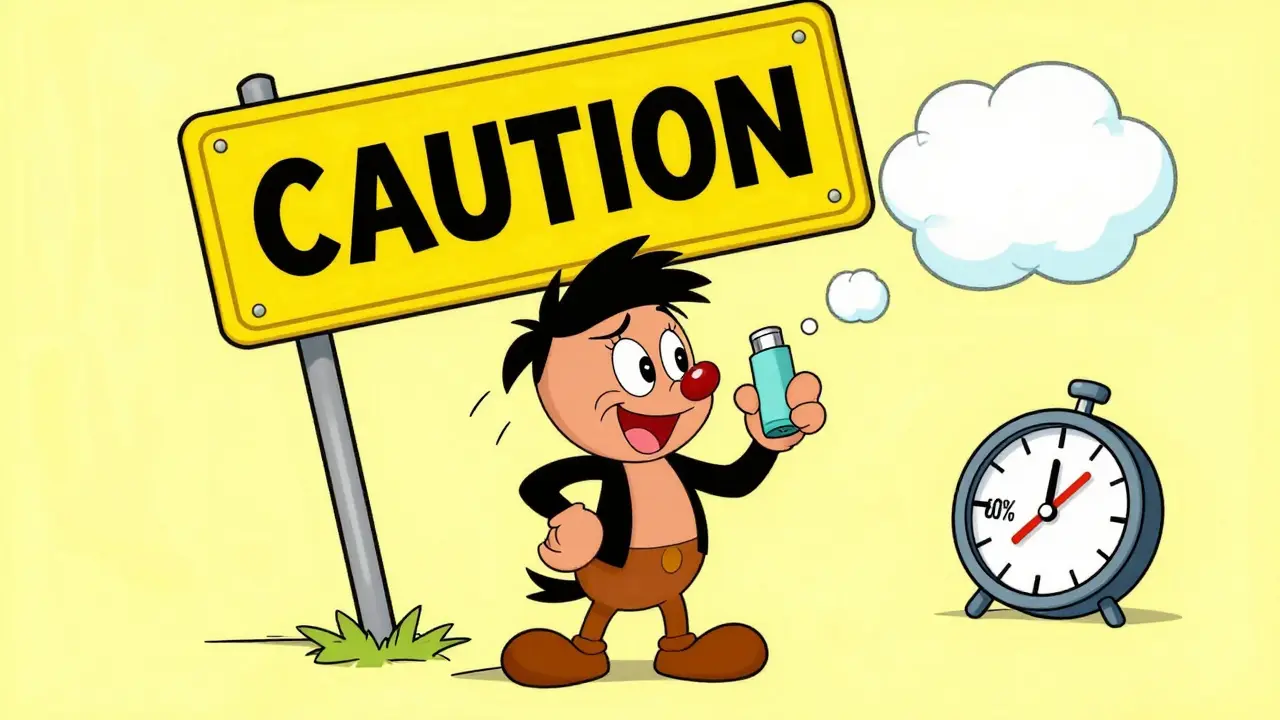
- Yellow Zone (Caution): This is your warning light. You might feel a tight chest, a persistent cough, or wheezing after activity. You could wake up at night. Your peak flow drops to 50-79% of your best. This isn’t an emergency-but it’s a signal. You need to act fast. Use your rescue inhaler (like albuterol) right away: 2-4 puffs every 4-6 hours. Keep taking your daily controller. Monitor your symptoms every hour. If you don’t improve in 24 hours, call your doctor. Don’t wait.
- Red Zone (Danger): This is when you need help now. You can’t speak in full sentences. Your lips or fingernails turn blue. Your rescue inhaler gives no relief. Your peak flow is below 50%. You’re gasping. This isn’t a suggestion-it’s a 911 situation. Call emergency services or go to the ER immediately. Don’t wait to see if it gets better. It won’t.
How to Build Your Plan (Step by Step)
You don’t build this alone. You work with your doctor. But you need to come prepared.- Get your personal best peak flow number. If you use a peak flow meter, take readings twice a day for two weeks when you’re feeling perfectly fine. Write down the highest number. That’s your personal best. If you don’t have a meter, ask your doctor for one. They’re cheap, and your plan won’t be accurate without this baseline.
- List your daily medications. What do you take every day? What dose? How many times? Write it clearly. Include brand names (Flovent, Advair) and generic names (fluticasone, salmeterol). Don’t assume your doctor remembers.
- Write your rescue meds. Which inhaler do you use when you’re struggling? How many puffs? How often? Include instructions like: “Take 2 puffs, wait 1 minute, repeat if needed.”
- Define your triggers. What makes your asthma worse? Pollen? Cold air? Smoke? Dust? List them. This helps you avoid flare-ups before they start.
- Add emergency contacts. Who do you call if you’re in the red zone? Your doctor? A family member? Your school nurse? Put names and numbers on the plan. Don’t make someone guess in a crisis.
- Keep a copy everywhere. One in your wallet. One taped to your fridge. One in your kid’s backpack. One at work. One on your phone as a photo. If you forget where it is, you won’t use it.
Why Most Plans Fail (And How to Fix It)
The biggest reason people don’t stick to their plan? They don’t know what their personal best is. I’ve talked to patients who’ve had asthma for 15 years and still don’t know what 50% of their peak flow looks like. Without that number, the yellow and red zones are meaningless. Another problem? Plans get outdated. If you’ve changed medications, gained weight, moved to a new city, or started exercising, your plan needs an update. Don’t wait for your annual checkup. If your symptoms change, call your doctor. Bring your plan. Update it. And yes-color matters. But not for everyone. About 8% of men have trouble telling red from green. If that’s you, ask your doctor for a version with shapes: green circle, yellow triangle, red diamond. The Allergy Asthma Network offers these alternatives. You’re not broken-you just need a different format.What Your Doctor Should Do (But Often Doesn’t)
Your doctor isn’t just handing you a paper. They should be helping you understand it. A good visit includes:- Using the Asthma Control Test (ACT) to score your symptoms
- Checking your inhaler technique-most people use them wrong
- Asking: “What do you do when you wake up coughing?”
- Reviewing your plan at every visit, not just once a year
Digital Tools That Actually Help
There’s an app for that. And it’s not just a reminder. The Asthma and Allergy Foundation of America has a free app that tracks your symptoms, medication use, and peak flow. It even shows you patterns-like how your asthma spikes every time the pollen count hits 100. It can tell you when to adjust your plan before you get sick. Smart inhalers like Propeller Health attach to your rescue inhaler and log every puff. They sync with your phone and tell you if you’re overusing it. In a 2022 study, users improved adherence by 35% just by seeing their data. And now, AI is stepping in. Researchers at UCSF are testing algorithms that predict asthma flare-ups 24-48 hours in advance by analyzing your symptom diary, weather, and air quality. It’s not mainstream yet-but it’s coming.
Special Cases: Kids, Seniors, and Schools
If your child has asthma, their plan needs to be at school. Teachers, coaches, and the school nurse must know what to do. Under U.S. law, schools are required to keep a copy on file. Don’t assume they’ll ask. Bring it. Give them a copy. Sign a release if needed. For older adults, understanding the plan can be harder. Studies show seniors need 2-3 extra sessions to fully get it. That’s okay. Bring a family member. Ask for a large-print version. Record the instructions on your phone. Use voice assistants: “Hey Siri, read my asthma plan.”Your Plan Is a Living Document
This isn’t a one-time thing. Your asthma changes. Seasons change. Triggers change. Your body changes. Your plan should too. In spring, pollen spikes. Update your plan to add “avoid outdoor exercise on high-pollen days.” In winter, cold air triggers coughing. Add “wear a scarf over your nose when outside.” If you start yoga and notice fewer symptoms, note it. Your plan isn’t just about emergencies-it’s about living better.Final Thought: You’re Not Just a Patient. You’re the Manager.
Asthma isn’t something that happens to you. It’s something you manage. And the best tool you have is your own knowledge. An asthma action plan gives you control. It turns fear into action. It turns confusion into clarity. You don’t need to be perfect. You just need to be prepared. Keep your plan handy. Review it every few months. Update it when things change. And if you ever feel like you’re barely holding on-use it. Because when your breathing is on the line, you don’t want to guess. You want to know.Do I need a peak flow meter for my asthma action plan?
You don’t absolutely need one, but your plan will be much less effective without it. Peak flow numbers turn vague symptoms like “I feel tight” into clear, measurable data. Without knowing your personal best, you can’t tell if you’re in the yellow or red zone. Most doctors recommend using a peak flow meter for at least two weeks to establish your baseline. If you can’t use one, your doctor can still create a plan based on symptoms-but you’ll need to be extra careful about tracking how you feel each day.
Can I use my asthma action plan for exercise-induced asthma?
Yes, and you should. Exercise-induced asthma is common. Your plan should include pre-exercise steps, like taking your rescue inhaler 15-30 minutes before activity. It should also say what to do if you start wheezing during exercise-usually stop, use your inhaler, and wait until symptoms clear before continuing. Many athletes with asthma manage their condition perfectly using an action plan. Just make sure your coach or trainer knows about it.
What if my asthma plan doesn’t match what my doctor says?
If your written plan contradicts your doctor’s advice, bring it to your next appointment. Mistakes happen-especially if the plan was printed from a generic template. Your plan should reflect what your doctor told you, not what’s on a website. Don’t rely on memory. Ask for a revised version with your exact medications, doses, and instructions. Make sure you both sign and date it.
Is it okay to share my asthma action plan with others?
Yes, and you should. If you have children, give their plan to teachers, babysitters, and coaches. If you live with someone, leave a copy where they can find it. If you travel, carry a copy with you. In an emergency, strangers may need to help you. A clear, printed plan gives them the confidence to act quickly. It’s not a secret-it’s a safety tool.
How often should I update my asthma action plan?
Update it anytime your asthma changes. That could be after a new diagnosis, a medication change, a move to a new city, or after a major flare-up. Seasonal changes matter too-if pollen or cold air triggers you more in winter, adjust your plan before the season starts. Most experts recommend reviewing your plan every 6 months, even if things feel fine. Your body changes. Your plan should too.


Jake Nunez
January 10, 2026My doctor never gave me a written plan. I just use my inhaler when I feel like I’m drowning. Turns out, that’s like driving with your eyes closed and hoping the road doesn’t curve.
Started tracking my peak flow after reading this. Now I know when I’m in yellow before I’m gasping. Life changed.
Still don’t have it printed, but it’s on my lock screen. That’s progress.
Michael Marchio
January 11, 2026It’s honestly baffling that so many people think an inhaler is a cure, not a band-aid. Asthma isn’t something you treat when it’s convenient-it’s a chronic condition that demands structure. The fact that only 30% of patients have a written plan isn’t negligence-it’s a systemic failure of education, not just medical care. And don’t get me started on the people who say, ‘I don’t need a peak flow meter, I know my body.’ You don’t. Not really. Not until you’ve got numbers to back up what your lungs are screaming. This isn’t intuition. It’s data. And data saves lives.
lisa Bajram
January 11, 2026OMG YES. I was one of those people who thought ‘I’ll just remember what to do’-until I had a 3 a.m. panic attack and couldn’t even find my inhaler because I’d left it in my car.
Now my plan is laminated and taped to my fridge, my bathroom mirror, AND my phone wallpaper. I even gave copies to my dog walker and my yoga instructor.
Pro tip: Use colored pens. Red = emergency. Yellow = call your doc. Green = you’re doing great, keep it up.
Also-get a smart inhaler. Propeller changed my life. I didn’t realize I was using my rescue inhaler 5x a week until the app told me. I was in yellow 24/7 and thought it was ‘normal’.
You’re not weak for needing a plan. You’re smart. And you’re not alone.
Ted Conerly
January 13, 2026This is the kind of post that makes you feel seen. I’ve had asthma since I was 6. I’ve been through every gimmick, every ‘miracle’ supplement, every ‘just breathe’ lecture.
But this? This is the first thing that actually gave me control.
I started using my plan last winter. I didn’t miss a single day of work. I even ran a 5K. Not because I was cured-but because I knew exactly when to slow down, when to puff, and when to call for help.
Don’t wait for a hospital visit to realize you need this. Make it today. Print it. Share it. Live it.
Faith Edwards
January 13, 2026It is truly lamentable that the medical establishment has allowed such a rudimentary, yet profoundly effective, intervention to remain underutilized. The notion that a patient can manage a chronic respiratory condition without a formally documented, evidence-based protocol is not merely negligent-it is a dereliction of professional duty. The fact that only thirty percent of individuals with asthma possess such a document is indicative of a broader cultural apathy toward preventive medicine, one that prioritizes reactive crisis management over proactive stewardship of health. One must wonder whether this statistic reflects incompetence, indifference, or both.
Jay Amparo
January 14, 2026I’m from India and I’ve seen how asthma is treated here-often ignored until it’s too late. My cousin’s son had a near-fatal attack because his school didn’t have a plan. Now I carry printed copies of this guide everywhere I go.
Even in rural clinics, we print these out in big font and hang them on the wall. Teachers, grandmas, auto drivers-they all learn the green-yellow-red system.
You don’t need fancy apps. You need clarity. And this post? It’s the clarity we needed.
Lisa Cozad
January 15, 2026I printed mine and put it in my kid’s backpack. His teacher didn’t even know what a peak flow meter was. I brought one in and showed her. Now she keeps it in her desk.
Also-my daughter uses the app. She loves seeing the graphs. It’s like a game: ‘Today I stayed in green!’
Who knew asthma management could feel like winning?
Saumya Roy Chaudhuri
January 16, 2026Everyone’s talking about peak flow meters like they’re the holy grail. Newsflash: they’re useless if you don’t know how to use them. I’ve seen people take readings while coughing, after drinking coffee, after running up stairs. The numbers are garbage.
And don’t get me started on those ‘smart inhalers.’ They cost $200. Most people can’t afford that. A piece of paper and a pen still works better than tech that breaks after two months.
Also, why are we letting tech companies dictate asthma care? This isn’t a startup pitch. It’s a life-or-death tool. Keep it simple.
anthony martinez
January 17, 2026So let me get this straight. The solution to asthma is… writing things down? And you’re shocked people don’t do it?
Next you’ll tell us that ‘wearing a seatbelt’ reduces car crash deaths. Groundbreaking.
Meanwhile, my doctor gave me a one-page PDF labeled ‘Asthma Plan’ with no numbers, no instructions, and a clipart of a lung. Thanks, I guess.
At least the post is honest-most doctors don’t care. We’re just supposed to Google it and hope we don’t die.
Mario Bros
January 18, 2026Just got my first smart inhaler. The app says I used my rescue inhaler 7 times last week. I thought I was doing fine. Turns out I was in yellow the whole time.
Changed my meds. Started tracking. Now I’m in green 90% of the time.
Don’t wait for a hospital trip to realize you’re not managing-you’re surviving.
You got this. 💪
Kunal Majumder
January 20, 2026My dad had asthma. He never had a plan. He died in his sleep at 58. I made sure my daughter has one. I printed it in three languages-English, Hindi, and Bengali. We keep one in every room.
This isn’t just advice. It’s legacy.
Dwayne Dickson
January 21, 2026It is imperative to note that the efficacy of asthma action plans is contingent upon the precision of clinical documentation, the fidelity of patient adherence, and the structural integration of such protocols within primary care workflows. The proliferation of digital health tools, while ostensibly beneficial, introduces significant heterogeneity in data interpretation, particularly among populations with low health literacy. One must exercise caution against the commodification of clinical guidelines under the guise of technological innovation. The core principle remains unchanged: patient empowerment through standardized, physician-verified protocols. The rest is noise.
Ian Cheung
January 22, 2026My plan has doodles on it. I drew a little sun in the green zone, a warning sign in yellow, and a giant red alarm bell in red.
My 8-year-old drew a dragon breathing fire in the red zone. We laugh about it now.
But when she had her first attack at school? She pointed to the red bell. The nurse knew what to do.
It’s not perfect. It’s not fancy. But it’s ours.
And that’s what matters.
Christine Milne
January 24, 2026As an American, I find it appalling that we are still relying on paper-based medical protocols in the 21st century. The U.S. healthcare system should be leveraging AI-driven predictive analytics, not handing out laminated charts from 1998. This is archaic. The NHLBI recommendations are outdated. We need mandatory electronic integration with EHRs, real-time air quality alerts, and biometric inhaler sensors linked to public health databases. This post is well-intentioned, but it’s a Band-Aid on a hemorrhage.