

INR Target Checker
INR Safety Checker
Enter your current INR value and condition to see if you're within safe ranges.
When you're on a blood thinner like warfarin, your life changes in quiet but powerful ways. You don't just take a pill-you track it. Every week or every month, you prick your finger, drop a drop of blood on a test strip, and wait for a number: your INR. That number doesn't just show up on a screen. It tells you whether you're safe from a clot or at risk of bleeding. It’s not just a lab result. It’s your safety line.
What Is INR, and Why Does It Matter?
INR stands for International Normalized Ratio. It’s a number that tells doctors how long it takes your blood to clot. If you’re on warfarin, your blood needs to clot slower than normal to prevent dangerous clots from forming in your heart, legs, or brain. But too slow, and you could bleed internally from a simple bump or cut.
The INR system was created in 1983 to fix a big problem: different labs used different reagents to test blood clotting time, so the same patient could get wildly different results depending on where they went. The WHO and international hematology groups solved this by standardizing everything into one number-the INR. Now, an INR of 2.5 means the same thing whether you’re in Melbourne, New York, or Sydney.
For someone not taking blood thinners, the normal INR is 1.0. That’s your baseline. But if you have atrial fibrillation, a mechanical heart valve, or a history of deep vein thrombosis, your target INR moves higher. For most people, it’s 2.0 to 3.0. For those with mechanical mitral valves, it’s 2.5 to 3.5. These numbers aren’t random. They’re based on decades of clinical trials showing that staying in this range cuts stroke risk by 42% and major bleeding by 28%.
What Happens If Your INR Is Too High or Too Low?
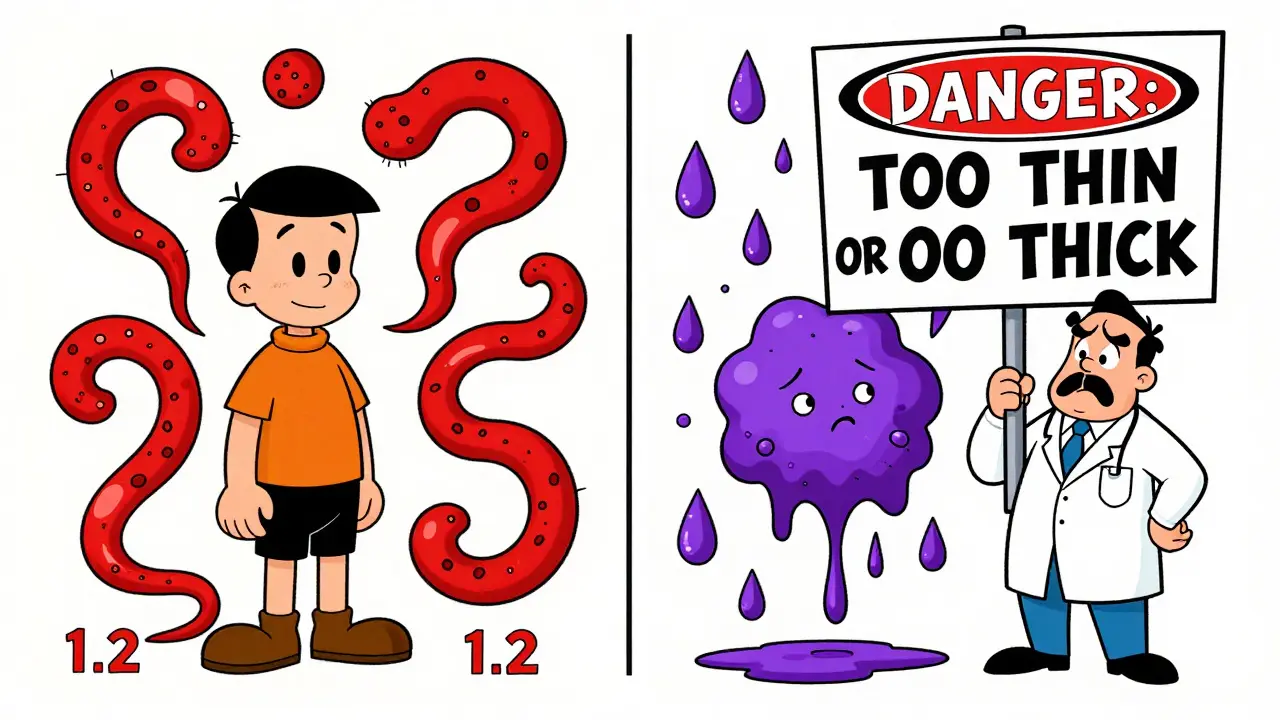
Think of your INR like a tightrope. Too low, and you’re at risk of a clot. Too high, and you’re at risk of bleeding.
If your INR drops below 1.5, your blood is clotting too fast. That’s dangerous if you have a mechanical valve or atrial fibrillation. A clot could form in your heart, travel to your brain, and cause a stroke. This is why skipping doses or eating too much vitamin K-found in kale, spinach, and broccoli-can be risky. Vitamin K reverses warfarin’s effect. One big salad might throw your INR off for days.
If your INR goes above 4.9, your bleeding risk spikes. Each 0.5-point increase above 3.0 raises your chance of a major bleed by 27%. An INR over 5.0 is a red flag. You may need to skip your next warfarin dose and contact your doctor immediately. In extreme cases, you might need vitamin K or fresh frozen plasma to reverse the effect.
But here’s the thing: most people don’t have emergencies. They have slow drifts. One week your INR is 2.8, next week it’s 3.4, then back to 2.6. That’s normal. What’s not normal is ignoring the pattern. Consistent, small changes over time are what lead to big problems.
Home Testing vs. Lab Testing: What’s Better?
You have two main options: go to a lab or test at home.
Lab testing is reliable. You get a venous blood draw, and results come back in 24 to 48 hours. But it means a trip to the clinic, waiting in line, taking time off work, and paying for a visit-even if you have insurance. For many, it’s a hassle.
Home testing uses a small device like the Abbott Acelis or Roche CoaguChek. You prick your finger, place a drop of blood on a strip, and get a result in under a minute. These devices are FDA-approved, accurate, and designed for daily use. Studies show that people who test at home spend 72% of their time in the target INR range, compared to just 58% for those who go to clinics. That’s a 34% drop in clots and a 21% drop in major bleeds.
But home testing isn’t for everyone. If you have shaky hands, poor eyesight, or trouble remembering to test, it can backfire. The FDA found that 25-30% of older adults can’t use these devices safely. Also, the strips cost $5.99 each. Medicare covers 100% for eligible patients. Private insurance usually covers it too, but you might need a doctor’s letter to get approved. Around 31% of patients face initial claim denials.
And here’s a real-world tip: don’t test right after eating or drinking coffee. The American Heart Association recommends fasting for 4-6 hours and testing between 8 AM and 12 PM for the most consistent results.
Warfarin vs. Newer Blood Thinners: The Big Trade-Off
There’s a reason newer blood thinners like apixaban (Eliquis), rivaroxaban (Xarelto), and dabigatran (Pradaxa) are so popular. You don’t need to test your INR. No finger pricks. No tracking. Just take your pill, and you’re good.
But here’s the catch: those drugs don’t work for everyone. If you have a mechanical heart valve, warfarin is your only option. The newer drugs can’t prevent clots on those valves reliably. Same goes for people with severe kidney disease. Warfarin is cleared by the liver, not the kidneys, so it’s safer for those with poor kidney function.
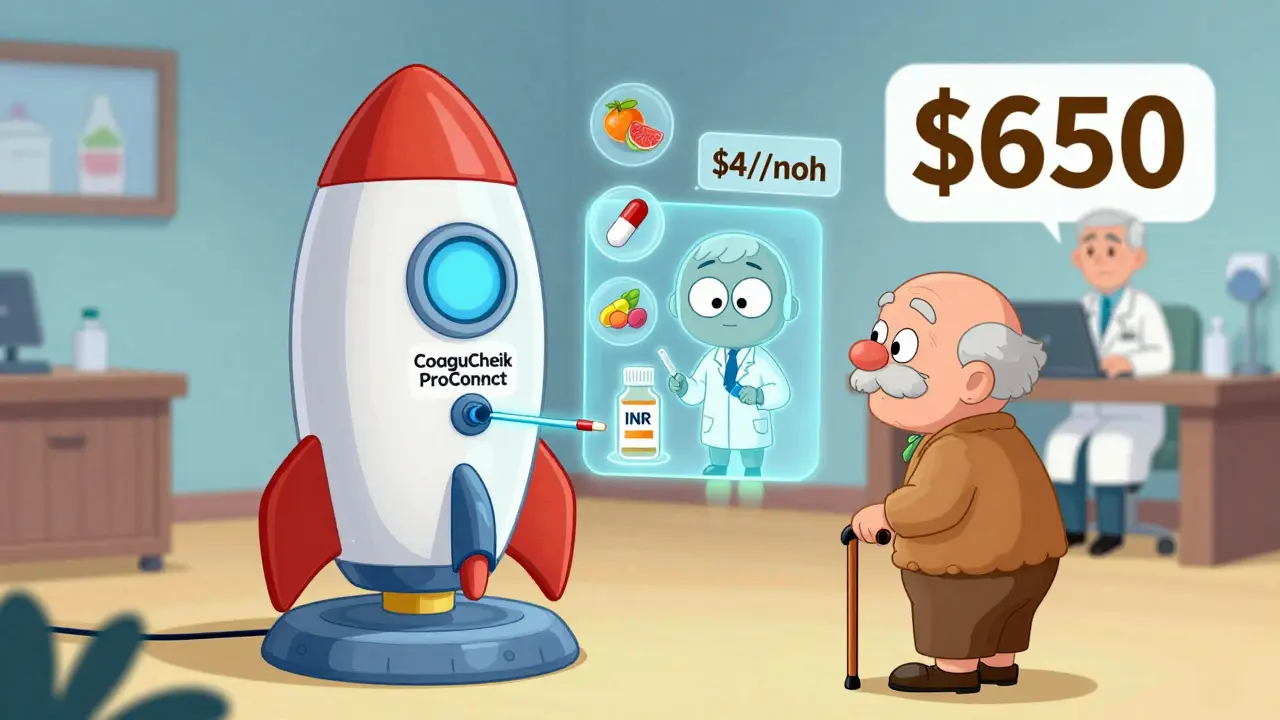
Cost is another factor. Warfarin costs about $4 a month. The newer drugs? $550 to $650. That’s a 150x difference. Even with insurance, copays can be $100 or more per month. For someone on a fixed income, that’s not just expensive-it’s unaffordable.
And while newer drugs have wider therapeutic windows (meaning they’re less sensitive to diet or other meds), they’re not magic. They still carry bleeding risks. And if you bleed while on them, there’s no quick reversal like vitamin K for warfarin. Some have antidotes, but they’re expensive and not always available.
So if you’re stable on warfarin, with good INR control, there’s no rush to switch. But if you’re struggling with frequent testing, missed appointments, or erratic INRs, talking to your doctor about switching to a DOAC might make sense.
How Often Should You Test?
There’s no one-size-fits-all schedule. When you first start warfarin, you might test every 2-3 days until your dose is stable. Once you’re steady, monthly testing is usually enough.
But here’s where things get messy. A 2021 study in the Annals of Internal Medicine found that 38% of patients on warfarin are tested weekly-even when their INRs haven’t changed in months. That’s unnecessary. It doesn’t improve safety. It just adds cost and stress.
Doctors are supposed to follow guidelines: if your last three INRs were all within 0.5 points of your target, you can go monthly. If your INR swings wildly, or you’ve changed meds, started antibiotics, or had major surgery, test every week until you’re stable again.
And don’t forget: your INR can be affected by things you wouldn’t expect. Antibiotics, antifungals, even some herbal supplements like St. John’s Wort can change how warfarin works. Always tell your doctor about every pill, vitamin, or supplement you take.
What You Can Do to Stay in Range
Staying in your target INR range isn’t just about testing. It’s about habits.
- Keep your vitamin K intake steady. Don’t go from eating no greens to a huge spinach salad every Monday. Eat the same amount every week.
- Don’t drink alcohol heavily. Even moderate drinking can raise your INR. Stick to one drink a day, if at all.
- Take warfarin at the same time every day. Most people take it at night. That way, if your INR is too high the next day, you can adjust the dose the same day.
- Use a tracker. Write down your INR, your dose, and any changes in diet, meds, or health. Apps like Warfarin Tracker or MyINR help. But even a notebook works.
- Know your emergency numbers. If your INR is above 5.0, or you have unusual bruising, blood in your urine, or a bad headache, call your doctor immediately.
What’s Next for INR Monitoring?
The future is connected. In January 2023, the FDA approved the first smartphone-linked INR device-the Bayer CoaguChek ProConnect. It automatically sends your results to your doctor’s system. No more calling in numbers. No more lost papers.
AI is also stepping in. Mayo Clinic tested an AI tool called INR Advisor that predicts the right warfarin dose with 83% accuracy. It looks at your history, diet, meds, and lab results to suggest adjustments. It’s not replacing doctors-but it’s making them smarter.
But challenges remain. Rural areas have far fewer anticoagulation clinics. Only 35% of rural healthcare centers offer full INR management, compared to 82% in cities. That’s a gap in care that can cost lives.
And while newer blood thinners are growing fast-projected to make up 85% of new prescriptions by 2028-warfarin still has a place. For 200,000 Americans with mechanical valves, it’s the only option. And for millions more, it’s affordable, effective, and well-understood.
The goal isn’t to eliminate INR testing. It’s to make it easier, more accurate, and less stressful. Whether you test at home or at a clinic, the number on the screen is your lifeline. Treat it with respect. Track it. Understand it. And never ignore it.
What is a normal INR range for someone on warfarin?
For most people on warfarin, the target INR range is 2.0 to 3.0. This applies to conditions like atrial fibrillation or deep vein thrombosis. For those with mechanical mitral valves, the range is higher-2.5 to 3.5. Always follow your doctor’s specific target, as it depends on your medical history and risk factors.
Can I check my INR at home?
Yes, home INR testing is available using FDA-approved devices like Abbott Acelis or Roche CoaguChek. These devices use a finger prick and give results in under a minute. They’re accurate, convenient, and linked to better outcomes-patients who test at home spend more time in their target range and have fewer clots and bleeds. However, they require training and may not be suitable for people with poor vision or dexterity.
How often should I test my INR?
When you first start warfarin, you may test every few days. Once your dose is stable and your INR stays consistent, monthly testing is usually sufficient. If your INR fluctuates, you change medications, or you get sick, your doctor may ask you to test weekly until you’re stable again. Unnecessary weekly testing for stable patients offers no benefit and increases cost and stress.
What should I do if my INR is too high?
If your INR is above 5.0, you’re at high risk of bleeding. Skip your next warfarin dose and contact your doctor right away. For INR levels above 4.9, your doctor may recommend vitamin K or other treatments to reverse the effect. Never ignore a high INR-even if you feel fine. Internal bleeding can happen without symptoms.
Why is my INR changing even though I haven’t changed my diet or meds?
Many factors can affect INR, even if you think you’ve done everything the same. Changes in gut bacteria, dehydration, fever, stress, or even a new over-the-counter cold medicine can alter how warfarin works. Some antibiotics and antifungals strongly interact with warfarin. Always tell your doctor about any new medication, supplement, or illness-even if you think it’s unrelated.


Lethabo Phalafala
January 14, 2026I used to hate these finger pricks-like, seriously, I’d skip them for weeks until I almost had a stroke. Now I keep a little logbook next to my coffee maker. Every morning, same time, same dose, same damn strip. It’s not glamorous, but it’s kept me alive. And yeah, I eat my spinach. But I eat the same amount every week. No surprises. No drama. Just consistency.
Warfarin ain’t sexy, but it’s my superhero cape.
PS: If you’re on it and you’re not tracking, you’re playing Russian roulette with your brain.
Lance Nickie
January 14, 2026inr? more like in-ruin. why do we still do this? just take xarelto and chill. no pricks, no stress, no weird salads. my dog could manage it.
Milla Masliy
January 14, 2026As someone who grew up in a family where warfarin was just part of Sunday dinner conversation, I appreciate how thorough this is. My abuela tested her INR every Monday with her little device, and she’d always say, ‘El número no miente, pero tú sí puedes mentirle.’ The number doesn’t lie-but you can lie to it.
Home testing changed everything for us. No more waiting 3 hours in the clinic, no more ‘we’ll call you if it’s bad.’ Now she gets the result before her coffee cools. And yes, she still eats kale. But always the same amount. Always.
Also, I’m so glad someone mentioned St. John’s Wort. That stuff is a silent assassin. I learned that the hard way.
sam abas
January 15, 2026Okay, let’s be real for a second. This whole INR thing is a glorified scam designed by lab companies and pharmaceutical reps to keep people dependent. The ‘target range’ of 2.0–3.0? That’s not science-it’s consensus from a 1998 panel that didn’t even consider individual variability. I’ve seen people with INRs of 4.2 who never bled and others with 2.1 who bled out from a paper cut.
And don’t get me started on home testing. Those devices are calibrated using proprietary algorithms that change every firmware update. The FDA approves them? Yeah, right. They approve everything that has a patent. Meanwhile, the real issue is that doctors don’t know how to interpret the data. They just see a number and panic. ‘Oh, 3.4? That’s too high!’ No, it’s not. It’s one data point. You need a trend.
And vitamin K? Please. You’re not a vampire. One salad won’t tank your INR. Unless you’re eating 3 heads of kale a day, which I doubt. Most people don’t even know what vitamin K is. They just think broccoli is ‘bad’ because some nurse said so.
Also, the cost difference between warfarin and DOACs? That’s not a trade-off. That’s a moral failure. If you can’t afford to live, the system failed you. And now we’re supposed to be grateful for AI predicting doses? Cool. Let’s outsource our health to a bot that doesn’t know I’m stressed because my cat died.
Bottom line: INR isn’t the problem. The healthcare industrial complex is.
Clay .Haeber
January 16, 2026Oh wow. A 2000-word essay on how to prick your finger and read a number like it’s the Holy Grail. How noble. How… *vintage*.
Meanwhile, in 2024, people are getting AI-powered subcutaneous anticoagulant patches that auto-adjust based on real-time biomarkers. But no-let’s keep the 1980s tech alive because ‘it’s affordable.’
Also, ‘eat the same amount of kale’? That’s not medicine, that’s a cult. Did you know your gut microbiome changes daily? Your INR should be dynamic, not a spreadsheet from 2007.
And yes, I’ve seen people on DOACs live longer, healthier, and *without* the emotional burden of being a human lab rat. But hey, if you like being told what to eat by a nurse who doesn’t even know your name, carry on. I’ll be over here, not bleeding out because I didn’t have to remember to test before brunch.
Nelly Oruko
January 18, 2026Consistency is not a suggestion. It is the foundation of survival. I have watched my mother go from INR 1.8 to 5.3 in 72 hours because she took ibuprofen for a headache. She didn’t know it interacted. No one told her.
Warfarin is not a drug. It is a relationship. With your body. With your doctor. With your calendar. With your grocery list.
And yes, the cost is unjust. But the solution isn’t to abandon it-it’s to demand better access. To fight for insurance reform. To push for home testing to be covered without a 6-month bureaucratic dance.
So yes-track it. Write it down. Tell your pharmacist every supplement you take. Even the ‘harmless’ ones.
Because the number on the screen? It’s not just data. It’s your name. Your life. Your tomorrow.
Angel Tiestos lopez
January 18, 2026bro. i’ve been on warfarin for 12 years. i test every monday. i eat 1 cup of spinach every tuesday. no more, no less. 🌿
my device beeps, i log it, my doc gets it, i get my dose. no drama. no panic.
also, if you’re on xarelto and think you’re ‘free’-you’re not. you’re just paying $600/month to not know if you’re bleeding internally. 😅
warfarin is the OG. respect the process. 🙏
Diana Campos Ortiz
January 20, 2026I just want to say thank you for writing this. My dad passed away from a brain bleed because his INR was never monitored properly after his valve replacement. He was told to ‘just come in monthly’-but his numbers were swinging wildly. No one caught it.
This post? It’s the kind of thing I wish someone had handed him. Not just facts-understanding.
And to everyone testing at home: you’re not just managing a number. You’re reclaiming your life. Keep going.
Jesse Ibarra
January 21, 2026Wow. What a masterpiece of medical propaganda. Let me get this straight-you’re glorifying a 40-year-old drug that requires daily ritualistic finger-stabbing while shaming people who choose modern alternatives?
‘Warfarin is affordable’? At what cost? Your mental health? Your freedom? Your dignity?
And you actually think eating the same amount of kale every week is ‘responsible’? That’s not medicine-that’s OCD dressed up as discipline.
Let’s be honest: this post was written by someone who got paid by a lab that sells test strips.
Meanwhile, real people are living full lives on DOACs without needing a PhD in nutrition to stay alive.
Stop gaslighting patients into thinking they’re weak if they want to stop pricking themselves.
Progress isn’t a betrayal. It’s evolution.