
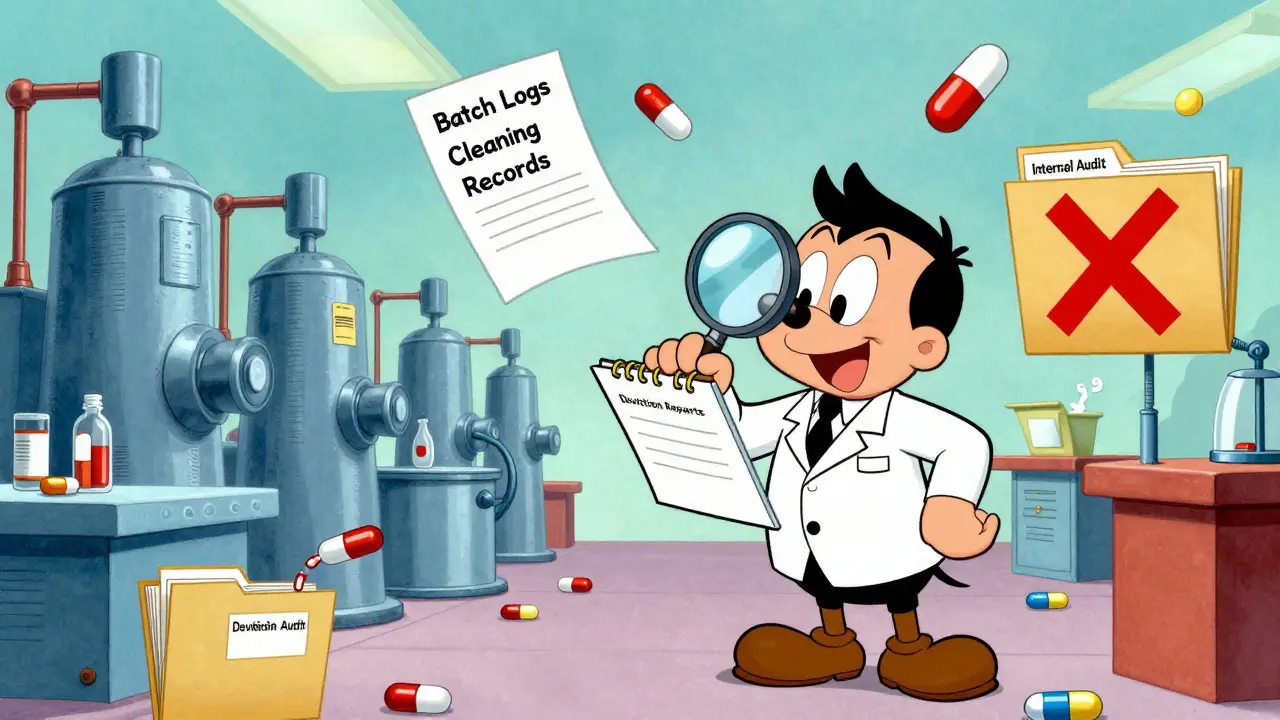
When you buy a pill, an inhaler, or a medical device, you assume it’s safe. But behind that assumption is a complex system of inspections, records, and rules that manufacturers must follow-and sometimes fight to protect. The FDA inspection records are not public documents you can download like a product manual. Yet, they hold the real story of whether a factory is truly producing quality medicine or just passing the surface checks.
What FDA Can See-And What It Can’t
The U.S. Food and Drug Administration doesn’t walk into a drug factory with a blank checklist. It has clear legal authority under Section 704(a)(1) of the Federal Food, Drug, and Cosmetic Act to inspect facilities and demand records tied to current Good Manufacturing Practices (CGMP). That means they can ask for production logs, validation reports, equipment maintenance logs, and any investigation into a product defect. But here’s the twist: internal quality audits? Those are often off-limits. Since 1996, the FDA has followed Compliance Policy Guide Sec. 130.300, which says it won’t review internal audit reports if they’re part of a company’s own quality program. The idea? Encourage companies to be honest with themselves. If every mistake gets reported to regulators, companies might stop auditing altogether. That’s why a pharmaceutical company can run a deep internal review of a batch failure, document every root cause, and the FDA won’t see it-unless it turns into a formal investigation. That line between protected audits and required records is razor-thin. If a team finds a recurring contamination issue during an internal audit, and then launches a full investigation to fix it, the investigation file? That’s fair game. The audit report itself? Not necessarily.Records You Must Keep-And How Long
The FDA doesn’t just show up and ask for things. Manufacturers are legally required to keep specific records. For drugs, 21 CFR 211.180 says you must hold onto CGMP records for at least one year after the product expires. For medical devices, it’s even longer: the device’s lifespan plus two years under 21 CFR 820.180. What counts as a CGMP record? Think:- Batch production and control records
- Equipment cleaning logs
- Validation protocols for sterilization or packaging
- Deviation reports when something goes wrong
- CAPA (Corrective and Preventive Action) files
- Complaint investigations and product recalls
The Inspection Process: From Notice to Form 483
When an FDA inspector walks into your facility, they hand you Form FDA 482: a Notice of Inspection. It’s not a request. It’s a legal requirement to allow access. You can’t refuse. Denying access violates Section 301(f) of the FD&C Act-and that’s a big deal. In Q1 2025, warning letters for inspection denial jumped 17% year-over-year. The inspector will spend days reviewing records, walking the floor, interviewing staff. They’ll look at your training logs, your calibration records, your supplier approvals. If they find issues, they issue Form FDA 483: Notice of Inspectional Observations. This isn’t a fine. It’s a list of observations. But it’s serious. You have exactly 15 business days to respond. Not 16. Not 20. Fifteen. The response matters. Companies that use FDA’s recommended root cause analysis-digging deep into why something happened, not just fixing the symptom-close 89% of their 483 items within six months. Those that write vague replies like “we’ve improved training”? Only 62% get closure.
Domestic vs. Foreign Facilities: A Double Standard?
There’s a growing gap in how the FDA treats factories inside the U.S. versus those overseas. In 2023, only 12% of foreign inspections were unannounced. By the end of 2025, that number will hit 35%. That’s a massive shift. Why? The 2024 GAO report found foreign facilities had higher rates of CGMP violations. The FDA is now treating them like high-risk sites. Domestic facilities? Around 92% of inspections are still scheduled. Companies get a heads-up. That gives them time to prep, clean up, train staff. Foreign plants? They might get a knock on the door with no warning. This isn’t about fairness. It’s about risk. The FDA knows that over half of the pills Americans take come from overseas. If a factory in India or China cuts corners, the risk to U.S. patients is real.Remote Inspections Are Changing the Game
In July 2025, the FDA finalized its guidance on Remote Regulatory Assessments (RRAs). These aren’t inspections. They’re virtual reviews. Companies can share read-only access to their digital systems-production databases, quality management software, electronic batch records. RRAs don’t generate Form 483s. But they’re becoming a key tool. In the first half of 2025, only 8% of inspections were RRAs-but that number is climbing fast. Why? Because companies using RRAs cut inspection-related downtime by 65%. Fortune 500 drugmakers are rushing to build RRA-ready systems. It’s not about convenience. It’s about control. If you can prove your records are accurate and real-time through a secure digital portal, you reduce the need for a full physical audit.What Professionals Are Saying
Industry insiders aren’t shy about the stress. David Chen, QA Manager at Merck, told the Biophorum forum: “The 15-day window for Form 483 responses hits hardest during product launches or regulatory submissions. You’re not just writing a letter-you’re assembling evidence, running investigations, coordinating legal and compliance teams.” Susan Martinez from Pfizer shared that 63% of quality professionals in her company over-disclose records because they’re confused about what’s protected. They send internal audit reports thinking they’re being transparent-only to realize they’ve handed over something the FDA legally can’t use. And it’s not just confusion. A 2024 ECA Academy survey of 215 quality executives found 41% saw inconsistent enforcement between FDA district offices. One office accepts a certain type of audit report as protected. Another demands it. That inconsistency adds cost, risk, and frustration.
How to Prepare-Without Going Broke
You don’t need a team of 50 to survive an FDA inspection. But you do need structure. Most companies spend an average of $385,000 a year on inspection readiness. That includes training, software, documentation audits, and mock inspections. Here’s what works:- Separate your internal audit reports from your investigation files. Use different folders, different naming conventions, different access controls.
- Train every new quality hire for 6-9 months before letting them handle inspection prep. Certification through RAPS increases readiness by 37%.
- Run quarterly mock inspections with an outside auditor. Don’t let your team get comfortable.
- Use digital systems that timestamp every entry. No handwritten logs. No backdated entries.
- Keep your Form 483 response templates ready. Pre-draft root cause analysis frameworks so you’re not starting from scratch.


Edith Brederode
January 20, 2026This is such a vital read for anyone in pharma. I work in QA and honestly, the 15-day response window for Form 483s is brutal. But knowing what’s protected vs. what’s not? Life-changing. 🙌
Emily Leigh
January 21, 2026So... the FDA doesn't even look at internal audits? That's just asking for disaster. 🤦♀️
Art Gar
January 21, 2026The notion that transparency requires public disclosure is a dangerous fallacy. The FDA's current framework is not merely adequate-it is a masterpiece of regulatory restraint. To mandate publication of inspectional data is to invite performative compliance and the erosion of internal accountability. One does not cultivate integrity by broadcasting shame.
Arlene Mathison
January 23, 2026If you're still using paper logs, you're already behind. I saw a plant in Ohio get nailed for backdating cleaning records-turned out the tech was just too lazy to log it in real time. Digital timestamps aren't optional anymore. Get with it. 💪
Greg Robertson
January 25, 2026I appreciate how you broke this down. My brother works at a contract manufacturer and he’s been stressed about RRAs. This gives me a lot to share with him. Thanks!
Crystal August
January 26, 2026Of course they don’t want you to share internal audits-because then you’d realize how many companies are just lying through their teeth. The FDA’s ‘trust us’ system is a joke. They’re letting poison get into your medicine because some exec doesn’t want to get fired.
Jacob Cathro
January 28, 2026So let me get this straight... you gotta keep records for 1+ year post-expiry, but if you do a deep dive audit internally? Nope, not even a peek? That’s like having a smoke detector that only works if the fire department shows up. 😅
Nadia Watson
January 29, 2026I’ve seen this play out in India and China-factories with perfect paper trails but zero real culture of quality. The FDA’s shift toward unannounced inspections is long overdue. But we also need to stop treating global supply chains like a game of telephone. Someone needs to audit the auditors.
Shane McGriff
January 30, 2026I’ve trained dozens of new QA hires, and the #1 mistake? Confusing internal audit reports with CAPA files. One team sent their whole audit folder to the FDA during a routine visit-thinking they were being transparent. The FDA returned it with a note: 'Not for review per CPG 130.300.' They were mortified. This post? Should be mandatory reading.
clifford hoang
February 1, 2026The FDA is a puppet of Big Pharma. They don't want you to see the audits because they're covering up the fact that every single generic drug maker is using substandard ingredients. The RRAs? Just a way to hide the data behind encrypted firewalls. You think your insulin is safe? Think again. The real story is buried in the blockchain they don't want you to know about. 🔐💊 #DeepStatePharma
Carolyn Rose Meszaros
February 1, 2026I love how this explains the difference between audits and investigations. My company just got our first 483 and I was so confused about what to send back. Now I get it. Also, love the mock inspection tip-so simple but so effective. 😊
Courtney Carra
February 3, 2026The real tragedy isn’t the inspections-it’s that companies treat compliance like a checklist, not a culture. I’ve seen QA teams celebrate when they ‘pass’ an inspection, like it’s a win. It’s not. It’s a baseline. The moment you stop asking ‘why’ is the moment someone dies because your batch was contaminated.
thomas wall
February 3, 2026The American regulatory apparatus has become a grotesque parody of governance. While domestic firms enjoy the luxury of scheduled inspections, foreign manufacturers are subjected to the whims of unannounced raids-a double standard that is both economically discriminatory and morally indefensible. The FDA’s strategic plan is not innovation; it is institutionalized hypocrisy.
Renee Stringer
February 5, 2026The FDA’s system works because it assumes companies have integrity. But integrity isn’t taught in training manuals. It’s built over years, by people who care more about patients than profit. If your quality system feels like a burden, you’re doing it wrong.