
When a generic drug hits the market, it doesn’t mean the work is done. In fact, the real challenge often begins after approval. The FDA doesn’t treat generic drugs as static products. If a manufacturer changes how it makes the drug - even slightly - it might trigger a full re-evaluation. This isn’t about quality control gone wrong. It’s about regulation. And understanding what changes force the FDA to step back in can mean the difference between a smooth production update and a 14-month delay that costs millions.
Why the FDA Cares About Manufacturing Changes
Generic drugs aren’t copies. They’re legally required to be identical in active ingredient, strength, dosage form, and, most critically, performance to the brand-name drug they’re based on. That’s called bioequivalence. But here’s the catch: two drugs can have the same active ingredient and still behave differently in your body if how they’re made changes. A different mixing process, a new machine, or even a shift in the supplier of an inactive ingredient can alter how quickly the drug dissolves or gets absorbed. That’s why the FDA requires manufacturers to prove nothing changed in the drug’s behavior - even if the pill looks the same.The system is built on the Abbreviated New Drug Application (ANDA). That’s the fast-track path generics use to get approved without repeating the brand’s expensive clinical trials. But that shortcut only works if the manufacturing process stays locked in. Change the process? The FDA needs to recheck the whole thing. It’s not distrust. It’s science.
Three Types of Changes, One Rule: Don’t Break Bioequivalence
Not every change needs the same level of scrutiny. The FDA sorts manufacturing changes into three buckets, based on risk:- Prior Approval Supplements (PAS): Major changes. Think new manufacturing sites, switching from batch to continuous production, or altering the synthesis route of the active ingredient. You can’t make these changes until the FDA says yes. Approval can take 10 to 14 months.
- Changes Being Effected (CBE): Moderate changes. You can implement these immediately but must notify the FDA within 30 days. Examples: changing a supplier of an inactive ingredient with similar properties, or adjusting in-process controls within already-approved limits.
- Annual Reports (AR): Minor changes. These go in your yearly report to the FDA. Think updating a label, changing packaging material, or minor equipment tweaks that don’t affect product quality.
Here’s what actually triggers a PAS - the big one:
- Moving production to a new facility
- Changing the drug’s synthesis method (how the active ingredient is made)
- Increasing batch size by more than 25%
- Introducing a new excipient (inactive ingredient) not in the original formulation
- Switching from a traditional tablet press to a continuous manufacturing line
A 2022 case study showed a company that increased batch size by 30% for a common blood pressure pill had to submit a PAS. They spent six months running stability tests, did three rounds of analytical comparisons, and waited 14 months for approval. All because they wanted to make more pills per run.
What the FDA Actually Looks For
The FDA doesn’t just read your paperwork. They demand proof. For a PAS, you need:- Comparative analytical data showing the pre- and post-change drug are chemically identical
- Stability data proving the drug won’t degrade faster or slower after the change
- Process validation reports showing your new method is consistent and controlled
- Bioequivalence studies - if the change could affect how the body absorbs the drug
And it’s not just about the drug. The FDA checks your facility. If you’re moving production overseas or upgrading equipment, they’ll send inspectors. In 2023, 41.7% of manufacturers reported unexpected inspections tied to change submissions. One company in Ohio spent $1.2 million upgrading their tablet press, only to have the FDA request a second inspection because the new machine’s vibration profile was slightly different. They had to prove it didn’t affect tablet hardness - a six-month detour.

Why Some Companies Avoid Making Changes
It’s not just slow. It’s expensive. A single PAS submission can cost $287,500 in fees, internal labor, testing, and delays. For a low-margin generic drug selling for pennies per pill, that’s a hard sell. A 2023 survey of 127 generic manufacturers found 78.4% struggled to decide whether a change needed a PAS or a CBE. Small companies with fewer than five ANDAs took 43% longer to get approvals than big players.Some companies just don’t bother. One quality manager on Reddit described a situation where their company upgraded a tablet press to reduce breakage. The new machine worked better - fewer cracked pills, less waste. But the FDA classified it as a PAS. Approval took 18 months. The cost of the delay outweighed the savings from fewer rejects. They reverted to the old machine.
This is the paradox: better manufacturing often means more regulatory pain. That’s why many experts push for Quality by Design (QbD). QbD means building flexibility into the process from day one. If you know during development that your tablet’s dissolution rate stays stable between 80% and 120% of the target pressure, you can later adjust the press within that range without triggering a PAS. Companies using QbD and Process Analytical Technology (PAT) saw 32.6% fewer PAS submissions over five years.
How the FDA Is Trying to Fix the System
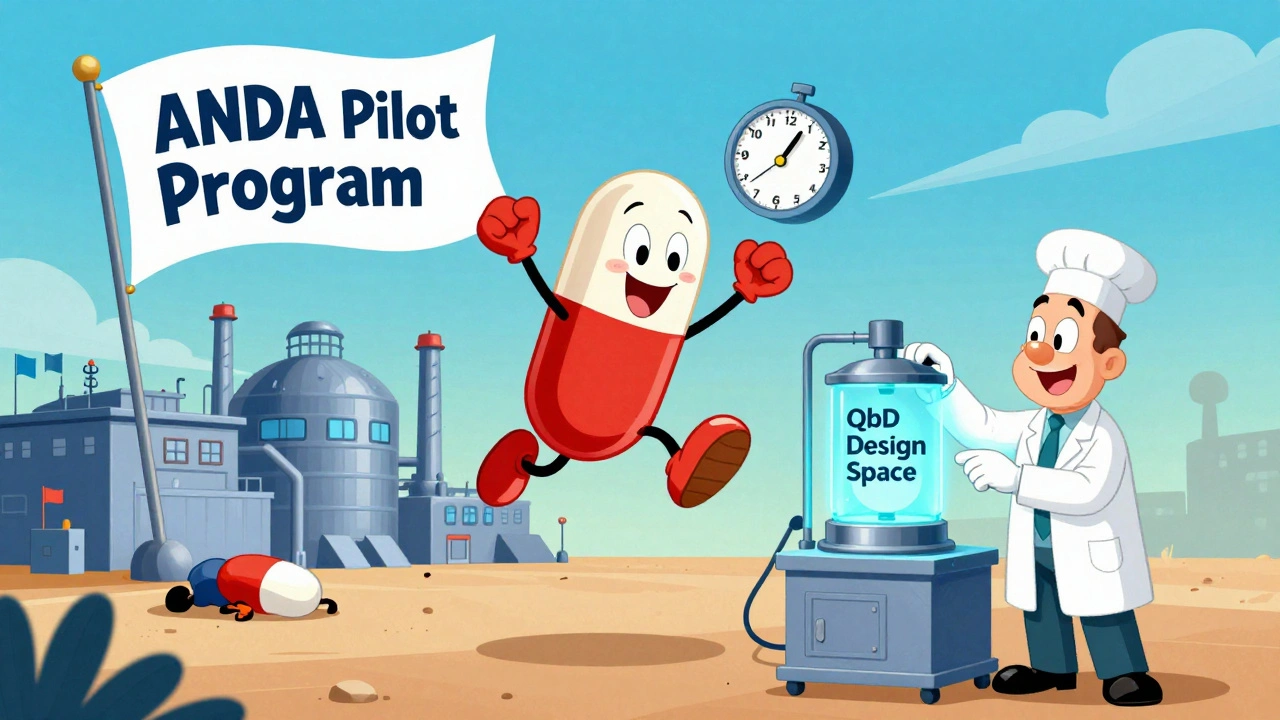
The FDA knows the system is broken. In September 2023, they launched the ANDA Prioritization Pilot Program. If you make your drug - and its active ingredient - in the U.S., your PAS review can drop from 10+ months to under 8 months. That’s a game-changer. The goal? To bring manufacturing back to American soil. Commissioner Robert Califf said this could spur $4.2 billion in new U.S. investment by 2027.They’re also testing a new draft guidance for complex generics - drugs like injectables, inhalers, and peptides. These are harder to copy, so they’ve traditionally faced more scrutiny. The new framework could cut PAS submissions for minor changes by up to 35%. And the PreCheck program, launched in February 2024, lets manufacturers get facility feedback before submitting a full application. That means fewer surprises and faster approvals.
What Manufacturers Should Do Now
If you’re making generic drugs, here’s your roadmap:- Map your current process. Know every variable that affects quality - temperature, mixing time, pressure, humidity.
- Use QbD principles. Define your design space early. What’s the acceptable range for each parameter? Document it.
- Don’t change anything without a risk assessment. Ask: Could this affect dissolution? Absorption? Stability?
- Use the FDA’s guidance documents. They’re public. Read the 2011 and 2021 CMC change guides.
- Request a pre-submission meeting. For any major change, talk to the FDA before you file. It’s free and saves months.
- Consider U.S.-based manufacturing. The pilot program is real. And it’s faster.
One company, Teva, got their PAS for continuous manufacturing of amlodipine approved in just 8 months. How? They held six pre-submission meetings, submitted 17 comparative analytical studies, and proved their new line produced identical drug release profiles. It wasn’t easy. But it worked.
Bottom Line
Manufacturing changes aren’t the enemy. Better manufacturing saves money, reduces waste, and improves supply chain reliability. But the current system treats every change like a threat. The FDA isn’t trying to block progress - they’re trying to prevent harm. The trick is proving you’re not changing the drug. With the right planning, the right tools, and the right communication, you can make improvements without getting stuck in regulatory limbo.What manufacturing changes require FDA approval before implementation?
Changes classified as Prior Approval Supplements (PAS) require FDA approval before you can implement them. These include moving production to a new facility, changing the synthesis method of the active ingredient, increasing batch size by more than 25%, introducing a new excipient not in the original formulation, or switching from batch to continuous manufacturing. Any change that could affect the drug’s bioequivalence, stability, or identity falls into this category.
Can I change my supplier of an inactive ingredient without submitting a PAS?
Yes, if the new supplier’s ingredient is chemically identical and meets the same specifications as the original, you can use a Changes Being Effected (CBE) notification. You must notify the FDA within 30 days of making the change. But if the new ingredient has different physical properties - like particle size or solubility - you may need a PAS. Always test for bioequivalence impact before switching.
How long does a PAS review usually take?
The FDA’s average review time for a PAS is 10 months. But complex changes - like facility transfers or new manufacturing technologies - can take 14 months or longer. If the FDA issues a complete response letter asking for more data, the clock resets. Under the new ANDA Prioritization Pilot Program, U.S.-based manufacturers can get PAS reviews completed in under 8 months.
What’s the difference between a PAS and a CBE-30?
A PAS requires FDA approval before you can make the change. A CBE-30 lets you implement the change immediately, but you must notify the FDA within 30 days. PAS is for major changes that could affect safety or effectiveness. CBE-30 is for moderate changes with lower risk, like changing a supplier of an inactive ingredient that’s already been approved in similar products.
Why do some generic manufacturers avoid improving their manufacturing processes?
Because the cost and delay often outweigh the benefits. A single PAS can cost over $287,500 in fees and lost production time. For low-margin generics, that’s not worth it. Some companies report avoiding upgrades - like better equipment or automation - just to avoid triggering a PAS review. One manufacturer even reverted to an older machine after an 18-month approval delay.
How can I reduce the chance of a PAS submission?
Use Quality by Design (QbD) during initial ANDA development. Define a wide, well-understood design space for your process - so you can make minor adjustments later without triggering re-evaluation. Use Process Analytical Technology (PAT) to monitor production in real time. And hold pre-submission meetings with the FDA before making changes. Companies using these strategies report up to 40% fewer PAS submissions.
Does the FDA inspect facilities every time a change is submitted?
Not every time, but inspections are common for PAS submissions - especially for facility transfers or major process changes. In 2023, 41.7% of manufacturers reported unexpected inspections tied to change submissions. The FDA uses inspections to verify your documentation matches reality. If your process validation data looks good on paper but your equipment doesn’t match, you’ll get a warning letter.
What’s the ANDA Prioritization Pilot Program?
Launched in September 2023, this FDA program speeds up review of generic drugs made in the U.S. If your drug’s active ingredient and final product are manufactured in the U.S., and you use U.S.-based bioequivalence testing, your PAS review can be cut to under 8 months - compared to the standard 10-14 months. It’s designed to incentivize domestic manufacturing and reduce supply chain risks.

Adam Everitt
December 12, 2025so like... if u change the mixer in the factory but the pill still looks the same, the fda still freaks out? thats wild. i thought generics were just cheaper versions, not like... scientific monuments.
wendy b
December 13, 2025Actually, the FDA’s regulatory framework is predicated upon the principle of bioequivalence, which is not merely a technicality-it is a pharmacokinetic imperative. Any alteration in manufacturing parameters, even those seemingly inconsequential, may induce variations in dissolution profiles, thereby compromising therapeutic equivalence. This is not bureaucratic overreach; it is evidence-based pharmacology.
Audrey Crothers
December 14, 2025OMG YES this is so important!! 😭 I work in pharma and saw a company spend $2M and 18 months on a PAS just to switch from one sugar coating to another that was actually *better*. They ended up going back to the old one. It’s insane how innovation gets stuck in red tape. QbD is the way forward!! 🙌
Nathan Fatal
December 14, 2025The real issue isn’t the FDA-it’s the lack of foresight from manufacturers. If you design your process with a defined design space from day one using QbD, you don’t need to beg for approval every time you upgrade a machine. The system isn’t broken. People just refuse to play by the rules they were given. PAT and real-time monitoring aren’t luxuries-they’re necessities. Stop treating regulation like an obstacle and start treating it like a framework.
Robert Webb
December 16, 2025It’s easy to call the FDA rigid, but think about what’s at stake here. People’s lives depend on these drugs working the same way every time. A change in particle size, a different humidity level during compression, even a new lubricant-these aren’t just ‘technical tweaks.’ They’re variables that can alter absorption rates, especially in elderly patients or those with kidney issues. The system is slow because it has to be thorough. We don’t want another thalidomide. We want consistency. And yes, that means waiting. But waiting is cheaper than hospitalizations.
nikki yamashita
December 16, 2025Just fix the process once and move on. No need to overcomplicate it. 😊
Levi Cooper
December 18, 2025Why are we letting foreign manufacturers get away with this? If you make the drug in the U.S., you get fast-tracked? That’s just rewarding patriotism. What about the companies that actually do the work? They’re stuck waiting while overseas plants get preferential treatment. This isn’t science-it’s politics.
sandeep sanigarapu
December 19, 2025From India, we see this every day. Many small factories avoid upgrades because PAS costs more than the annual profit. The system favors big players. Small ones suffer. QbD helps, but only if you have engineers and budget. Without both, you just survive. Not innovate.
Ashley Skipp
December 20, 2025Tea got approved in 8 months? Lucky. Most of us get ignored for a year then get a letter asking for 17 more studies. The pilot program is just a shiny sticker on a broken system