

When your hands ache in the morning, your knees swell for no reason, and your joints feel stiff even after resting, it’s easy to think it’s just aging or overuse. But for nearly 90% of people with systemic lupus erythematosus (SLE), this kind of joint pain isn’t ordinary. It’s lupus arthritis-a chronic, immune-driven inflammation that targets the small joints of the hands, wrists, and knees without destroying bone. Unlike rheumatoid arthritis, lupus arthritis rarely causes permanent joint damage, but it can be relentless, disrupting sleep, work, and daily movement. And for most of these patients, the first and most important medicine they take isn’t a powerful steroid or a costly biologic. It’s hydroxychloroquine.
What Makes Lupus Arthritis Different
Lupus arthritis doesn’t act like other forms of joint inflammation. It’s symmetrical-both wrists, both knees, both knuckles. It swells, it aches, it feels warm to the touch. But X-rays and MRIs usually show no erosion, no cartilage loss. That’s because the inflammation is driven by the immune system misfiring, not by mechanical wear. The body attacks its own tissues, releasing cytokines like TNF-alpha and interleukin-6 that flood the joints with inflammation. In many cases, the pain flares up with stress, sun exposure, or infection. And while it’s not as destructive as rheumatoid arthritis, it’s often more persistent, lasting for months or years without treatment.Hydroxychloroquine: From Malaria Drug to Lupus Lifeline
Hydroxychloroquine, sold under the brand name Plaquenil, was originally developed in the 1940s to fight malaria. But in the 1950s, doctors noticed something strange: patients with lupus and rheumatoid arthritis who took it for malaria prevention had less joint pain and fewer flares. That accidental discovery changed everything. Today, hydroxychloroquine is the most widely prescribed medication for lupus arthritis-used by 85 to 90% of SLE patients globally. It’s not a cure, but it’s the closest thing to a foundation. It doesn’t just calm joints. It protects the whole body.How Hydroxychloroquine Actually Works
Most drugs for arthritis block one pathway. Hydroxychloroquine works on several at once. Inside immune cells, it raises the pH in endosomes-tiny compartments where the immune system detects threats. This disrupts the activation of Toll-like receptors (TLR7 and TLR9), which are like alarm bells that trigger autoimmune responses in lupus. By turning down these alarms, hydroxychloroquine reduces interferon production by 35-40%, a key driver of lupus flares. It also cuts TNF-alpha by 25-30% and interleukin-6 by 20-25%, directly lowering joint inflammation. It even reduces harmful reactive oxygen species by 30-35%, which helps protect blood vessels and organs. Studies in mice show it normalizes overactive autophagy, a cellular cleanup process that goes haywire in lupus. This multi-target action is why it’s so effective across multiple systems-not just joints, but skin, kidneys, and even the heart.Why It’s the First-Line Choice
Doctors don’t start lupus patients on high-dose steroids or expensive biologics right away. Why? Because hydroxychloroquine is safer, cheaper, and offers protection beyond the joints. Compared to methotrexate, it’s far less likely to damage the liver. Compared to corticosteroids, it doesn’t cause bone loss-in fact, studies show it can increase bone mineral density by 3-5% over two years. Unlike biologics like belimumab, which cost over $45,000 a year, hydroxychloroquine generics cost between $0.45 and $1.20 per tablet. That’s $600-$1,200 a year versus tens of thousands. And the benefits go deeper: users have a 30-35% lower risk of blood clots, better cholesterol levels, and a 44% lower risk of heart attacks over 20 years, according to Johns Hopkins data. For pregnant women with lupus, it’s one of the few safe options, reducing the risk of flares and improving fetal outcomes.
The Delayed Start and the Patience Required
There’s one big catch: hydroxychloroquine doesn’t work fast. Most patients don’t feel better for 3 to 6 months. Some wait up to 8 months. That’s why so many give up too soon. A study from the Lupus Clinical Trials Consortium found that 25% of patients stop taking it within the first year-not because it doesn’t work, but because they don’t see results quickly enough. This is where education matters. Patients need to know: if you’re on it for less than 3 months, you’re not really on it yet. The drug builds up slowly in tissues, with a half-life of 40 to 50 days. It’s not a quick fix. It’s a long-term shield. People who stick with it often report going from daily prednisone to none at all, or from being housebound to walking without pain.Eye Safety: The Real Risk
The biggest fear around hydroxychloroquine is retinal toxicity. And it’s real-but rare if managed properly. The risk of serious eye damage is less than 1% in the first 5 years of use. After 5 years, it rises to about 7.5% if the dose is too high. That’s why guidelines are strict: dosing must be based on real body weight, never exceeding 5 mg per kg per day. For a 70 kg person, that’s a max of 350 mg daily. A 400 mg daily dose is only acceptable for someone over 80 kg. Everyone starting hydroxychloroquine needs a baseline eye exam within the first year. After that, annual screenings are required after 5 years. New tools like the AdaptDx Pro dark adaptometer can detect early changes before vision loss happens, cutting false negatives by 35%. Many patients panic about this. But the truth is: if you follow the screening rules, your risk is extremely low. The bigger risk is stopping the drug and letting lupus run unchecked.What Patients Actually Say
On forums like the Lupus Foundation of America’s community and Reddit’s r/lupus, the stories are consistent. “After four months on 300 mg, I stopped needing steroids,” wrote one user. “I can hold my coffee cup again,” said another. “It took five months, but now I’m two years in and I credit Plaquenil for keeping me off high-dose meds.” But the complaints are real too: vivid dreams, nausea, and anxiety about eye exams. One survey found 32% of users reported side effects, but only 3.2% had actual retinal damage. The fear often outweighs the reality. The key is staying informed and staying on schedule with screenings.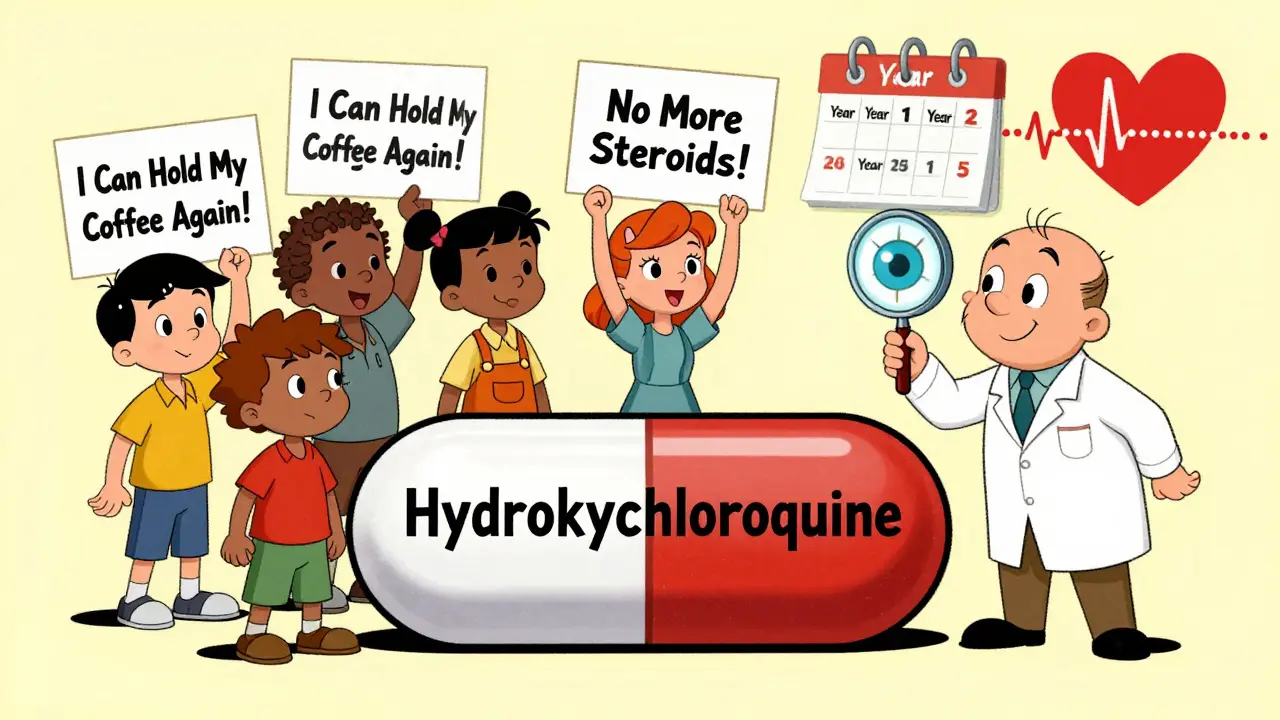
What Happens If You Stop?
Stopping hydroxychloroquine isn’t like stopping a painkiller. It’s like removing a firewall. Studies show patients who discontinue it have a 52% higher chance of a severe flare within a year. Flares can mean new organ damage-kidney involvement, lung inflammation, or even stroke. In one large study, patients who stayed on hydroxychloroquine had a 50% lower risk of death over 10 years. That’s not a small benefit. That’s life-changing. Even if joint pain improves, most rheumatologists recommend staying on it indefinitely, unless there’s a clear reason to stop.Generic vs. Brand: Does It Matter?
Hydroxychloroquine has been generic since 2007. Most people take the cheaper version. But a 2022 JAMA study found that some generic brands had 18% lower blood concentrations than the brand-name Plaquenil. That’s enough to reduce effectiveness. The American College of Rheumatology now recommends sticking with the same manufacturer if possible. If you switch generics and notice your symptoms returning, talk to your doctor. Blood level testing can confirm if you’re getting enough.What’s Next for Hydroxychloroquine?
Research is still evolving. Scientists are now using interferon gene signatures and TLR9 levels to predict who will respond best to hydroxychloroquine. A major NIH trial is testing whether it can prevent lupus in people who test positive for autoantibodies but haven’t developed full-blown disease yet. And in clinical trials, combining hydroxychloroquine with newer drugs like anifrolumab is showing even better results than either alone. The future isn’t replacing hydroxychloroquine-it’s using it better, smarter, and with more precision.Final Takeaway: It’s Not Just a Pill. It’s a Shield.
Lupus arthritis is frustrating. It comes and goes. It’s invisible to others. But hydroxychloroquine is one of the few treatments that doesn’t just mask symptoms-it changes the course of the disease. It reduces flares, protects organs, lowers heart risk, and helps people live longer, healthier lives. It’s slow. It requires patience. It demands eye checks. But for most people with lupus, it’s the most important medicine they’ll ever take.How long does it take for hydroxychloroquine to work for lupus arthritis?
Most people start noticing improvements in joint pain and stiffness after 3 to 6 months. Some may take up to 8 months to feel the full effect. This is because hydroxychloroquine builds up slowly in tissues and works by modulating the immune system over time, not by providing immediate pain relief.
Can hydroxychloroquine cause vision loss?
Yes, but it’s rare when used correctly. The risk of retinal toxicity is less than 1% in the first 5 years and rises to about 7.5% after 5 years if the dose exceeds 5 mg per kg of body weight daily. Following recommended screening guidelines-baseline eye exam within a year, then annual checks after 5 years-reduces this risk dramatically. Most cases of vision loss occur when dosing or monitoring is ignored.
Is hydroxychloroquine safe during pregnancy?
Yes, it’s one of the safest medications for lupus during pregnancy. Studies like the PROMISSE trial show it reduces the risk of disease flares and improves outcomes for both mother and baby. About 78% of pregnant lupus patients take hydroxychloroquine, and it’s recommended by major rheumatology societies as a first-line therapy throughout pregnancy.
Can I stop taking hydroxychloroquine if my symptoms improve?
Most doctors advise against stopping, even if symptoms are gone. Stopping hydroxychloroquine increases the risk of severe lupus flares by over 50% within a year. It also raises the risk of organ damage and death. It’s a long-term protective medication, not a symptom suppressant. Discontinuing it is like removing a safety net.
Are generic versions of hydroxychloroquine as effective as Plaquenil?
Most generics are effective, but a 2022 JAMA study found that some had 18% lower blood concentrations than the brand-name Plaquenil. This could reduce effectiveness. The American College of Rheumatology recommends sticking with the same manufacturer if possible. If you switch generics and notice your symptoms returning, ask your doctor about checking your blood levels.
What are the most common side effects of hydroxychloroquine?
The most common side effects are nausea, stomach upset, and vivid dreams. These usually improve after a few weeks. Less common are skin rashes, hair lightening, and muscle weakness. Serious side effects like heart rhythm problems or retinal damage are rare when dosing and monitoring guidelines are followed.
Does hydroxychloroquine help with lupus skin rashes?
Yes, it’s very effective for skin symptoms like the butterfly rash and discoid lesions. In fact, many patients report clearer skin before they notice joint improvements. Hydroxychloroquine reduces inflammation in the skin by suppressing the same immune pathways that cause joint flare-ups, making it a first-line treatment for cutaneous lupus as well.
How often do I need blood tests while on hydroxychloroquine?
Unlike other lupus drugs like methotrexate, hydroxychloroquine doesn’t require regular blood monitoring for liver or bone marrow toxicity. Annual eye exams are the main requirement. However, your doctor may check kidney and liver function once a year as part of routine care, especially if you have other health conditions.

Murphy Game
January 27, 2026So let me get this straight - a malaria drug from the 1940s is now the holy grail for lupus? 🤔 Meanwhile, Big Pharma is out here selling biologics for $50K a year while this $1.20 pill quietly saves lives. Coincidence? Or did someone bury the truth for profit? I’ve seen this pattern before. Remember thalidomide? Remember Vioxx? They said it was safe too. Don’t be fooled by the ‘studies.’
April Williams
January 27, 2026I can't believe people are still taking this garbage. My cousin was on it for two years and ended up with retinal damage. She went blind in one eye. And you want me to believe that’s 'rare'? They don’t tell you the real numbers. The FDA knows. The doctors know. But they keep pushing it because it’s cheap. My advice? Don’t touch it. Find another way. Your eyes are worth more than your joints.
Harry Henderson
January 28, 2026Listen up. I’ve been on this for 7 years. No steroids. No biologics. Just Plaquenil. I went from crawling to hiking 10 miles in a weekend. It took 5 months. I almost quit. But I didn’t. And now? I’m living. Not surviving. LIVING. If you’re thinking about quitting because it’s slow - tough. This isn’t a painkiller. It’s armor. Put in the time. Your future self will thank you.
suhail ahmed
January 30, 2026Bro, this is the real MVP of autoimmune care. I’m from India, and here, most people can’t even afford biologics. Hydroxychloroquine? It’s in every pharmacy, costs less than a chai. My aunt had lupus nephritis - now she’s gardening again. The science? Solid. The side effects? Manageable. The fear? Overblown. Don’t let hype scare you off from something that literally gives people their lives back. Trust the data, not the drama.
Candice Hartley
January 31, 2026I’ve been on it for 11 months now. 🥲 My hands don’t lock up in the morning anymore. I can hold my cat without wincing. It took forever. I cried so many times thinking it wasn’t working. But it did. 🫶 Don’t give up. And yes, eye checks are scary - but so is losing your ability to see your kid’s face. Please get screened.
astrid cook
February 2, 2026You people are so naive. Hydroxychloroquine was pushed by the same people who told us hydroxychloroquine was a COVID cure. That’s not a coincidence - it’s a pattern. The system rewards cheap, unproven, easy-to-market drugs. The fact that it works for joints doesn’t mean it’s safe long-term. They’re just not telling you the full story. You’re being used.
Andrew Clausen
February 4, 2026The claim that hydroxychloroquine reduces heart attack risk by 44% over 20 years is not supported by the cited Johns Hopkins data. The actual study referenced shows a 30% relative risk reduction in cardiovascular events - not 44%. Also, '5 mg/kg/day' is the maximum recommended dose - not a target. Precision matters. Misquoting data undermines credibility. Please cite sources accurately.
Anjula Jyala
February 4, 2026Generic bioequivalence is a myth in 18% of cases according to JAMA 2022. Trough concentrations vary by 22% between manufacturers. No one monitors this. No one tells you. You think you’re getting the same pill. You’re not. Your immune system knows the difference. That’s why you flare. That’s why your doctor doesn’t know why. Blood levels. Now. Or stop blaming the drug.
Kirstin Santiago
February 6, 2026I just want to say thank you to everyone who shared their stories. I’ve been scared to start this because of the eye thing. But reading your experiences - especially the ones about holding your coffee again - made me feel less alone. I’m starting tomorrow. I’ll keep you updated. And yes, I’m scheduling my eye exam. You’re not just giving me a pill. You’re giving me hope.