

When you throw away an empty pill bottle, you might think you’re just tossing out trash. But if you haven’t removed your name, address, prescription number, or diagnosis from the label, you’re leaving behind more than empty plastic-you’re leaving your medical history wide open for anyone to find. Identity thieves don’t need your credit card number to steal your identity. Sometimes, they just need a discarded pill bottle.
Why Your Prescription Label Is a Goldmine for Thieves
Your prescription label isn’t just a reminder of what to take and when. It’s a mini-file of your health. It includes your full name, date of birth, pharmacy name, doctor’s name, the exact medication you’re taking (like oxycodone, Adderall, or Xanax), dosage, and even the reason it was prescribed-sometimes written right on the label as "for anxiety" or "for back pain." That’s enough for someone to impersonate you. They can call your pharmacy and request refills. They can file fake insurance claims. They can even sell your prescription details to others looking to buy controlled substances illegally. According to a 2021 study in the Journal of the American Pharmacists Association, 42% of prescription bottles thrown in the trash still had readable personal information. And in 2023, a woman in Ohio lost $1,200 to insurance fraud after someone used her discarded oxycodone bottle to get more pills in her name.What the Law Says About Privacy and Medication Disposal
In the U.S., the Health Insurance Portability and Accountability Act (HIPAA) requires healthcare providers and pharmacies to protect your health information-even after you’ve stopped using the medication. The HIPAA Privacy Rule (45 CFR 164.530(c)) says covered entities must implement "reasonable safeguards" to prevent unauthorized access to your Protected Health Information (PHI) during disposal. That means your pharmacy has to train staff to handle labels properly. But it also means you have a responsibility. The FDA, DEA, and HHS all agree: if you’re disposing of meds at home, you must make sure your personal info is unreadable. It’s not just good practice-it’s the law.The Four Safe Ways to Dispose of Medications (Ranked by Privacy Protection)
Not all disposal methods are created equal. Here’s how they stack up when it comes to keeping your privacy safe.1. Drug Take-Back Programs (Best for Privacy)
The gold standard for privacy protection is taking unused meds to a DEA-authorized collection site. These include pharmacies like Walgreens, CVS, or local police stations that host drop-off bins. The DEA’s National Prescription Drug Take Back Day collected over 821,000 pounds of meds in 2024 alone. At these sites, your medications are collected in sealed, secure containers and destroyed by incineration. No one sees your name. No one touches your label. Your info stays private. You don’t have to wait for Take Back Day. Most major pharmacies have year-round drop-off bins. Just check the DEA’s website or call your local pharmacy to find the nearest one.2. Mail-Back Envelopes (Very Good Privacy)
Some pharmacies, including Walgreens and CVS, sell pre-paid mail-back envelopes for $2.99 to $6.99. You put your meds and empty bottles inside, seal it, and drop it in the mailbox. The envelope goes directly to a licensed disposal facility. Your label never leaves your hands, and your meds are destroyed without exposure to anyone else. This method is ideal if you live far from a drop-off site or want to dispose of meds discreetly.3. Deactivation Pouches (Good Privacy)
Products like DisposeRx or MedSafe pouches contain activated carbon that neutralizes medications within minutes. You pour your pills into the pouch, add water, shake, and throw it in the trash. The pouch destroys the drug’s potency, but you still need to remove or cover your label. These pouches cost about $1.50 to $3 each and are handy for travelers or people with mobility issues. They’re a step up from trash disposal-but not as secure as take-back programs.4. Trash Disposal (Lowest Privacy Protection-Unless Done Right)
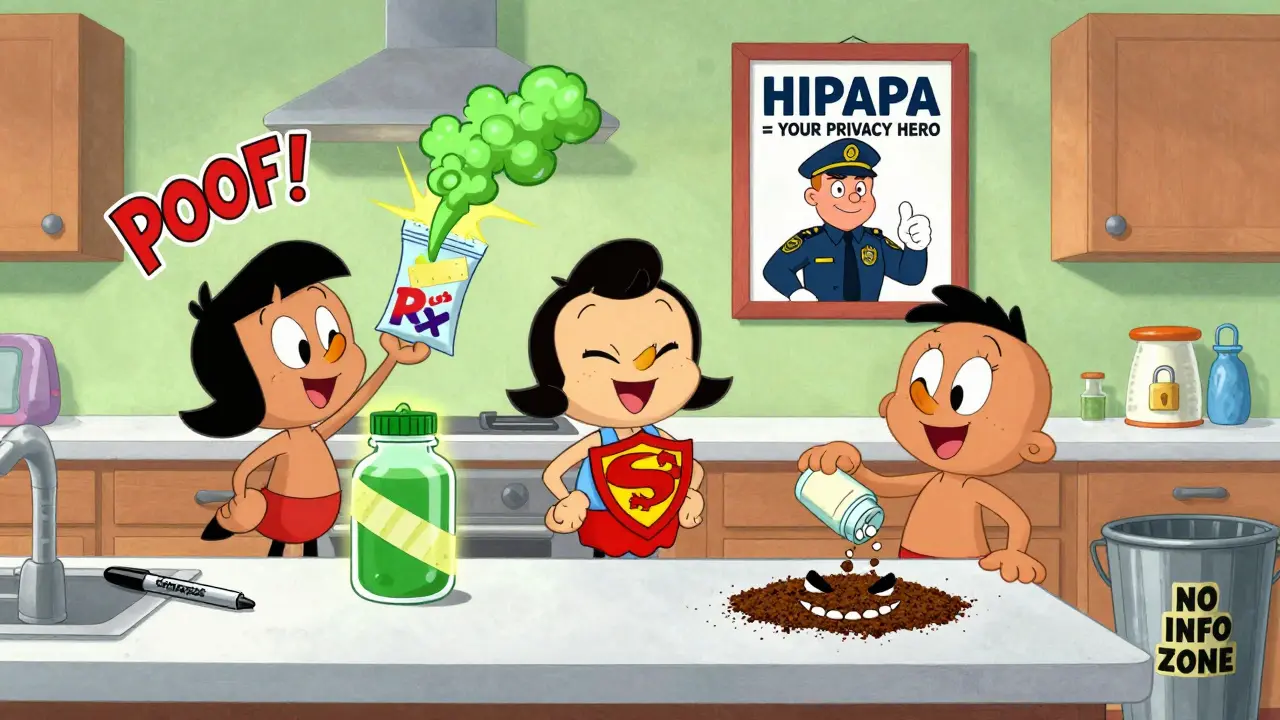
The FDA says you can throw non-flushable meds in the trash-if you follow these steps:- Take pills out of their original bottles.
- Mix them with something unappealing: used coffee grounds, cat litter, or dirt.
- Pour the mixture into a sealed container like a jar or zip-top bag.
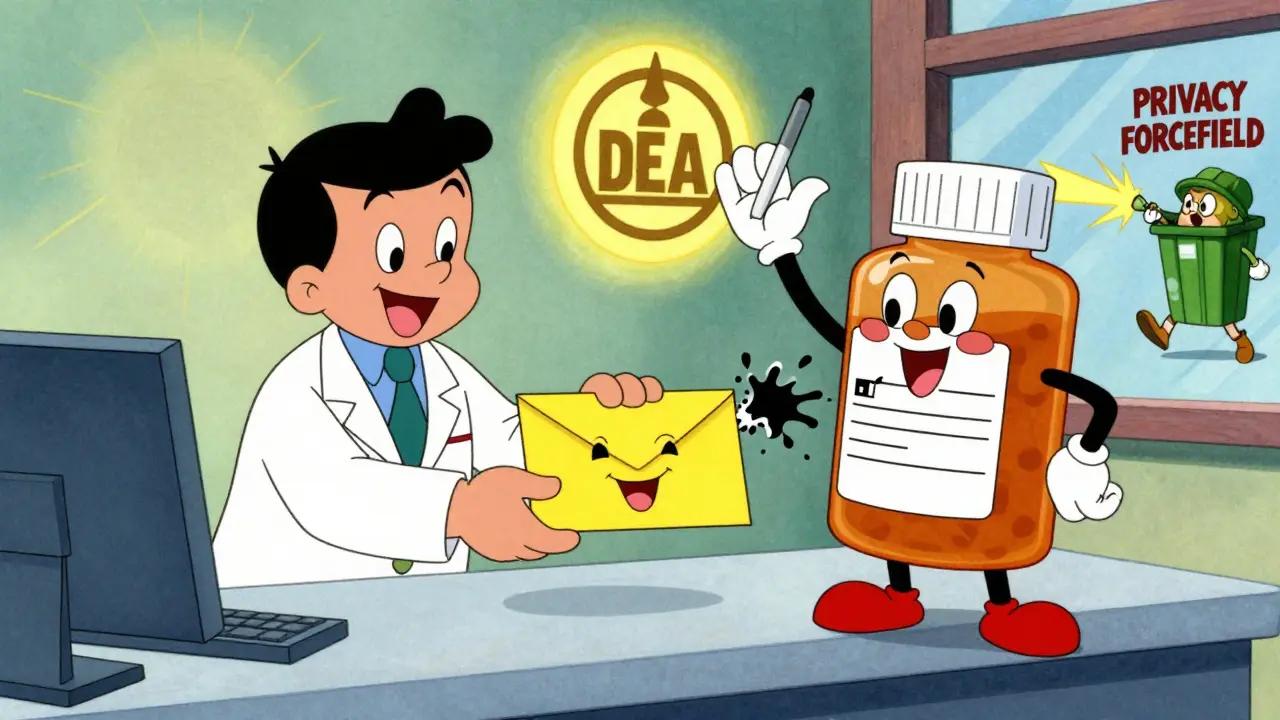
- Scratch out or cover every bit of personal info on the empty bottle with a permanent marker or duct tape.
- Put both the sealed container and the blanked-out bottle in your regular trash.
How to Destroy Your Prescription Label (Step-by-Step)
If you’re using the trash method, here’s how to make sure your label is truly unreadable:- Use a Sharpie Industrial Permanent Marker-regular pens smear. Industrial markers are designed to soak into plastic and resist wiping.
- Don’t just scribble over your name. Cover every field: Rx number, pharmacy name, doctor’s name, dosage, and refill info.
- If the label is too hard to mark, peel it off. Soak the bottle in warm soapy water for 10 minutes, then scrape it off with a plastic scraper or butter knife.
- If you can’t remove it, cover the entire label with 2-3 layers of duct tape. Then throw the bottle in the trash.
What Medications Should Be Flushed?
The FDA maintains a short list of medications that pose a high risk if accidentally ingested-especially by children or pets. For these, flushing is the safest option, even though it’s not ideal for the environment. As of May 2024, the Flush List includes:- Fentanyl patches
- Alprazolam (Xanax)
- Oxycodone (OxyContin)
- Hydrocodone (Vicodin)
- Morphine sulfate
- Meperidine (Demerol)
- Tapentadol (Nucynta)
- Tramadol (Ultram)
- Levorphanol (Levo-Dromoran)
- Methadone
- Butorphanol (Stadol)
- Nalbuphine (Nubain)
- Pentazocine (Talwin)
- Phenylephrine (in some nasal sprays)
- Clonidine (Catapres)
Common Mistakes People Make (And How to Avoid Them)
- Mistake: Throwing away bottles without touching the label. Solution: Always mark or remove it-even if you’re in a hurry.
- Mistake: Thinking "I’m the only one who sees this." Solution: Trash collectors, dumpster divers, and neighbors can all access your bin.
- Mistake: Believing "I’ll just keep them until the next Take Back Day." Solution: Unused meds can be stolen from your medicine cabinet. Dispose of them promptly.
- Mistake: Assuming pharmacies will handle it. Solution: Pharmacies are required to protect your info-but only if you return the bottle to them. Don’t assume they’ll collect it from your trash.
What’s Changing in 2025 and Beyond
Privacy-focused medication disposal is getting smarter. By 2027, 40% of major pharmacies plan to install smart kiosks that automatically erase labels and destroy meds in one step. The Safe Drug Disposal Act of 2024, currently in Congress, would fund $50 million a year for community disposal programs-with privacy protection built in. Meanwhile, the DEA is expanding its take-back network. In 2024, they added 15% more collection sites across the U.S. And in early 2025, HHS is expected to update HIPAA guidelines to include specific technical standards for making PHI unreadable-meaning your pharmacy might soon be required to give you a label-destroying tool with every prescription.Final Thought: Privacy Isn’t Optional
Protecting your privacy when disposing of meds isn’t about being paranoid. It’s about being smart. Your health data is valuable. And if you don’t destroy it, someone else will use it. The easiest fix? Make it a habit. When you finish a prescription, grab your Sharpie. Scratch out the label. Throw the bottle away. If you can, drop it off at a pharmacy. You’re not just protecting your identity-you’re helping stop drug abuse and keeping dangerous meds out of waterways.It takes five minutes. But it could save you years of trouble.


Nicola George
December 28, 2025Wow, so now I’m supposed to carry a Sharpie around like it’s my new BFF? Next they’ll ask me to wear gloves when I throw out my expired ibuprofen. 😒
Meanwhile, my trash is getting picked up by a guy named Greg who probably thinks ‘oxycodone’ is a new flavor of Pop-Tarts.
Nikki Thames
December 29, 2025It is imperative to recognize that the dissemination of Protected Health Information (PHI) via improper pharmaceutical waste disposal constitutes a fundamental breach of the ethical covenant between patient and provider. One must not conflate convenience with culpability; the negligence exhibited in the casual discarding of prescription containers is not merely incautious-it is ontologically irresponsible.
James Bowers
December 30, 2025HIPAA mandates reasonable safeguards, not obsessive label destruction. The FDA’s guidance is advisory, not statutory. This article is fearmongering dressed as public service.
Olivia Goolsby
December 31, 2025Let me tell you something they don’t want you to know: pharmacies are secretly selling your prescription labels to data brokers who sell them to insurance companies who then raise your premiums based on your ‘health risk profile’-and guess what? They’re also using the info to trigger AI-driven ‘fraud algorithms’ that flag you as a ‘potential pill mill patient’ even if you’re just taking fish oil for your arthritis.
And don’t get me started on the smart kiosks-those are just Trojan horses for facial recognition and biometric tracking! The DEA is already feeding your disposal habits into a national surveillance matrix. They’re building a health-data shadow government, and you’re helping them by not using duct tape! You think your Sharpie is protecting you? It’s just a placebo. The real solution? Burn your bottles in a backyard furnace and bury the ashes under a pine tree while chanting in Latin. That’s the only way to break the chain.
And if you think I’m crazy, just wait until 2027 when the kiosks start syncing with your Fitbit and your pharmacy sends you a text saying, ‘We noticed you disposed of 3 bottles of Adderall last week. Would you like to schedule a mental health consultation?’
They’re watching. They’re always watching. And they’re not just after your meds-they’re after your soul.
Monika Naumann
January 1, 2026In India, we have strict rules for pharmaceutical waste. Every hospital and pharmacy is required to have a designated disposal unit under the Bio-Medical Waste Management Rules, 2016. Why does America still treat medicine like disposable plastic? This is not just privacy-it is public health negligence on a national scale. We do not throw away our dignity so carelessly.
Elizabeth Ganak
January 2, 2026my mom used to soak labels in hot water and scrape 'em off with a butter knife-she was a legend. i just use a sharpie now, but honestly? i’ve never had anyone go through my trash. still, better safe than sorry. thanks for the reminder 😊
Liz Tanner
January 3, 2026This is one of those things that seems obvious until you realize half the population doesn’t do it. Seriously-just grab a Sharpie. Keep one in your medicine cabinet. Do it right after you finish the bottle. It takes 30 seconds. You’re not being paranoid-you’re being responsible.
And if you’re worried about the environment? Take-back programs are better than flushing or trashing anyway. Win-win.
Also, props to the folks who use those DisposeRx pouches. That’s next-level thinking.
Babe Addict
January 4, 2026Y’all are over-engineering this. The real privacy threat isn’t your pill bottle-it’s the pharmacy’s EHR system, which is hacked 12 times a year. You’re focusing on the wrong vector. HIPAA compliance is a joke. Your label being readable is a drop in the ocean compared to the data lakes pharmacies sell to third-party analytics firms. The DEA’s take-back bins? They’re just PR theater. The real solution is end-to-end encrypted prescription labels with blockchain-backed destruction logs. Until then, you’re all just performing performative privacy.
Satyakki Bhattacharjee
January 5, 2026Why do we need all this? Just burn the bottle. Simple. No sharpie. No tape. No pouch. Just fire. Then the smoke goes up, and the truth goes with it. People forget. But fire remembers. And fire does not lie.