
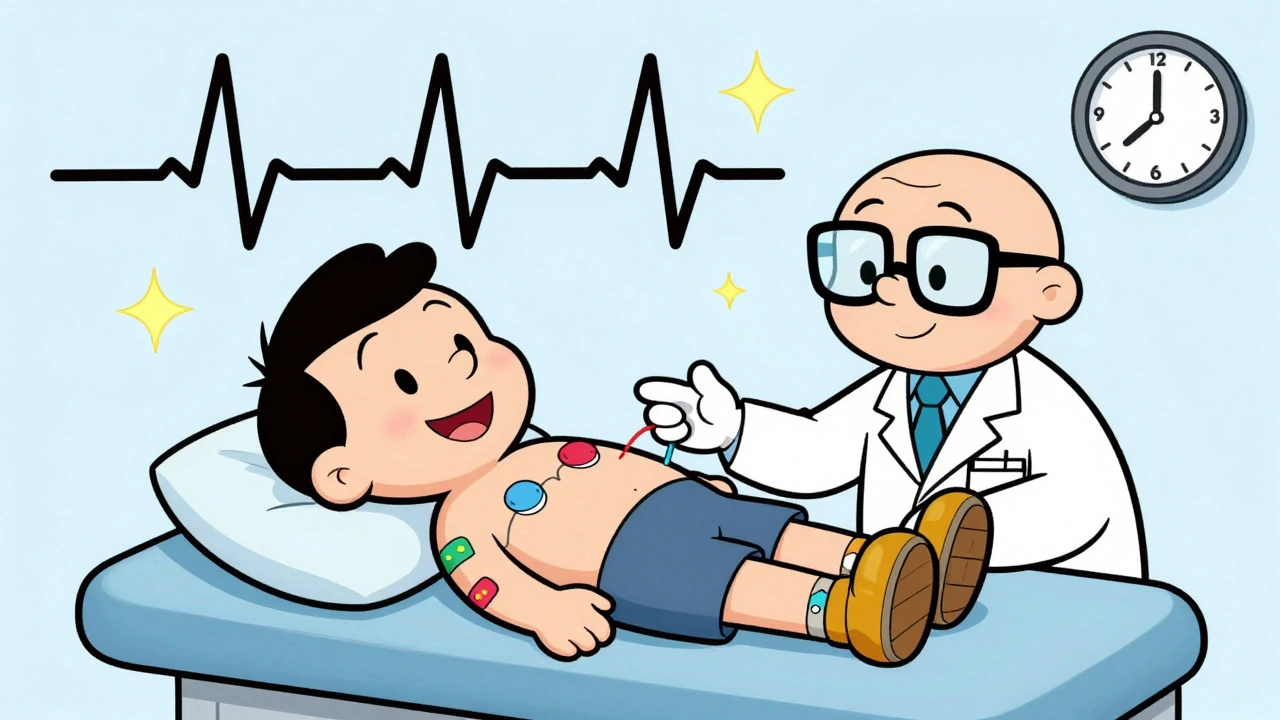
When your doctor says you need an ECG or a stress test, it’s normal to feel unsure. What are they checking? Why do you need both? And what happens if something shows up? These aren’t just routine procedures-they’re powerful tools that can catch heart problems before they become emergencies.
What an ECG Actually Shows
An ECG, or electrocardiogram, is a quick, painless snapshot of your heart’s electrical activity. It doesn’t measure blood flow or how hard your heart is pumping-it records the tiny electrical signals that make your heart beat. Electrodes stick to your chest, arms, and legs, and in about five minutes, you get a graph of waves and spikes that tell doctors about your heart’s rhythm, speed, and whether any part of it’s damaged.
It’s not magic, but it’s precise. A normal ECG shows a clear pattern: the P wave (atria firing), the QRS complex (ventricles contracting), and the T wave (heart resetting). If the pattern’s off-say, the QRS is too wide or the T wave is flipped-it could mean a past heart attack, an irregular rhythm like atrial fibrillation, or even an electrolyte imbalance. The beauty of an ECG is how fast it works. You walk in, they slap on the stickers, you lie still, and you’re done. No needles, no fasting, no waiting.
But here’s the catch: a resting ECG can miss problems that only show up when your heart is working hard. That’s why so many people end up needing a stress test next.
Why Stress Tests Are Different
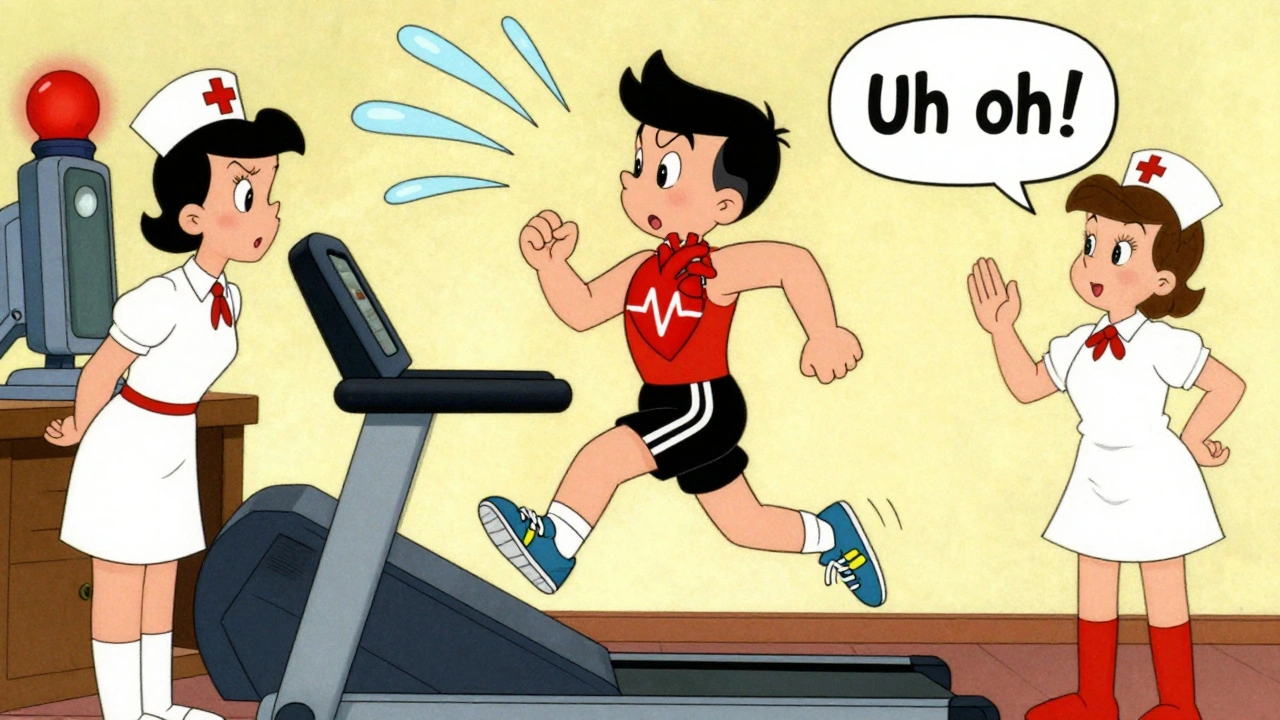
A stress test doesn’t just watch your heart at rest-it pushes it. The goal? To see how your heart handles the kind of strain it faces during daily life: climbing stairs, carrying groceries, running for the bus. Most people do this on a treadmill. You start slow, then every three minutes, the speed and incline go up. The test keeps going until you’re tired, your heart hits 85% of its predicted maximum (220 minus your age), or you get symptoms like chest tightness, dizziness, or shortness of breath.
While you’re on the treadmill, they keep watching your ECG, your blood pressure, and your oxygen levels. If your heart doesn’t get enough oxygen during exercise, it shows up as a dip in the ST segment on the ECG. That’s a red flag for coronary artery disease-when arteries are narrowed and can’t deliver enough blood under pressure.
But not everyone can run on a treadmill. If you have arthritis, severe lung disease, or just can’t move well, doctors use a chemical stress test instead. Medicines like adenosine or dobutamine mimic exercise by making your heart beat faster or widening your blood vessels. You might feel flushed, short of breath, or even get a brief chest ache. It’s uncomfortable, but it’s temporary. And it’s safe when done under supervision.
Which Test Is Better? ECG vs. Stress Test
They’re not rivals-they’re teammates. An ECG is your baseline. A stress test is your stress test. Think of it like checking your car’s oil level (ECG) versus taking it on the highway to see how the engine holds up under load (stress test).
Studies show that a resting ECG alone catches only about half of the heart problems that show up under stress. One big study of over 24,000 people found that a standard stress ECG spots coronary artery disease correctly about 68% of the time. That’s decent, but not perfect. That’s why doctors often add imaging.
Stress echocardiography uses ultrasound to watch your heart move during stress. If a part of the heart wall doesn’t pump as well when you’re working hard, it means a blocked artery is starving that area. This test has higher accuracy than plain ECG-specificity jumps to around 88%. And no radiation.
Nuclear stress tests use a tiny amount of radioactive dye to show blood flow to the heart muscle. They’re more sensitive-catching about 85% of blockages-but they expose you to radiation, roughly equal to three years of natural background exposure. That’s why they’re usually saved for cases where the other tests are unclear or for higher-risk patients.
Costs vary. A CT scan of the heart runs about $400. A stress echo is around $500. A nuclear stress test? Nearly $950. But here’s the twist: research shows that over three years, total healthcare costs are about the same whether you start with a CT scan or a stress test. So the best test isn’t always the cheapest-it’s the one that gives you the clearest answer.
Who Needs These Tests?
Not everyone needs a stress test. Doctors use a risk calculator to decide who benefits most. If you’re young, healthy, and your chest pain is clearly from muscle strain, you probably don’t need one. But if you’re a 55-year-old with high blood pressure, a family history of heart disease, and you get tightness in your chest when you walk uphill? That’s a classic case.
The American College of Cardiology recommends stress testing for people with a 15% to 65% chance of having coronary artery disease. That’s the sweet spot where the test adds real value. Below that, false positives cause unnecessary worry. Above that, you’re likely already in serious territory and might need a catheter instead.
Women are a special case. Studies show that stress tests are less accurate in premenopausal women. Their symptoms might be different-more fatigue, nausea, jaw pain than classic chest pressure. Their heart’s tiny arteries can be diseased without big blockages. That’s why stress echocardiography is now recommended for women with intermediate risk. No radiation, better accuracy.
What to Expect Before, During, and After
Preparation is simple but important. No caffeine for 24 hours before the test-coffee, tea, chocolate, energy drinks. Caffeine blocks the chemicals used in chemical stress tests and can mess up the results. Wear loose, comfortable clothes and walking shoes. No lotions on your chest-they interfere with the electrodes.
During the test, you’ll be monitored closely. Nurses and technicians are trained to watch for trouble. If you feel dizzy, have chest pain, or feel like you’re going to pass out, tell them immediately. The test stops if there’s any sign of danger.
Afterward, you can usually drive yourself home and go back to normal activities. Results aren’t always immediate. The technician might give you a rough idea, but the cardiologist needs time to review the full tracing. Don’t panic if you don’t get answers right away. A detailed report takes time-and it’s worth waiting for.
What the Results Mean
A normal stress test doesn’t guarantee you’re heart-healthy forever. It just means your heart handled the test well. You could still have early disease or problems in tiny arteries that don’t show up yet.
An abnormal result doesn’t mean you’re having a heart attack tomorrow. It means your heart didn’t respond the way it should. That could mean blocked arteries, scar tissue from an old heart attack, or even a rhythm problem. The next step isn’t always surgery. Often, it’s lifestyle changes-diet, exercise, quitting smoking-or medication to lower cholesterol and blood pressure.
Some results are inconclusive. About 25% of intermediate-risk patients need a second test. That’s not failure-it’s precision. Cardiologists don’t guess. They follow up.
What’s New in Heart Testing
Technology is making these tests smarter. Artificial intelligence is now being used to analyze ECG patterns during stress tests. One study showed AI improved accuracy by up to 22%. That means fewer missed diagnoses and fewer false alarms.
Portable devices like the Cardiac Dynamics StressPal are now FDA-approved. They let you do a stress test in a doctor’s office, a clinic, even a nursing home-no big lab needed. And research at Stanford is combining stress echocardiography with new imaging techniques that detect subtle heart muscle strain. This is especially helpful for women with chest pain but no major blockages. Their disease was invisible before. Now, it’s not.
Doctors are also cutting radiation doses in nuclear tests by 35% since 2021. That’s a big win for patient safety.
Real Stories, Real Results
One Reddit user, 'CardiacWarrior87,' got a normal resting ECG but failed his stress test. He was asymptomatic-no chest pain, no symptoms. The test caught silent ischemia. He got a stent. He’s alive today because the treadmill didn’t lie.
Another person, 'AnxiousPatient22,' had a chemical stress test and felt like they were dying for three minutes. Flushing, chest pressure, breathlessness. It was scary. But the doctor said, ‘That’s the medicine. It’s normal.’ The test showed no blockages. She was relieved.
These aren’t just tests. They’re conversations between your body and your doctor. They give you information you can’t get any other way.
When to Avoid These Tests
Stress tests aren’t for everyone. If you’ve had a heart attack in the last two days, have unstable angina, or are in acute heart failure, you’re not a candidate. The risk of triggering something worse is too high. Same if you have a serious arrhythmia that’s not controlled.
And if you’re completely healthy-with no symptoms, no risk factors-you don’t need one. Screening everyone leads to overtesting, false positives, and unnecessary procedures.
These tests are for people with symptoms or risk factors. Not for checkups. Not for fear. For facts.
What Comes Next
If your test is normal and you’re still having symptoms, don’t give up. Some heart problems, especially in women, don’t show up on standard tests. Ask about coronary microvascular disease or advanced imaging. If your test was abnormal, don’t panic. Most people don’t need surgery. Lifestyle changes, medication, and regular follow-ups can manage the problem effectively.
Heart disease doesn’t always scream. Sometimes it whispers. ECGs and stress tests are the tools that help us hear it before it’s too late.
Can an ECG detect a heart attack?
Yes, an ECG can show signs of a recent or past heart attack by detecting abnormal electrical patterns, like elevated ST segments or Q waves. But not all heart attacks show up on ECG, especially if they’re small or happened a while ago. That’s why doctors often combine it with blood tests for heart enzymes.
Is a stress test dangerous?
Stress tests are very safe when done in a medical setting. Serious complications are rare-less than 1 in 1,000. The team monitors your heart and blood pressure constantly and stops the test if anything looks risky. Chemical stress tests can cause temporary side effects like flushing or dizziness, but these fade quickly. The risk of not finding a problem is much higher than the risk of the test itself.
Do I need to fast before a stress test?
You don’t need to fast, but you should avoid eating a heavy meal for 2-4 hours before the test. The bigger rule is no caffeine for 24 hours. Caffeine interferes with the medications used in chemical stress tests and can give false results. Stick to water, and avoid chocolate, tea, coffee, or energy drinks.
Why do I need a stress test if my ECG was normal?
A normal resting ECG doesn’t rule out heart disease. Many people with blocked arteries have perfectly normal ECGs when they’re sitting still. A stress test forces the heart to work harder, which can reveal problems that only appear under pressure. It’s like checking your brakes while parked versus while driving at 60 mph.
How accurate are stress tests for women?
Traditional stress ECG tests are less accurate in women, especially younger women, because their heart disease often affects small arteries rather than large ones. Stress echocardiography is more reliable for women-it doesn’t rely on ECG changes alone but looks at how the heart muscle moves. New techniques like speckle-tracking strain analysis are making detection even better, with sensitivity rising to 89% in women with symptoms but no major blockages.
Can I drive home after a stress test?
Yes, in most cases. After a treadmill stress test, you can usually drive yourself home. After a chemical stress test, you might feel dizzy or tired for a short time, so it’s wise to have someone drive you. The effects of the drugs usually wear off within 30 to 60 minutes. Always check with your provider-they’ll tell you what’s safe for your situation.
Are there alternatives to stress tests?
Yes. For some patients, especially those with low risk, a heart CT scan (coronary calcium scan or CT angiography) can be used instead. It shows blockages directly but involves radiation and doesn’t show how well the heart functions under stress. For others, cardiac MRI or advanced echocardiography may be options. The best test depends on your symptoms, risk level, and what your doctor suspects.
Myles White
December 6, 2025Man, I didn’t realize how much nuance goes into these tests until I read this. I had a stress test last year after my dad had a scare, and I thought it was just a fancy treadmill session. Turns out, the way they monitor ST segments and adjust for age and gender? That’s some serious science. I mean, I didn’t know chemical stress tests could mimic exercise so accurately-like your heart’s being tricked into thinking it’s sprinting. And the part about women’s microvascular disease? Eye-opening. My sister had chest pain for years and got told it was anxiety. Turns out, her tiny arteries were narrowing. No big blockages, but still dangerous. We need more awareness around this. Also, the AI improvements in ECG analysis? That’s the future. I’m betting in five years, your phone’s gonna do a basic ECG and flag anomalies before you even see a doctor.
And honestly, the cost comparison thing? Super important. People freak out about $950 nuclear tests, but if it avoids a misdiagnosis and saves you from triple bypass later? Totally worth it. Healthcare’s broken, but this is one area where the system actually works pretty well if you’re in the right risk bracket.
Also, no caffeine for 24 hours? I’m guilty of sipping espresso at 7am before my test. Thank god they caught it. Lesson learned.
Big props to the writer. This wasn’t just info-dump-it was a guide for people who are scared and confused. I wish my doctor had given me something this clear.
Also, portable devices like the StressPal? Genius. Imagine getting tested in a rural clinic instead of driving two hours to a hospital. That’s equity in healthcare right there.
Saketh Sai Rachapudi
December 6, 2025USA medical system is so overcomplicated. In India we dont need all this fancy machines. If heart paining, take asprin and rest. No need for 950$ test. Also stress test is useless for young people. Only old rich people need these. Doctors just want to make money. I had friend who did stress test and got false positive. He got stent and now he is in debt. Why not just eat less oil and walk daily? Simple solution. Why make money from fear? I think this article is propaganda for big pharma.
joanne humphreys
December 7, 2025I appreciate how thorough this is. I’ve had both tests-first as a precaution after a panic attack that mimicked angina, and later because my BP was spiking during exercise. What stood out to me was how the article emphasized that normal results don’t mean you’re immune. I had a clean stress test and still ended up with microvascular disease two years later. It’s not failure-it’s just that medicine still has blind spots. I’m glad they mentioned women’s symptoms being different. I never had chest pressure. Just fatigue, nausea, and a weird left arm heaviness. No one connected it until I pushed back. This kind of clarity matters. Also, the AI angle? I’m cautiously optimistic. If it reduces misdiagnoses, especially in under-resourced areas, that’s a win. Just hope it doesn’t replace human judgment entirely.
Gwyneth Agnes
December 8, 2025No caffeine before the test. Simple. Stop overcomplicating everything.
Mansi Bansal
December 9, 2025It is with profound intellectual gravity that I must address the epistemological underpinnings of contemporary cardiac diagnostic paradigms as delineated in this exposition. The conflation of symptomatic correlation with physiological causality remains a persistent epistemic flaw in Western medical orthodoxy. One cannot, in good conscience, reduce the somatic expression of myocardial ischemia to mere electrocardiographic anomalies or treadmill-induced hemodynamic stressors. The Cartesian dichotomy between mind and body has rendered our diagnostic modalities fundamentally reductive. The human organism is not a machine whose metrics can be isolated and quantified without acknowledging the psychosomatic continuum. Furthermore, the commercialization of cardiac diagnostics-evidenced by the $950 nuclear stress test-is not merely a fiscal concern, but a moral indictment of healthcare capitalism. The invocation of AI as a panacea betrays a technocratic hubris that obscures the patient’s lived experience. One must ask: Who benefits? The patient? Or the conglomerate that owns the imaging equipment? The answer, regrettably, is self-evident. Let us not mistake precision for truth, nor efficiency for healing.
Kay Jolie
December 10, 2025Okay but CAN WE TALK ABOUT THE AI IMPROVEMENTS?? Like, 22% accuracy boost?? That’s not just a stat-that’s a paradigm shift. We’re talking about machines reading ECGs better than some residents who’ve been up for 36 hours. And the fact that they’re cutting radiation by 35%? That’s a win for every woman who’s been told, ‘It’s probably anxiety.’ I had a chemical stress test last year and I swear I thought I was going to die. Flushed, sweaty, heart pounding like a drum solo. The tech said, ‘You’re doing great!’ and I was like, ‘I’m not doing great, I think I’m having a heart attack!’ Turns out? Nothing. But the fact that we now have tools that can detect strain in tiny arteries? That’s revolutionary. Especially for women. We’ve been invisible in cardiology for decades. Now? We’re being seen. And honestly? I’m emotional. This isn’t just medicine-it’s justice.
pallavi khushwani
December 11, 2025I’ve been thinking a lot about how we treat our bodies like machines that need diagnostics instead of listening to them like living systems. You know? The ECG is just a snapshot, right? Like taking a photo of a river and saying, ‘This is the river.’ But the river flows. The stress test is like watching the river during a storm. It shows you what’s hidden beneath the calm. I wonder if we’re too focused on the data and not enough on the story. My grandma had no tests, no cholesterol numbers, no stress tests. She just ate fresh food, walked every day, and never stressed about anything. Lived to 94. Maybe the real test is how you live-not how your heart performs under pressure. Still, I’m glad these tools exist for people who need them. Just don’t let them make you forget: your body speaks. You just have to be quiet enough to hear it.
Dan Cole
December 11, 2025Let’s be brutally honest: the entire cardiac testing industrial complex is built on the assumption that asymptomatic people need screening. That’s not medicine-it’s fearmongering disguised as prevention. The American College of Cardiology’s 15–65% risk threshold? Arbitrary. It’s a revenue model. Studies show that for low-risk individuals, stress tests generate more false positives than actual diagnoses. That means more invasive follow-ups, more stents, more anxiety. Meanwhile, the real epidemic-sedentary lifestyles, ultra-processed food, chronic stress-is ignored. You don’t need a $950 nuclear scan to fix that. You need to stop sitting all day and start moving. And if you’re a 55-year-old with high BP and family history? Yes, get tested. But don’t confuse correlation with causation. The ECG doesn’t detect plaque. It detects electrical noise. Plaque is a structural issue. You need imaging for that. And yet, we treat the ECG like gospel. That’s not science. That’s ritual. The real innovation isn’t AI-it’s the courage to question the system.
Shayne Smith
December 12, 2025My mom did a stress test last year and cried after because she thought she was dying. Turned out it was just the medicine. She still won’t drink coffee now. I told her, ‘Mom, it’s not the test. It’s the fear.’ But you know what? She’s alive. And she walks every morning now. So maybe the test wasn’t just about the heart. Maybe it was the wake-up call. I’m not a doctor. But I’ve seen how scared people get. This article didn’t just explain tests. It explained why we’re scared. And that’s just as important.
Max Manoles
December 13, 2025One thing this post didn’t mention: the psychological toll of false positives. I had a borderline stress test result at 38. No symptoms. Healthy weight. Active. But the ‘possible ischemia’ label haunted me for months. I started avoiding stairs. Checked my pulse hourly. Went to three different cardiologists. Turned out it was a misaligned electrode. The system doesn’t prepare you for the anxiety that follows a ‘maybe.’ We treat diagnostics like yes/no switches, but they’re gradients. A 68% accuracy rate means one in three people get told something’s wrong when it isn’t. That’s not just a number. That’s sleepless nights. That’s unnecessary biopsies. That’s insurance premiums going up. We need better communication around uncertainty. Not just better tech.
Katie O'Connell
December 14, 2025The commodification of cardiac diagnostics is a systemic failure of medical ethics. The proliferation of nuclear stress tests, despite their radiation burden, is a direct consequence of reimbursement structures that incentivize volume over value. The $950 price point is not reflective of clinical utility but of market-driven extraction. Furthermore, the normalization of AI-assisted diagnostics without transparent algorithmic validation constitutes a breach of informed consent. Patients are not informed that their ECG interpretation may be mediated by proprietary machine-learning models trained on non-representative datasets. This is not innovation-it is obfuscation. The American College of Cardiology’s guidelines, while seemingly evidence-based, are inevitably influenced by industry sponsorship. Until cardiac diagnostics are decoupled from profit motives, true patient-centered care remains an aspirational fiction.
Brooke Evers
December 15, 2025I’m a nurse who’s run hundreds of stress tests, and I’ve seen everything-from panic attacks mistaken for heart attacks to silent ischemia in people who looked perfectly fine. I want to say thank you for writing this. So many patients come in scared, confused, and feeling like they’re being judged for being ‘too anxious.’ But this? This is what they need. Clear. Calm. No jargon. I especially loved the part about women’s symptoms. I had a 42-year-old patient last month who said, ‘I just feel like I’ve been running even when I’m sitting.’ We did a stress echo. Turns out she had microvascular disease. No blockages. Just tired, starving heart muscle. She cried when she heard it wasn’t ‘all in her head.’ That’s the thing-these tests don’t just find disease. They validate suffering. And that matters more than we admit.
Also, the caffeine rule? I’ve had patients show up with a Starbucks in one hand and a chocolate bar in the other. We have to say, ‘Nope.’ But we also have to say, ‘I get it. You’re tired. But this matters.’ It’s not about being strict. It’s about being accurate. And accuracy saves lives.
And yes, the AI stuff? I’ve seen it in action. It flagged a subtle rhythm abnormality I missed. I was embarrassed. Then I was grateful. Tech isn’t replacing us. It’s helping us see what we can’t. Just don’t let it replace the human touch. That’s still the most important part.
Nigel ntini
December 16, 2025Brilliant breakdown. I’ve worked in NHS cardiology for 18 years and this is exactly how I explain it to patients. The ECG is your heartbeat’s fingerprint. The stress test is how it dances under pressure. And yes, women’s symptoms are different-not because they’re ‘hysterical,’ but because their disease often looks different. We used to miss so many. Now with echo and strain analysis, we’re catching it early. And the portable tech? Huge for rural areas. I had a patient in Cumbria who couldn’t get to a hospital for months. We did a StressPal in her kitchen. She’s fine now. The future isn’t just high-tech-it’s high-touch. And this article nails it.
Priya Ranjan
December 18, 2025How can anyone still trust Western medicine after reading this? You claim these tests are life-saving, but you ignore the fact that 70% of heart disease is caused by diet and lifestyle. You promote expensive, invasive procedures while ignoring the simple truth: eat whole foods, move daily, sleep well. You call it ‘precision medicine’-I call it profit-driven distraction. The fact that you even mention AI as a solution proves you’ve lost touch with the root cause. Your entire system is built on treating symptoms, not preventing disease. And you wonder why people are sick? It’s because you’ve turned healthcare into a business, not a calling. Shame on you for normalizing fear as a diagnostic tool.
Dan Cole
December 18, 2025Actually, the comment about false positives and anxiety? That’s spot on. I’m the one who posted about the 68% accuracy rate. And I stand by it. But here’s the twist: the real danger isn’t the test. It’s the silence after. You get a borderline result and the doctor says, ‘We’ll monitor.’ Then you’re left alone with your fear for weeks. No one tells you what ‘monitor’ means. Do you check your pulse? Avoid stairs? Cancel your trip? That’s the gap. We need better follow-up protocols-not just better machines. And maybe, just maybe, we need doctors who say, ‘I don’t know yet,’ instead of rushing to the next test.