
Medication Side Effect Comparison Tool
Compare Your Medication
Your Medication Comparison
Sexual Side Effect Rate:
0%
Article Insight: Switching from your current medication to alternatives has a 65-70% success rate for resolving sexual side effects.
Alternative Options
What Your Doctor Should Know
- "Are there other medications with lower sexual side effects?"
- "Can we try a lower dose or a drug holiday?"
- "Is there a way to track this over time?"
When you start a new medication for depression, anxiety, or another mental health condition, you expect relief-not a strained sex life. But here’s the truth: sexual side effects from medications are more common than most doctors admit, and far more treatable than most patients realize. If you’ve noticed a drop in desire, trouble getting or keeping an erection, delayed orgasm, or pain during sex after starting a new drug, you’re not alone. And you don’t have to live with it.
Why This Happens
Many psychiatric medications-especially SSRIs like fluoxetine, sertraline, and paroxetine-change how serotonin works in your brain. While that helps lift mood, it also interferes with the pathways that control sexual response. Studies show between 58% and 70% of people on these drugs experience some form of sexual dysfunction. For men, that often means trouble with erections or delayed ejaculation. For women, it’s usually low desire, trouble reaching orgasm, or pain during sex. The problem isn’t just the medication, though. Up to half of people with untreated depression already have sexual issues before they even start treatment. That makes it hard to tell what’s the illness and what’s the drug.What the Research Shows
It’s not all bad news. Different drugs carry different risks. SSRIs have the highest rates-up to 70% of users report sexual side effects. But bupropion (Wellbutrin) and mirtazapine (Remeron) are much gentler on libido, with only 5-10% of users affected. That’s why switching medications is one of the most effective strategies. Research shows a 65-70% success rate when people move from an SSRI to one of these alternatives. There are also targeted fixes. For men with erectile issues, drugs like sildenafil (Viagra) help about 55-60% of the time. But they don’t do much for orgasm problems. For women, there’s less data, but some find relief with low-dose testosterone or vaginal lubricants. If you’re on an antipsychotic and notice low libido or breast changes, high prolactin levels might be the culprit. Switching to aripiprazole can fix that in 75% of cases.The Counseling Gap
Here’s the frustrating part: most people aren’t told about this risk before they start treatment. A 2023 survey on Reddit found that 68% of respondents said their doctor never mentioned sexual side effects. A National Alliance on Mental Illness (NAMI) study found that 73% of people waited over four months to bring it up-because they were embarrassed, or thought nothing could be done. That’s a huge missed opportunity. But when doctors do talk about it, outcomes change. One study found that 82% of patients who received clear counseling and a plan for managing side effects stayed on their medication. Only 47% of those who weren’t told anything did the same. The difference isn’t just in knowledge-it’s in trust. When a provider says, “This happens to 6 out of 10 people on this drug,” it normalizes the issue. It doesn’t make it feel like a personal failure.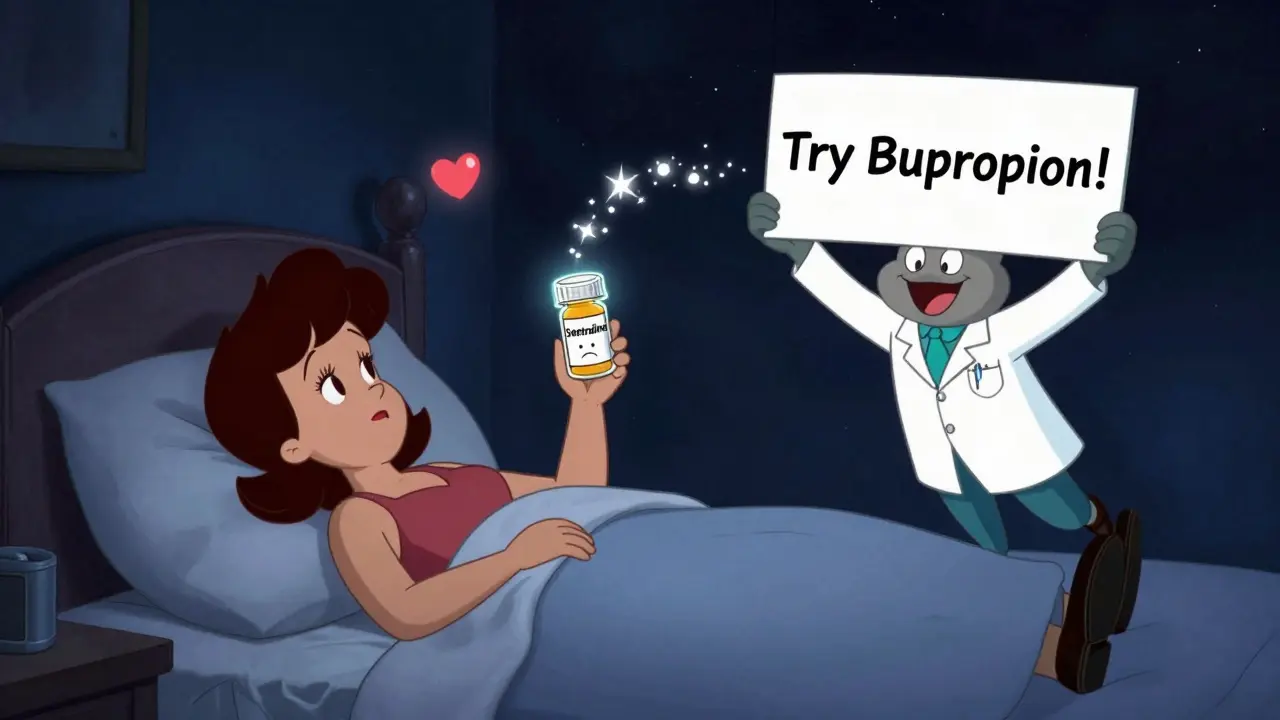
What Works: Evidence-Based Strategies
There’s no one-size-fits-all fix, but here are the top five strategies backed by data:- Switching medications - Moving from an SSRI to bupropion or mirtazapine works for 65-70% of people. It’s often the best long-term solution.
- Dose reduction - Lowering the dose by 20-30% helps 25-30% of patients without losing mood benefits. Not always possible, but worth trying.
- Drug holidays - Skipping your pill for 2-3 days before planned intimacy can restore function in 40% of cases. Risky if you’re on short-acting meds like paroxetine-relapse risk is 15%.
- Adding a rescue medication - Sildenafil helps men with erections. For women, flibanserin (Addyi) is approved but has limited effectiveness and side effects. Always use under medical supervision.
- Couples therapy - If your relationship is strained because of this issue, therapy helps 50% of couples improve intimacy and communication.
What to Ask Your Doctor
Don’t wait for your doctor to bring it up. Be direct. Here’s what to say:- “I’ve noticed changes in my sex life since starting this medication. Is this common?”
- “Are there other medications with lower sexual side effects?”
- “Can we try a lower dose or a drug holiday?”
- “Is there a way to track this over time?”
Where Counseling Falls Short
Many providers avoid the topic because they’re uncomfortable. A 2021 JAMA Internal Medicine survey found that 64% of medical residents felt awkward talking about sex. That’s changing, but slowly. Some clinics now train pharmacists to lead these conversations-because pharmacists often have more time and are trained to explain side effects clearly. In fact, one study found that patients who got counseling from their pharmacist reported higher satisfaction than those who only talked to their doctor. Another problem? Insurance. Only 38% of U.S. commercial plans cover sex therapy. And LGBTQ+ patients report 28% fewer discussions about sexual side effects than straight, cisgender patients. This isn’t just a medical issue-it’s a systemic one.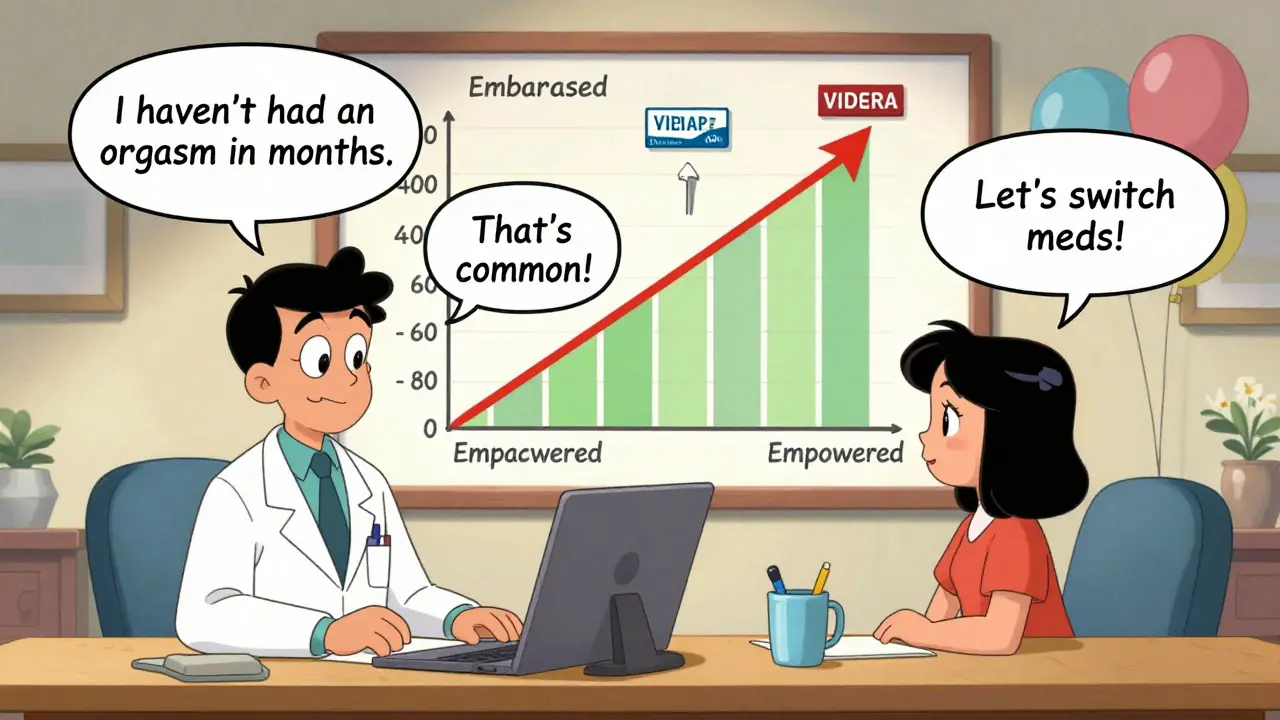
What’s Next
The field is evolving. New tools like the MoodFX app let you track mood and sexual function together. Clinical trials are testing drugs designed specifically to block SSRI-induced sexual side effects without affecting mood. One is in phase 3 and results are expected in early 2024. The American Psychiatric Association now officially recommends routine screening for sexual side effects during every follow-up. And more hospitals are adding it to their quality metrics. The goal? Cut medication discontinuation due to sexual side effects by 50% by 2030.Real Stories
One patient on HealthUnlocked shared: “When I told my doctor I wasn’t having orgasms anymore, she didn’t panic. She said, ‘That’s common with sertraline.’ Then she switched me to bupropion. Within two weeks, things felt normal again. I’ve stayed on it for 18 months.” Another man on a mental health forum wrote: “I tried Viagra. It helped with erections but not with wanting sex. My doctor finally said, ‘Try cutting your dose in half for a week.’ It worked. I still feel better, and my sex life is back.” These aren’t outliers. They’re examples of what happens when you speak up-and when your provider listens.Bottom Line
Sexual side effects from medication aren’t a sign you’re broken. They’re a known, predictable, and often fixable part of treatment. The biggest barrier isn’t the drug-it’s silence. If you’re struggling, talk to your provider. Ask for alternatives. Ask for a plan. You deserve to feel better in every way-emotionally, physically, and intimately.Can medication side effects cause permanent sexual dysfunction?
In most cases, no. Sexual side effects from medications like SSRIs typically reverse within days to weeks after stopping or switching the drug. A small number of people report lingering issues, sometimes called Post-SSRI Sexual Dysfunction (PSSD), but this is rare and not well understood. Research is ongoing, and experts agree that permanent damage is extremely uncommon. If symptoms persist after stopping the medication, see a specialist in sexual medicine.
Do all antidepressants cause sexual side effects?
No. While SSRIs and SNRIs have high rates-up to 70%-other antidepressants like bupropion (Wellbutrin) and mirtazapine (Remeron) are much less likely to cause sexual problems. In fact, bupropion can sometimes improve libido. If sexual side effects are a major concern, these are often the first alternatives your doctor should consider.
Is it safe to take Viagra with antidepressants?
Yes, in most cases. Sildenafil (Viagra) and similar drugs like tadalafil (Cialis) are generally safe to use with antidepressants. They don’t interfere with how the antidepressant works. But they’re only effective for erectile problems-not low desire or delayed orgasm. Always get medical approval before combining them, especially if you have heart conditions or take nitrates.
Why don’t doctors talk about this more?
Many providers feel uncomfortable discussing sex, worry about embarrassing patients, or assume it’s not a priority. Time constraints in short appointments also play a role. But guidelines now clearly state that asking about sexual function is part of standard care. If your doctor doesn’t bring it up, you have every right to start the conversation. You’re not being difficult-you’re advocating for your health.
What if I’m afraid to tell my doctor?
Start small. Write down your concerns and hand them a note. Or say: “I’m not sure how to bring this up, but I’ve noticed changes in my sex life since starting this medication. Is that normal?” Most providers will appreciate your honesty. If they react dismissively, it’s okay to seek a second opinion. Your sexual health matters as much as your mental health.


Joe Prism
March 7, 2026Let’s be real-medication isn’t the enemy. Silence is. Doctors act like sex is a side note, not a core part of human health. You wouldn’t ignore a patient’s chronic pain, so why treat sexual dysfunction like it’s embarrassing? It’s not about libido-it’s about autonomy.
And yeah, switching from SSRIs to bupropion? That’s not a hack. It’s basic pharmacology. Why isn’t this the first conversation, not the last?
Adebayo Muhammad
March 8, 2026Here’s the philosophical dilemma: if a drug fixes your mind but breaks your body, is it healing-or colonizing? We treat mental health like a binary: ‘better’ or ‘broken.’ But what if the cost of ‘better’ is the erasure of intimacy? That’s not treatment. That’s trade-off capitalism disguised as medicine.
And don’t get me started on ‘drug holidays.’ You’re telling someone to risk a depressive relapse… so they can orgasm? The system is built to prioritize productivity over pleasure. Pathetic.
Bridget Verwey
March 9, 2026OMG YES. I was on sertraline for 3 years. No orgasms. No desire. Felt like a robot with anxiety. My doctor? ‘It’ll pass.’
It didn’t. I switched to bupropion. Two weeks later, I had sex for the first time in 18 months. Not because I ‘wanted to’-because I *could*. This isn’t a ‘side effect.’ It’s a damn medical oversight.
Also-pharmacists are the real MVPs. My pharmacist explained it better than my psychiatrist. 🙌
Weston Potgieter
March 11, 2026Why do people act like this is new? We’ve known SSRIs kill libido since the 90s. Doctors just don’t wanna deal with it. They’d rather you quit meds than admit they didn’t warn you.
Viagra? Fine for dicks. Doesn’t fix low drive. Testosterone for women? FDA approved but barely covered. System’s rigged. End of story.
Vikas Verma
March 12, 2026From a clinical perspective, the data is unequivocal: SSRI-induced sexual dysfunction affects majority of users, yet screening protocols remain inconsistent. The ASEX tool is underutilized globally. In India, where mental health stigma persists, patients rarely report these issues due to cultural taboos.
However, when integrated into routine follow-ups, adherence improves by over 70%. This is not anecdotal-it is evidence-based. Systemic change requires institutional mandates, not individual courage.
Ian Kiplagat
March 12, 2026Same. Took me 14 months to say anything. Thought I was broken. Turns out I was just on the wrong pill.
Switched to mirtazapine. Libido back. Mood stable. No drama.
Doctors need to stop acting like this is a weird secret.
Amina Aminkhuslen
March 12, 2026Wow. So we’re supposed to be grateful that we can *try* Viagra to get hard while our brains are chemically neutered? That’s not healthcare. That’s a Band-Aid on a hemorrhage.
And who the hell approved a drug like Addyi? It’s basically a placebo with a price tag and a warning label that says ‘Don’t drink.’
Why are we still treating women’s desire like a puzzle to be solved with hormones and hope?
amber carrillo
March 14, 2026I’ve been a therapist for 12 years. I’ve seen too many clients shut down because they felt ashamed to talk about this.
One woman told me, ‘My husband thinks I don’t love him anymore.’ But it was the medication.
When providers normalize this-when they say, ‘This is common, let’s fix it’-it changes everything.
You’re not broken. You’re medicated.
Tim Hnatko
March 15, 2026I read the whole thing. Took notes. I’m on an SSRI. Haven’t told my doctor yet. Too scared.
But now I know it’s not just me. And I know there are options.
Thanks for writing this.
Aaron Pace
March 16, 2026Bro. I took a drug holiday. Skipped my pill for 3 days before a date. Got hard. Got off. Felt human again.
Then I had a panic attack the next day.
So yeah. It works. But it’s a gamble.
Why should I have to risk my mental health to have sex?
😤