
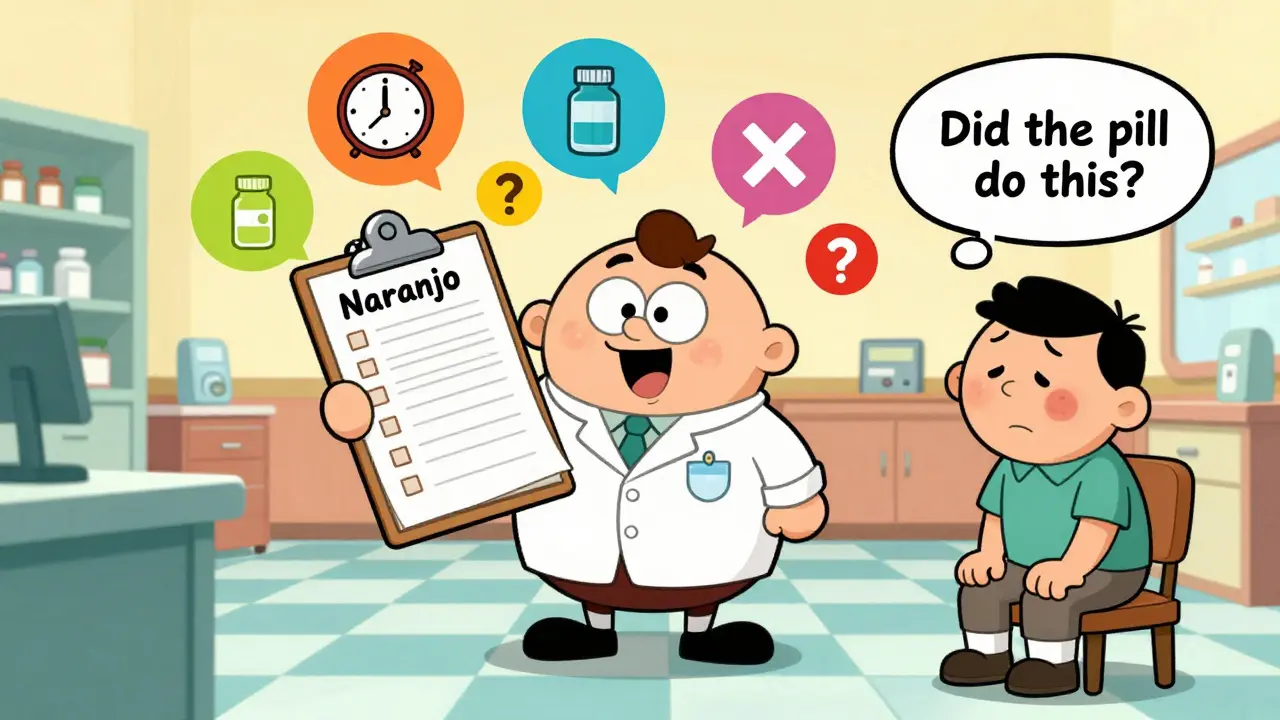
When a patient gets sick after taking a new medication, how do you know if the drug actually caused the problem? It’s not always obvious. The patient might have had an underlying condition. Maybe they took something else. Or it could just be bad timing. That’s where the Naranjo Scale comes in. It’s not magic. It’s not a fancy machine. It’s a simple, 10-question checklist used by doctors, pharmacists, and researchers around the world to figure out if a drug really caused an unexpected side effect.
What Is the Naranjo Scale, Really?
The Naranjo Scale was created in 1981 by a team of researchers led by Dr. Carlos A. Naranjo. It came out of a growing need after the thalidomide disaster - when a drug meant to help pregnant women caused severe birth defects - showed how badly we needed a way to prove which drugs were dangerous. Before this, doctors often guessed. Now, they answer 10 specific questions. Each answer gives you points: +2, +1, 0, or even -1. Add them up, and you get a score that tells you how likely the drug caused the reaction.
It’s not perfect. But it’s the most used tool of its kind. A 2022 study found it was used in 78% of published drug reaction reports - more than any other method. Hospitals, pharmacies, and drug companies rely on it to report side effects to regulators like the FDA and the European Medicines Agency. You won’t find it in your GP’s office every day, but if you’re in a hospital pharmacy or a clinical trial, you’ll see it in use.
How the 10 Questions Work
Here’s how it breaks down. Each question is designed to test a different clue that helps link the drug to the reaction.
- Question 1: Has this reaction been reported before with this drug? (+1 if yes)
- Question 2: Did the reaction start after the drug was given? (+2 if timing fits, -1 if it didn’t)
- Question 3: Did symptoms get better when the drug was stopped? (+1 if yes)
- Question 4: Did the reaction come back when the drug was given again? (+2 if yes, -1 if it got worse)
- Question 5: Could something else have caused it? (-1 if yes, +2 if no)
- Question 6: Was a placebo used to test the reaction? (-1 if yes, +1 if no - but this one’s controversial)
- Question 7: Were drug levels in the blood toxic? (+1 if yes)
- Question 8: Did higher doses make the reaction worse? (+1 if yes)
- Question 9: Has the patient had this reaction to the same drug before? (+1 if yes)
- Question 10: Is there objective proof - like lab results or imaging - that confirms the reaction? (+1 if yes)
That’s it. Ten questions. No blood tests needed. No scans. Just answers based on medical records, patient history, and clinical judgment.
What the Score Means
Your total score tells you the likelihood:
- 9 or higher: Definite - the drug almost certainly caused it. You’ve got timing, improvement after stopping, and no better explanation.
- 5 to 8: Probable - likely the drug, but maybe not 100% sure. Maybe rechallenge wasn’t possible, or evidence is thin.
- 1 to 4: Possible - it could be the drug, but other factors (like infection or another medication) might be involved.
- 0 or lower: Doubtful - the reaction probably wasn’t caused by the drug at all.
For example: A 72-year-old woman starts taking a new blood pressure pill. Three days later, she develops a rash and swelling. Her doctor stops the pill. The rash fades in two days. She’s never had this reaction before. No other drugs changed. No infection. Score? +2 (timing), +1 (improvement), +1 (no alternative cause), +1 (objective evidence - the rash), +1 (previous similar reaction? no). Total: 5. That’s probable. The team reports it. That’s how drug safety systems learn.
Why It’s Still Used - Even in 2026
It’s old. It’s simple. And it’s still the gold standard. Why? Because it forces you to think systematically. Without it, people rely on gut feelings. One doctor might say, “That looks like a side effect.” Another says, “She’s just getting older.” The Naranjo Scale removes the guesswork. It makes sure everyone’s asking the same questions.
It’s also free. No software license. No subscription. You can print it out. Fill it in by hand. That’s why it’s still used in clinics across Africa, Asia, and rural hospitals where high-tech tools aren’t available. Even in fancy hospitals, it’s the starting point.
And it’s built into major reporting systems. The FDA’s FAERS database and the WHO’s global drug safety program both accept Naranjo scores as part of their official reports. If you’re a pharmacist filing a side effect report, you’ll be asked to score it.
Where It Falls Short
But here’s the problem: modern medicine isn’t what it was in 1981.
First, most patients take five or six medications. The Naranjo Scale only looks at one drug at a time. If a patient is on warfarin, metformin, lisinopril, and a new antibiotic - and they get liver damage - which one caused it? The scale doesn’t help. That’s why tools like the Liverpool ADR Scale were created - they handle multiple drugs.
Second, some questions are outdated. Question 6 asks if a placebo was used to test the reaction. In 2026, giving someone a placebo to see if they get sick again? That’s unethical. Most clinicians mark “don’t know.” That skews the score. Experts now suggest replacing it with a question about therapeutic drug monitoring - like, “Was the drug level in the blood checked?”
Third, it doesn’t work well for new types of drugs. Immunotherapies for cancer can cause side effects months after stopping. Gene therapies can have irreversible effects. The Naranjo Scale assumes reactions happen quickly and go away when you stop the drug. That’s not always true anymore.
And then there’s the human factor. One study found that 35% of doctors disagreed on whether an alternative cause was “sufficient.” What counts as a “reasonable” explanation? A cold? Stress? Age? That’s where training matters.
How It’s Being Updated - and Used Today
People aren’t just using paper forms anymore. In 2023, a team in India built a Python program that auto-calculates the Naranjo score. Nurses type in answers, and it spits out the result in seconds. Error rates dropped from 28% to 9%. Time saved: from 11 minutes to 4.
Some electronic health records - like Epic - now auto-fill four of the ten questions. Did the patient take the drug? When? Was it stopped? Did symptoms improve? The system pulls that from the chart. That leaves only the tricky ones: alternative causes, rechallenge, objective evidence.
Medical schools and pharmacy programs now teach it with interactive case studies. Fiveable, a popular learning platform, has 15,000 students using its free Naranjo Scale module. Most master it after 3 to 5 practice cases.
And while AI tools like the FDA’s Sentinel Initiative are starting to predict drug risks using machine learning, they still use Naranjo scores to train their models. It’s the foundation.
Who Uses It - and When
You won’t see it in a quick clinic visit. But you’ll find it in:
- Hospital pharmacovigilance units
- Pharmaceutical safety departments
- Clinical trial monitoring teams
- Regulatory agencies reviewing drug safety data
It’s used when someone reports a serious side effect - like liver failure, severe rash, or heart rhythm problems. That’s when the formal assessment kicks in. A pharmacist reviews the chart. Answers the 10 questions. Scores it. Files it. That data goes into national and global databases. And over time, patterns emerge. A drug once thought safe gets flagged. A warning gets added. Someone else avoids the reaction.
It’s slow. It’s manual. But it’s the backbone of drug safety.
What Comes Next
Will the Naranjo Scale be replaced? Probably not soon. It’s too simple, too proven, too widely accepted. But it’s evolving. Digital tools are making it faster. New guidelines are replacing outdated questions. And in complex cases, it’s being used alongside newer tools like ALDEN or the Liverpool Scale.
Its future isn’t about being the only tool. It’s about being the first tool. The starting point. The common language. Even in a world of AI and gene therapy, if you can’t agree on whether a drug caused a reaction, you can’t fix the problem. The Naranjo Scale gives you that agreement.
It’s not glamorous. But it saves lives.
Is the Naranjo Scale still used today?
Yes. As of 2026, it’s still the most widely used tool for assessing whether a drug caused an adverse reaction. It’s required in regulatory reporting systems like the FDA’s FAERS and the WHO’s global pharmacovigilance program. While newer tools exist, the Naranjo Scale remains the standard baseline for structured assessment in hospitals, pharmacies, and drug companies worldwide.
Can the Naranjo Scale be used for any drug?
It works best for traditional medications - antibiotics, blood pressure drugs, painkillers - where reactions happen quickly and are tied to dose. It’s less reliable for newer therapies like immunotherapies, biologics, or gene treatments, where side effects may appear months later or be irreversible. In those cases, it’s used as a starting point, not the final answer.
Why is the placebo question (Question 6) controversial?
Because intentionally giving a placebo to see if a reaction returns is considered unethical today. If a patient had a severe allergic reaction, you wouldn’t risk giving them the drug again - even in a controlled setting. Most clinicians mark “don’t know,” which lowers the score. Experts now recommend replacing this question with one about therapeutic drug monitoring - checking if drug levels were high enough to cause the reaction.
Can I use the Naranjo Scale at home?
No. It’s not designed for patients. It requires access to medical records, knowledge of drug timing, alternative causes, and clinical judgment. Even healthcare workers need training to use it correctly. If you suspect a side effect, talk to your doctor or pharmacist - don’t try to score it yourself.
How long does it take to learn the Naranjo Scale?
Most healthcare professionals learn the basics in 2 to 4 hours of training. But getting good at it - especially interpreting questions about alternative causes or objective evidence - takes practice. Studies show proficiency usually comes after 20 to 30 real cases. Pharmacists and clinical pharmacologists typically master it faster than general practitioners.
Is the Naranjo Scale better than other tools?
It’s more objective than the WHO-UMC system, which uses vague categories like “probable” or “unlikely.” The Naranjo Scale gives a number, so results are more consistent across users. But for patients on multiple drugs, tools like the Liverpool Scale are better. For pediatric cases, the PADRAT tool is designed specifically for children. The Naranjo Scale isn’t the best for every situation - but it’s the most widely accepted starting point.

lisa Bajram
January 9, 2026I love this breakdown! The Naranjo Scale is like the OG drug detective-no fancy gadgets, just pure clinical logic. I used it last month on a patient who got a rash after starting a new statin. Scored it 7-probable. We reported it, and guess what? Two other hospitals had the same case. That’s how safety nets work, folks.
Also, can we talk about how it’s still paper-based in 90% of rural clinics? I printed a copy and laminated it. My pharmacist coworkers now call me ‘The Naranjo Queen.’
Jaqueline santos bau
January 11, 2026Okay but why are we still using a 1981 tool in 2026? This is like using a rotary phone to call 911. I had a patient on six meds get liver failure and the scale said ‘possible’ because ‘alternative cause’ was ‘maybe.’ Maybe?! That’s not medicine, that’s guesswork with a spreadsheet.
Kunal Majumder
January 12, 2026Bro, in India we use this daily-no internet, no EHR, just pen and paper. I taught 12 nurses last week how to use it. One of them said, ‘Sir, this is like cricket scorecard for drugs.’ And honestly? That’s the beauty. It’s simple. It’s fair. You don’t need AI to know if the rash went away after stopping the pill.
Aurora Memo
January 13, 2026I appreciate the effort to preserve this tool, but I worry about how it’s applied. The ‘alternative cause’ question is so subjective. One clinician thinks ‘stress’ counts, another thinks it doesn’t. We need clearer guidelines-not just a checklist, but a framework for interpretation. Training matters more than the tool itself.
chandra tan
January 14, 2026In my hospital in Kerala, we use the Naranjo Scale and then cross-check with the Liverpool Scale for polypharmacy cases. It’s not either/or-it’s layered. We’ve reduced misclassification by 40% since we started doing both. The Naranjo is the first filter. Not the final word.
Dwayne Dickson
January 15, 2026The notion that a 43-year-old checklist remains the gold standard is, frankly, a testament to the stagnation of pharmacovigilance infrastructure. Question 6’s inclusion-despite its ethical obsolescence-reflects a systemic resistance to paradigmatic evolution in adverse drug reaction assessment. We are not merely preserving a tool; we are institutionalizing cognitive dissonance.
Ted Conerly
January 17, 2026Honestly? I used to roll my eyes at the Naranjo Scale. Then I saw a 12-year-old kid with a drug-induced seizure. We stopped the antibiotic, score was 8-probable. We reported it. Three months later, the FDA updated the warning label. That’s real impact. It’s not sexy, but it works. Keep using it.
Faith Edwards
January 17, 2026It’s appalling that institutions still rely on a rudimentary, hand-scored instrument when AI-driven pharmacovigilance platforms have existed for over a decade. The Naranjo Scale is a relic of pre-digital empiricism-a charming antique, perhaps, but wholly inadequate for the complexity of modern polypharmacy regimens. One wonders if the FDA’s acceptance of it is a bureaucratic inertia masquerading as due diligence.
Jay Amparo
January 17, 2026I used to think this was just paperwork... until I saw a nurse in a village clinic in Bihar use it to catch a deadly interaction between an antifungal and a TB drug. No lab. No EHR. Just her, the chart, and this 10-question form. She saved a life. That’s why it still matters. Not because it’s perfect. Because someone, somewhere, still has the patience to care enough to fill it out.
Lisa Cozad
January 18, 2026My pharmacy team started using a digital version last year. It auto-fills the easy ones-timing, discontinuation, improvement. We only manually answer the tricky ones: alternative causes, rechallenge, objective proof. Time cut from 10 mins to 3. Accuracy up. No one hates it anymore. It’s not magic, but it’s way better than scribbling on a napkin.
Saumya Roy Chaudhuri
January 19, 2026Let’s be real-anyone who still thinks the Naranjo Scale is the best tool hasn’t read the 2024 Lancet paper on machine learning-based causality models. It’s like using a slide rule when you have a quantum computer. The scale ignores drug metabolism pathways, genetic polymorphisms, and gut microbiome interactions. It’s cute. But outdated. Like fax machines.
Ian Cheung
January 19, 2026I used to think this was just for pharmacists but then I saw a med student use it on her grandma’s rash and it actually made sense. No jargon. No apps. Just questions you can ask while sipping coffee. It’s not perfect but it’s the only thing that makes you pause before blaming the patient for being ‘just old’
anthony martinez
January 21, 2026So we’re still using a tool that asks if a placebo was used... in 2026? That’s like asking if we still use typewriters. The fact that this is still in FAERS is a joke. Someone needs to retire this thing before it gets its own museum exhibit.
Mario Bros
January 21, 2026This scale saved my butt last week. Patient on 5 meds, weird fatigue. We scored it 4-possible. We held off on the new antiviral until we ruled out the statin. Turned out the statin was the culprit. No ICU. No lawsuit. Just a checklist and a little patience. Sometimes the old ways still work. 🙌
Jake Nunez
January 22, 2026The Naranjo Scale is the reason I got into pharmacovigilance. It’s not glamorous, but it’s honest. I’ve seen doctors ignore it because it’s ‘too slow.’ But when you’re the one who has to explain to a family why their loved one had a stroke after a new med, you want that paper trail. It’s not perfect-but it’s the only thing that makes us all speak the same language.