
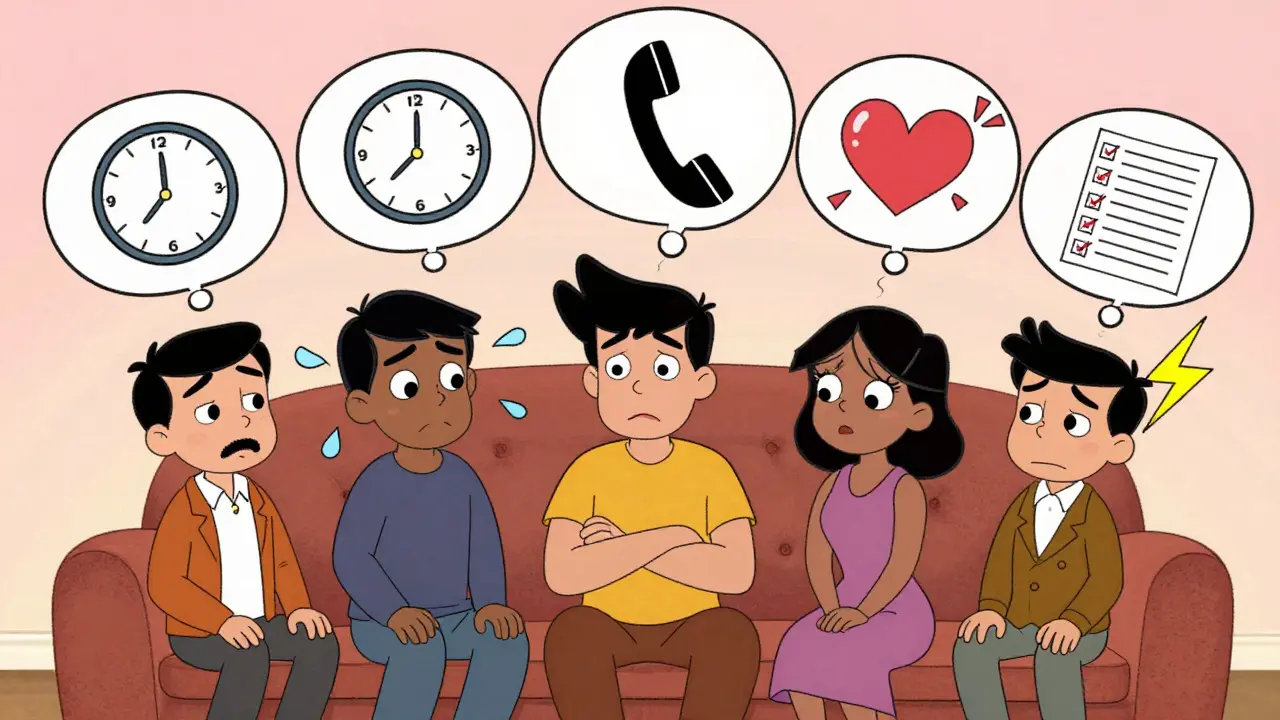
More than 1 in 5 adults in the U.S. deals with an anxiety disorder every year. It’s not just feeling stressed before a presentation or nervous about a job interview. This is constant, overwhelming fear that shows up even when there’s no real danger. It keeps you up at night, makes your heart race for no reason, and turns simple tasks like answering a phone call or walking into a store into exhausting battles. The good news? We know exactly what works.
What Are the Main Types of Anxiety Disorders?
Anxiety isn’t one thing. It comes in different shapes, each with its own triggers and patterns. The DSM-5, the standard guide used by clinicians worldwide, lists seven major types.
Generalized Anxiety Disorder (GAD) is the most common. People with GAD worry constantly-about work, health, bills, even things that haven’t happened yet. It’s not just being cautious. It’s needing to check things 10 times, replaying conversations in your head for hours, and feeling physically tense all day. To be diagnosed, this has to happen more days than not for at least six months.
Panic Disorder hits like a thunderclap. One minute you’re fine, the next you’re gasping for air, your chest feels like it’s being crushed, your hands shake, and you’re sure you’re having a heart attack. These panic attacks come out of nowhere. After one, you start fearing the next one-so you avoid places, people, or situations that might trigger it. That’s when it becomes a disorder.
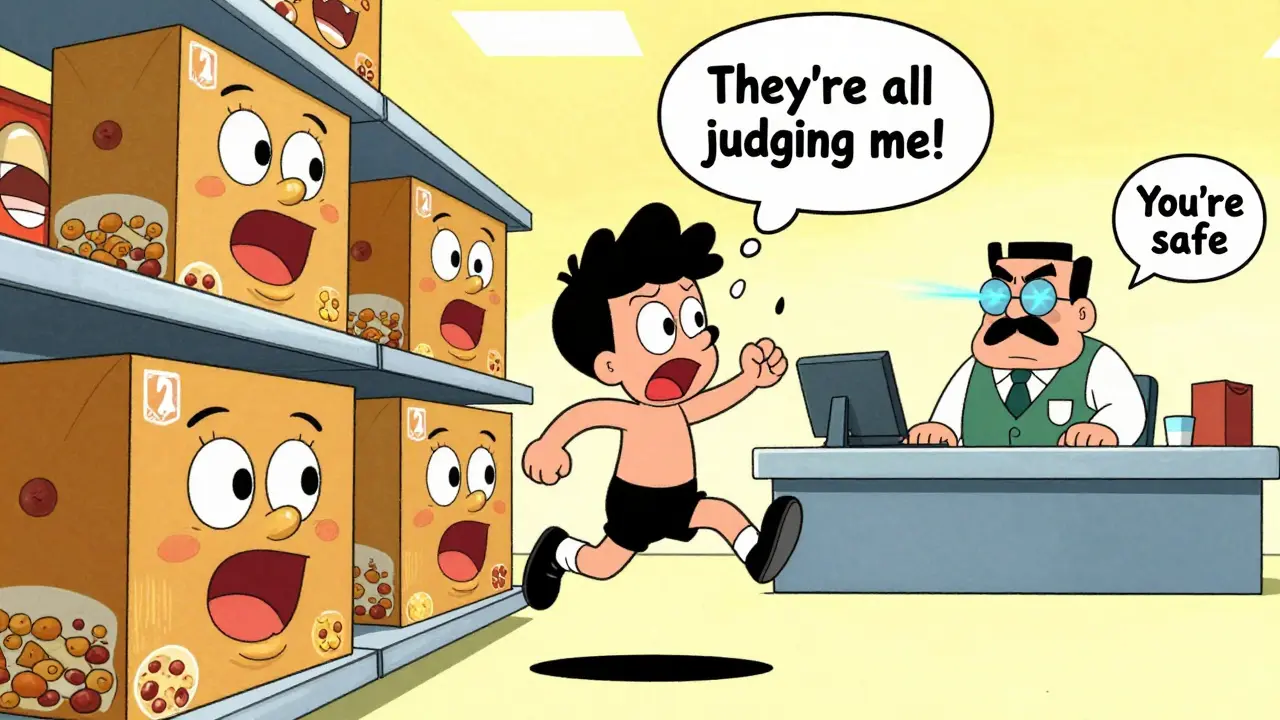
Social Anxiety Disorder isn’t just shyness. It’s the terror of being judged, embarrassed, or humiliated in everyday situations. Ordering coffee, speaking up in a meeting, or even making eye contact can feel unbearable. People with this condition often stay silent, avoid parties, or quit jobs because the fear outweighs the reward.
Specific Phobias are intense fears of particular things-spiders, heights, flying, needles. The fear is out of proportion to the actual danger. Someone might refuse to fly for 20 years because of a fear of turbulence, even though flying is statistically safer than driving.
Separation Anxiety Disorder isn’t just for kids. Adults can feel extreme distress when separated from loved ones-even if they’re safe and the separation is temporary. This can show up as constant texting, refusing to travel, or panic when a partner leaves the room.
Obsessive-Compulsive Disorder (OCD) used to be grouped with anxiety disorders. Now it’s its own category, but the link is clear. It’s not just being neat. It’s having intrusive, unwanted thoughts (obsessions) that cause intense anxiety, followed by repetitive behaviors (compulsions) to calm it down-like washing hands until they bleed or checking locks 50 times.
Selective Mutism mostly affects children. They speak normally at home but stay completely silent in school or social settings. It’s not defiance. It’s paralysis from anxiety.
What Do Anxiety Symptoms Actually Look Like?
Anxiety doesn’t just live in your head. It lives in your body too. Here’s what most people experience:
- Physical: Heart rate spikes to 110-140 beats per minute during panic attacks. Sweating (92% of panic disorder cases), trembling (87%), shortness of breath (83%), dizziness (76%), nausea (68%), muscle tension, and headaches are common.
- Cognitive: Racing thoughts (82%), trouble concentrating (89%), catastrophic thinking (‘I’m going to die,’ ‘Everyone hates me’), and constant rumination (91% of GAD patients replaying past mistakes).
- Emotional: Feeling like something terrible is about to happen (95% during panic attacks), excessive worry that doesn’t match reality (100% in GAD), and fear of losing control.
These symptoms aren’t ‘in your head’-they’re real, measurable biological responses. Your nervous system is stuck in fight-or-flight mode, even when there’s no tiger in the room.
What Treatments Actually Work?
There’s no magic pill. But there are two treatments backed by decades of research and proven to change lives: cognitive behavioral therapy (CBT) and SSRIs.
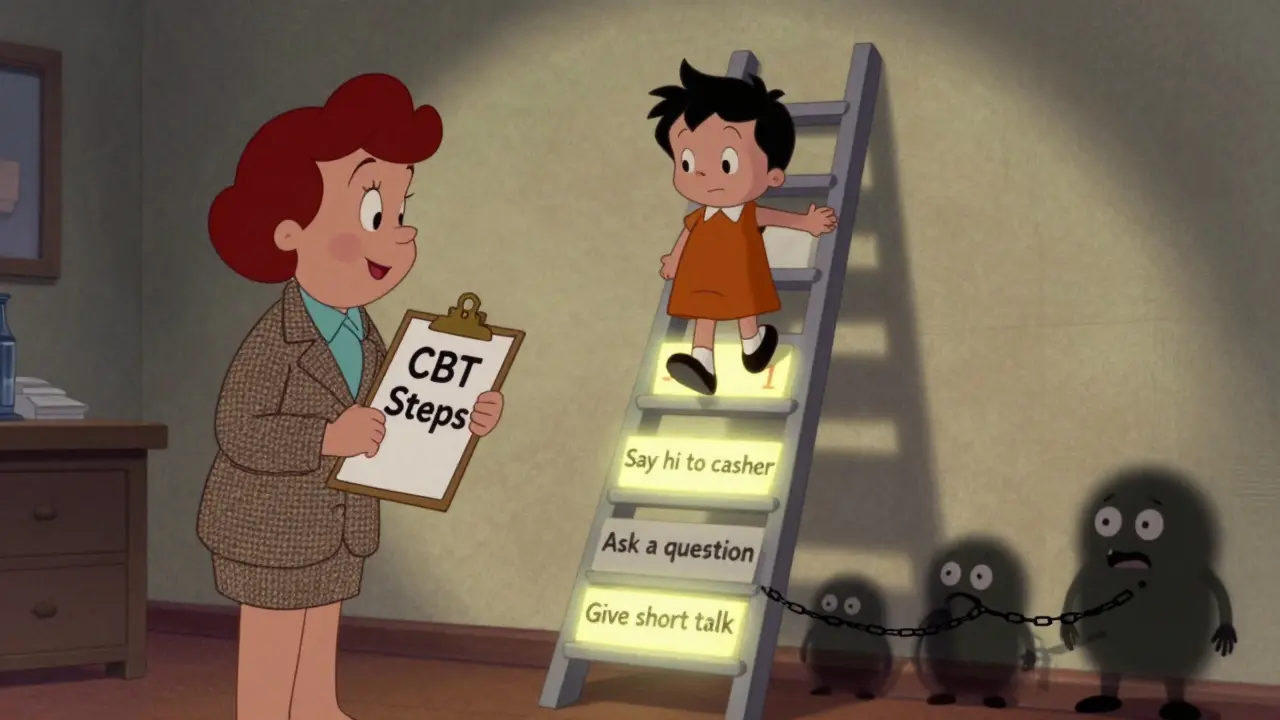
CBT is the gold standard. It teaches you to recognize distorted thoughts, challenge them, and gradually face fears instead of avoiding them. For example, someone with social anxiety might start by saying hello to a cashier, then move to asking a question in a small group, then giving a short presentation. This is called exposure therapy-and it’s not easy. Many people feel worse before they feel better. But studies show 60-80% of people with phobias and social anxiety see major improvement after 12-20 sessions.
SSRIs like sertraline (Zoloft) and fluoxetine (Prozac) are the first-line medications. They don’t make you ‘happy.’ They help calm the nervous system so you can actually use the tools from therapy. It takes 4-8 weeks to work. Side effects like nausea or sleep changes are common at first but usually fade. Response rates? 40-60% of people see significant symptom reduction.
Why not benzodiazepines like Xanax? They work fast-within minutes. But they’re addictive. Up to 30% of people who use them long-term become dependent. They also cause brain fog and increase fall risk in older adults. Doctors now avoid them for chronic anxiety.
What About Newer Treatments?
The field is moving fast. In 2023, the FDA approved zuranolone (Zurzuvae), the first oral drug specifically for postpartum anxiety. It works differently than SSRIs-targeting brain receptors that regulate stress response-and showed 54% remission in clinical trials.
Acceptance and Commitment Therapy (ACT) is now considered just as effective as CBT. Instead of fighting thoughts, ACT teaches you to notice them without judgment and focus on actions that align with your values. ‘I’m having the thought that I’ll fail,’ you say. ‘Okay. What’s one small thing I can do anyway?’
Digital tools are filling gaps. Apps like nOCD and Wysa offer guided CBT exercises. In 8 weeks, users report 35-45% symptom reduction with just 20-30 minutes a day. Medicare now covers two of these platforms, reimbursing $120-$180 per module.
Early research on ketamine-assisted therapy is promising. In 2022, a JAMA Psychiatry study found 65% of treatment-resistant anxiety patients had rapid relief after just a few sessions. It’s still experimental, but it’s giving hope to people who’ve tried everything else.
Why Do So Many People Still Struggle?
Even with proven treatments, only 37% of people achieve remission after six months. Why?
- Access: The average wait for a specialized therapist is 6-8 weeks. In rural areas, it’s longer.
- Cost: Insurance often limits therapy sessions. Out-of-pocket costs for 20 sessions can hit $2,000.
- Side effects: Some people stop SSRIs because they feel emotionally numb. Others can’t tolerate the initial nausea or insomnia.
- Exposure is hard: ‘I want to get better, but facing my fear feels like torture,’ says one Reddit user. That’s normal. The discomfort is part of the healing.
Combining therapy and medication works best. A 2023 NAMI survey found 58% of people improved with both, compared to 42% with meds alone and 38% with therapy alone.
What Can You Do Right Now?
You don’t need to wait for a therapist to start feeling better.
- Practice diaphragmatic breathing: Breathe in slowly through your nose for 5 seconds, hold for 2, then out through your mouth for 6. Do this 5 times. It signals your body you’re safe.
- Write down your thoughts: When you’re spiraling, write: ‘What’s the evidence for this thought? What’s a more realistic version?’
- Use a free app: Try nOCD or Pacifica for guided exposure exercises.
- Reach out: Call NAMI’s 24/7 helpline. Talk to someone who gets it.
Recovery isn’t linear. Some days will feel like progress. Others will feel like backsliding. That’s okay. What matters is you keep showing up-for yourself, even when it’s hard.
What’s the Long-Term Outlook?
Anxiety disorders are treatable. Not curable, but manageable. People who stick with treatment live full lives-work, relationships, travel, joy. The stigma is fading. More people now see anxiety as a medical condition, not a weakness.
Looking ahead, precision medicine is coming. By 2030, genetic testing may tell your doctor which medication is right for you-cutting out months of trial and error. AI tools are already predicting panic attacks 24 hours in advance with 87% accuracy.
You’re not broken. You’re not alone. And there’s a clear, science-backed path forward.
Can anxiety disorders go away on their own?
Sometimes symptoms improve temporarily, but anxiety disorders rarely disappear without treatment. Avoiding triggers might give short-term relief, but it often makes the fear worse over time. Evidence-based treatments like CBT and medication address the root causes, not just the symptoms.
Is medication necessary for anxiety?
No, but it helps-especially for moderate to severe cases. Many people do well with CBT alone. Others need medication to reduce physical symptoms enough to engage in therapy. It’s not about weakness. It’s about giving your brain the chemical support it needs to heal.
How long does CBT take to work?
Most people start noticing changes in 4-6 weeks. Significant improvement usually happens by session 12. Full benefits often take 12-20 weekly sessions. Consistency matters more than speed. Skipping sessions or avoiding exposure slows progress.
Can children have anxiety disorders?
Yes. Half of all anxiety disorders begin by age 11. Symptoms in kids might look like tantrums, school refusal, or excessive clinginess. Early intervention with CBT adapted for children is highly effective and can prevent lifelong struggles.
What’s the difference between normal worry and an anxiety disorder?
Normal worry is temporary and proportional. Anxiety disorders involve persistent, excessive fear that lasts for months, interferes with daily life, and causes physical symptoms. If your worry keeps you from working, sleeping, or spending time with loved ones, it’s likely more than just stress.
Are anxiety disorders genetic?
Genetics play a role-people with close relatives who have anxiety are 2-3 times more likely to develop it. But environment matters too. Trauma, chronic stress, or early life adversity can trigger anxiety even without a family history. It’s a mix of biology and experience.
Can I use alcohol or weed to manage anxiety?
They might seem to help in the moment, but both worsen anxiety over time. Alcohol disrupts sleep and lowers serotonin. Cannabis can trigger panic attacks in sensitive people. Relying on substances delays real healing and increases the risk of addiction.
Where can I find a qualified therapist?
Start with the Anxiety and Depression Association of America’s directory or Psychology Today’s therapist finder. Look for someone who specializes in CBT or ACT and has experience treating your specific type of anxiety. Ask if they offer a free 15-minute consultation.
Annie Choi
January 16, 2026Just had a panic attack before my Zoom meeting today and I did the 5-2-6 breathing thing from the post-holy shit it worked. Felt like someone flipped a switch in my chest. Thanks for listing the actual stats, this isn’t just fluff.
Ayush Pareek
January 16, 2026Been doing CBT for 8 months. The first 3 were brutal. Felt like I was tearing my brain apart. But now I can walk into a grocery store without sweating through my shirt. It’s not magic. It’s muscle. And you gotta lift even when your arms are shaking.
Nishant Garg
January 17, 2026In India, anxiety is still called 'stress' or 'overthinking'-like it's a luxury problem. My cousin had OCD and was told to 'pray more' and 'stop being weak'. No one knew SSRIs could help. Now she’s on sertraline and actually laughs again. Cultural stigma kills more than the disorder sometimes. We need more voices like this, especially in places where therapy is a dirty word.
Frank Geurts
January 19, 2026It is imperative to note, with the utmost gravity, that the statistical prevalence of anxiety disorders-specifically, the 1 in 5 adult cohort-is not merely a sociological observation, but a public health emergency of quantifiable magnitude. Furthermore, the empirical efficacy of CBT, as corroborated by meta-analyses published in JAMA and The Lancet, constitutes the gold standard of intervention, and any deviation therefrom constitutes a dereliction of clinical duty.
Arjun Seth
January 20, 2026Everyone’s just taking pills now. No discipline. No willpower. Back in my day, we just held our breath and pushed through. You think your heart races? Good. That means you’re alive. Stop coddling yourself with apps and breathing exercises. Real men don’t need Zoloft.
Mike Berrange
January 20, 2026Why are you all acting like this is new information? I’ve been reading about CBT since 2007. And why does everyone ignore the fact that SSRIs make people emotionally numb? I took Prozac for 18 months. I stopped crying… but I also stopped feeling joy. This article feels like a pharmaceutical ad.
Amy Vickberg
January 22, 2026Thank you for writing this. I’ve been too scared to say it out loud, but I have separation anxiety. My partner left for a weekend trip last month and I called them 47 times. I cried every night. I thought I was broken. Turns out I’m just wired this way-and there’s a name for it. That’s the first time I didn’t feel alone.
Tom Doan
January 22, 2026So… you’re telling me the same treatment that works for panic attacks also works for someone who’s terrified of elevators? Interesting. So if I’m afraid of spiders, I just… stare at one until I stop shaking? Sounds like a bad horror movie plot. But hey, if it works.
Sohan Jindal
January 22, 20261 in 5 Americans has anxiety? That’s because the government is pumping fluoride and 5G into the water. They want us docile. CBT? That’s just brainwashing with a fancy name. SSRIs? Big Pharma’s latest scam. Real freedom is ignoring fear. Not medicating it away.
Iona Jane
January 23, 2026They didn’t mention the real cause: the corporate machine. You’re anxious because your job hates you. Your rent’s too high. Your phone’s always buzzing. This isn’t a disorder-it’s a rebellion your body’s having. They want you to take a pill so you go back to scrolling and working 70 hours. Wake up.
Jaspreet Kaur Chana
January 23, 2026Bro I used to think anxiety was just for rich white people with too much time on their hands. Then I saw my little sister freeze in class because she couldn’t answer a question. She’s 13. She didn’t even know what to call it. We found nOCD on YouTube. Now she does 10 minutes a day. She raised her hand in class last week. I cried. Not because she’s ‘fixed’-but because she finally feels like she’s not a ghost.
ellen adamina
January 24, 2026Diaphragmatic breathing works. I do it before every shift at the ER. I also write down the thought: 'I’m going to mess up this patient' and then write: 'I’ve done 327 shifts without a single error. What’s the evidence I’ll fail now?' It’s stupid simple. But it stops the spiral.
Gloria Montero Puertas
January 24, 2026Let’s be honest-this article is a bit… basic. The DSM-5? Outdated. ACT? Overrated. You’re not even mentioning neurofeedback or transcranial magnetic stimulation. And why no mention of the gut-brain axis? The real breakthroughs are in microbiome modulation and vagus nerve stimulation. This reads like a college freshman’s term paper.