
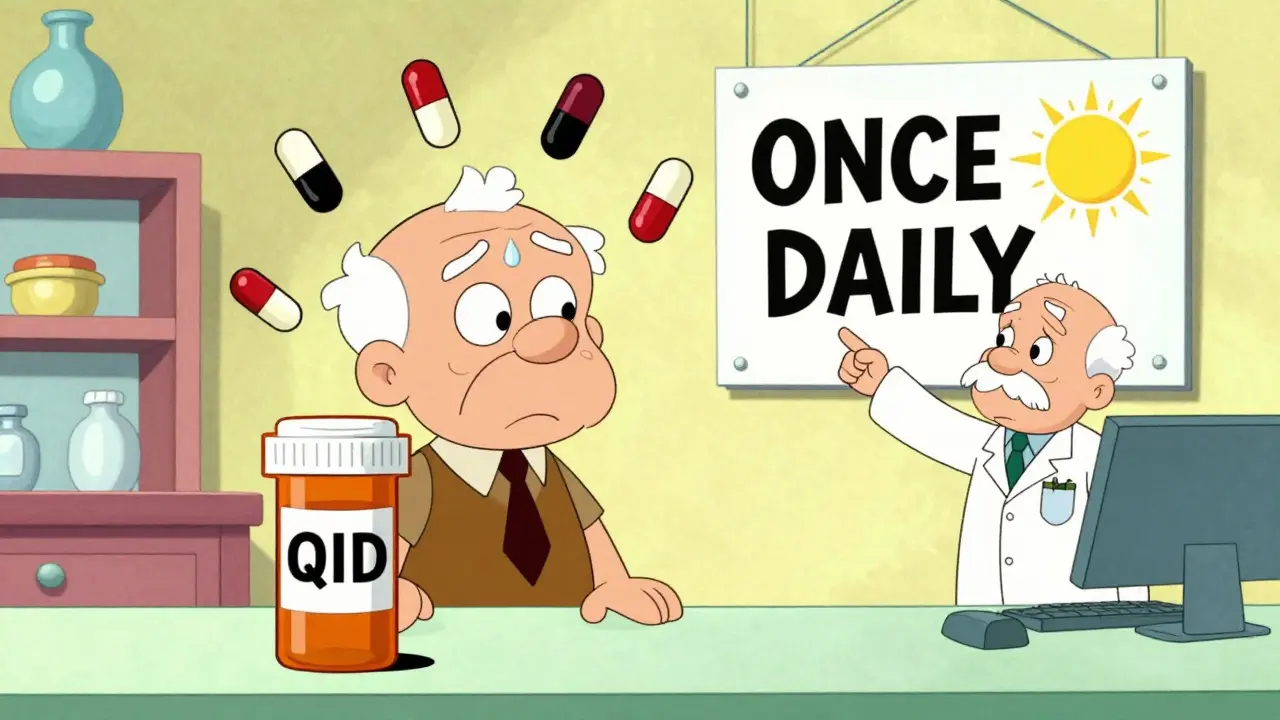
Imagine taking a pill four times a day when your doctor only meant for you to take it once. That’s not a hypothetical. It’s happened. And it’s not rare. The confusion between QD and QID - two tiny abbreviations that look almost identical - leads to real harm, hospitalizations, and even deaths. These aren’t just letters. They’re life-or-death instructions that millions of people misread every year.
What QD and QID Actually Mean (And Why It Matters)
QD stands for quaque die, Latin for “once daily.” QID means quater in die, or “four times daily.” Simple, right? But in handwritten prescriptions, or when squinting at a blurry digital screen, those two letters can blur together. A quick glance, a tired pharmacist, or a distracted nurse can turn a safe dose into a dangerous one.
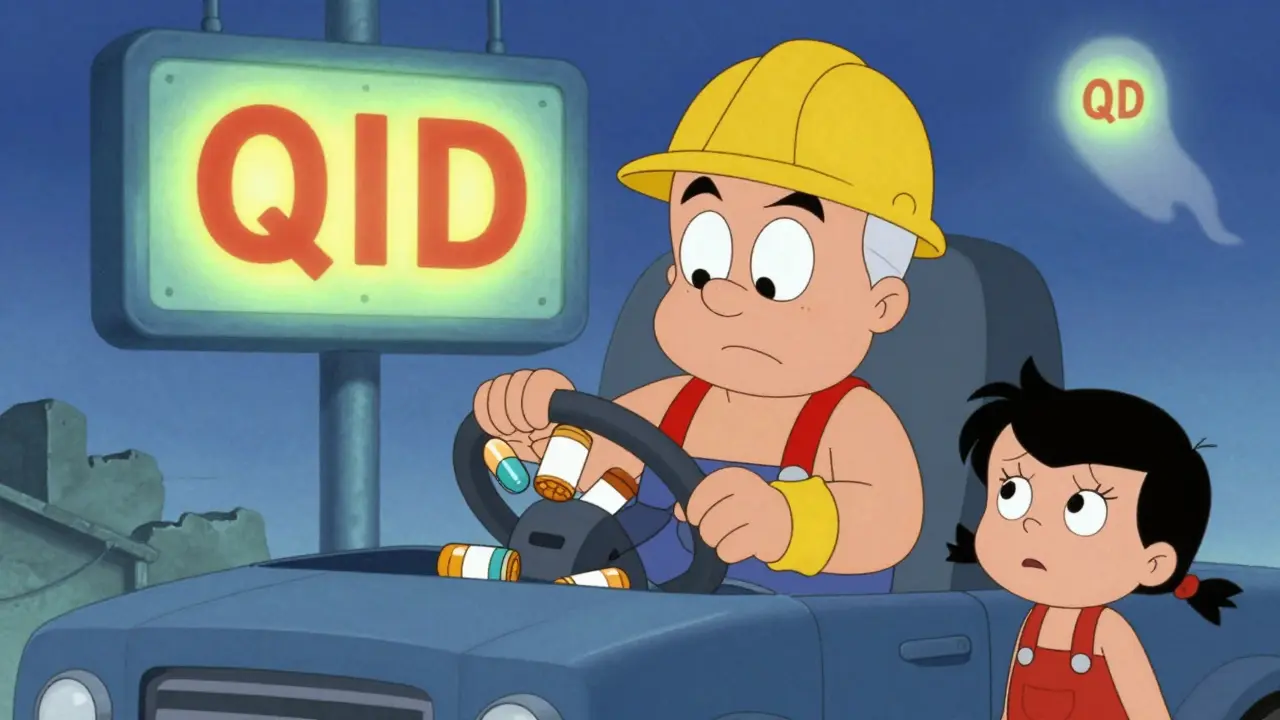
When a patient takes a medication meant for once daily - like a blood thinner or a sedative - four times a day, the drug builds up in their system. One documented case involved a construction worker who took his medication four times daily for a full week. He was driving with his 7-year-old daughter, barely able to stay awake. He didn’t realize anything was wrong until he went back for a refill and the pharmacist caught it. That’s not an outlier. It’s a pattern.
QID doesn’t mean every six hours. It means four times during waking hours - say, 7 AM, 1 PM, 7 PM, and 11 PM. But patients often assume it’s every six hours, which can lead to nighttime doses that disrupt sleep or increase side effects. Even BID (twice daily) and TID (three times daily) are misinterpreted. But QD and QID? They’re the most dangerous pair.
Why This Mistake Keeps Happening
These abbreviations have been around for centuries. Doctors learned them in medical school. Pharmacies printed them on labels. Patients saw them on bottles. They became normal. But in the 2000s, safety experts started sounding the alarm. The Institute for Safe Medication Practices (ISMP) flagged them as high-risk in 2001. The Joint Commission added them to their “Do Not Use” list in 2004. Yet, over 20 years later, they’re still everywhere.
A 2015 AMA report found that 30% of handwritten prescriptions still used QD and QID. Even today, 31% of community pharmacies in the U.S. still get handwritten scripts with these abbreviations - mostly from small practices that haven’t switched to electronic systems. In those cases, a doctor’s sloppy handwriting turns “QD” into “QID” before it even reaches the pharmacy.
Electronic health records (EHRs) were supposed to fix this. Most now have alerts that flag QD or QID. But here’s the problem: providers can still override them. A 2021 AHRQ study found that 3.8% of errors in EHR systems still came from providers manually typing in these abbreviations. Why? Because it’s faster. Because it’s habit. Because they don’t think it matters.
Who Gets Hurt the Most
The people most at risk? Older adults. People over 65 make up 68% of all documented cases of QD/QID confusion. Why? They’re often on five, six, or more medications. Their memory isn’t what it used to be. They might not read the label closely. They trust the pharmacist. They trust the doctor. And when the label says “QID,” they assume it’s correct.
One patient in a 2022 Healthgrades review took warfarin - a blood thinner - four times daily instead of once. Her INR (a measure of blood clotting) spiked to 12.3. Normal is 2-3. She nearly bled out. She ended up in the hospital. That’s not an exaggeration. That’s a real case from Reddit’s r/medicine forum.
A 2021 survey by the National Patient Safety Foundation found that 63% of patients admitted they’d been unsure about how often to take a medication at least once. QD vs. QID ranked as the third most confusing instruction - right after “take with food” and “take on empty stomach.” That’s not just inconvenient. That’s deadly.
How the System Is Trying to Fix It
Change is happening - slowly. In 2023, the American Medical Association updated its prescribing guidelines to require writing “daily” instead of “QD.” The FDA’s new draft guidance says Latin abbreviations should be banned entirely from prescriptions. Epic and Cerner, the two biggest EHR platforms, now have hard stops. If you type “QD” or “QID,” the system won’t let you save the prescription. You have to type out “once daily” or “four times daily.”
Hospitals that made this switch saw a 42% drop in dosing errors within a year. The National Action Alliance for Patient Safety launched the “Clear Communication Campaign” in April 2023 with $45 million in funding to eliminate these errors by 2026. That’s a big deal.
One of the most effective fixes? Pharmacists calling patients to confirm dosing. The University of Michigan found that when pharmacists verbally verified every new prescription, errors dropped by 67%. That’s not expensive. It’s not complicated. It’s just human.
What You Can Do to Protect Yourself
You don’t have to wait for the system to fix itself. Here’s what you can do right now:
- Always ask: “Is this supposed to be once a day or four times a day?” Don’t assume. Say it out loud.
- Read the label twice. If it says “QD” or “QID,” write it out: “once daily” or “four times daily.”
- Use a pill organizer. Fill it yourself with instructions written in plain language. Don’t let the pharmacy’s label be your only guide.
- Take a picture. Snap a photo of the prescription label and send it to a family member. Ask them: “Does this make sense?”
- Know your meds. If you’re on blood thinners, diabetes meds, or sedatives, a dosing error can kill you. Be extra careful.
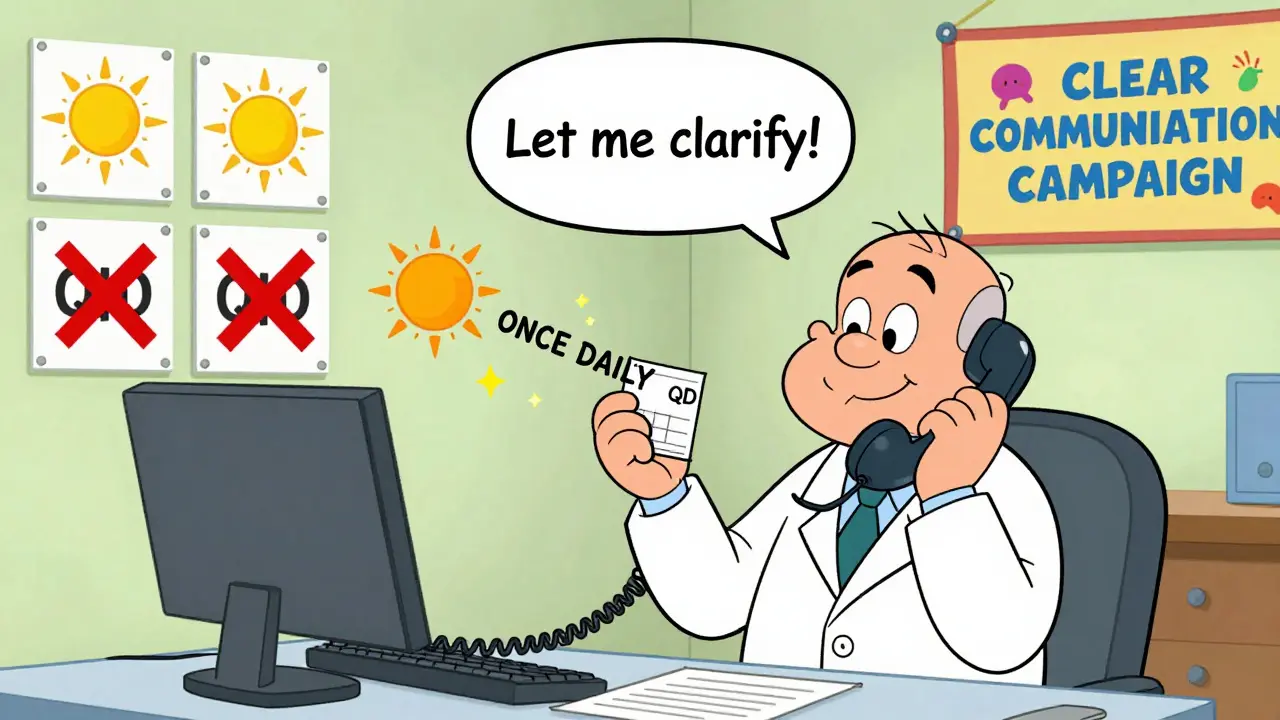
Visual aids help too. A Johns Hopkins study in 2023 showed that adding simple icons - like a sun for “once daily” and four suns for “four times daily” - cut confusion by 82%. Some pharmacies are starting to do this. Ask yours if they can add pictures to your labels.
The Bigger Picture
This isn’t just about letters. It’s about how we treat safety in healthcare. We’ve known for over 20 years that QD and QID are dangerous. We’ve had the technology to fix it. We’ve had the evidence. But we kept waiting. We kept assuming people would “just know.”
The cost? Over $780 million a year in the U.S. alone - just for errors caused by confusing dosing instructions. That’s not just money. It’s hospital stays. It’s lost work. It’s families scared for their loved ones.
Every time you ask a pharmacist to clarify a prescription, you’re not being difficult. You’re saving a life. Every time a doctor writes “daily” instead of “QD,” they’re choosing safety over speed. And every time a system blocks those abbreviations, it’s saying: we won’t let this happen anymore.
Medication errors don’t have to be inevitable. They’re preventable. But only if we stop pretending that tiny abbreviations are harmless. They’re not. They’re a ticking clock.

Chloe Hadland
January 23, 2026I had no idea QD and QID could be so dangerous. My grandma took her blood pressure med wrong for months because of this. She’s fine now but we always read the label out loud together now. So simple but so life-changing.
Thanks for sharing this.
Amelia Williams
January 24, 2026I work in a pharmacy and we still get handwritten scripts with QID all the time. One guy came in asking why his sleep med was making him dizzy at 3am - turned out he thought QID meant every 6 hours. We had to call the doctor. He apologized and said he didn’t even know it was Latin. Honestly? Most patients don’t. We started printing ‘once daily’ in bold now. Small change, huge difference.
Viola Li
January 24, 2026This is such a basic issue. Why are we still having this conversation in 2025? It’s not rocket science. If you can’t write ‘once daily’ instead of QD, maybe you shouldn’t be writing prescriptions. This isn’t a system failure - it’s a laziness failure.
Dolores Rider
January 24, 2026I think the FDA and AMA are hiding something. Why do they still allow EHRs to be overridden? Someone’s making money off these errors. Big Pharma? Hospitals? I’ve seen the invoices - the same meds cost 3x more when you’re admitted for an overdose from a misread script. Coincidence? I don’t think so. 🤔👁️
venkatesh karumanchi
January 24, 2026In India, we use 'OD' and 'QID' too. But most patients don't read labels at all. They trust the doctor. We started using color-coded stickers - red for once daily, green for four times. People remember colors better than letters. It works. Simple. No tech needed.
Sharon Biggins
January 25, 2026i just had to call my drs office because i saw qd on my pill bottle and thought it was qid… i took it 4 times by accident for 2 days. i felt so stupid but then i realized i’m not the only one. my mom did the same thing with her heart med. we need pictures on labels. like actual icons. not just words. please.
John McGuirk
January 25, 2026Let’s be real. This isn’t about Latin. It’s about control. The system wants you confused so you keep coming back. More pills. More visits. More profit. You think they’d fix QD/QID? Nah. They’d rather you die quietly than lose the revenue stream. Wake up.
Michael Camilleri
January 27, 2026People think healthcare is about healing but it’s really about obedience. You’re not supposed to question QD or QID. You’re supposed to swallow the pill and shut up. The fact that you’re reading this means you’re already ahead of 90% of the population. Most people don’t even know they’re being manipulated by 17th century Latin. The system thrives on ignorance. Don’t be part of it.
lorraine england
January 28, 2026I love that some pharmacies are adding icons. My cousin’s kid has autism and can’t read labels at all - but he knows the sun means once a day. We started asking for picture labels on all his meds. The pharmacist said they’re rolling it out next month. Small wins, right? Keep pushing for this stuff. It matters.