
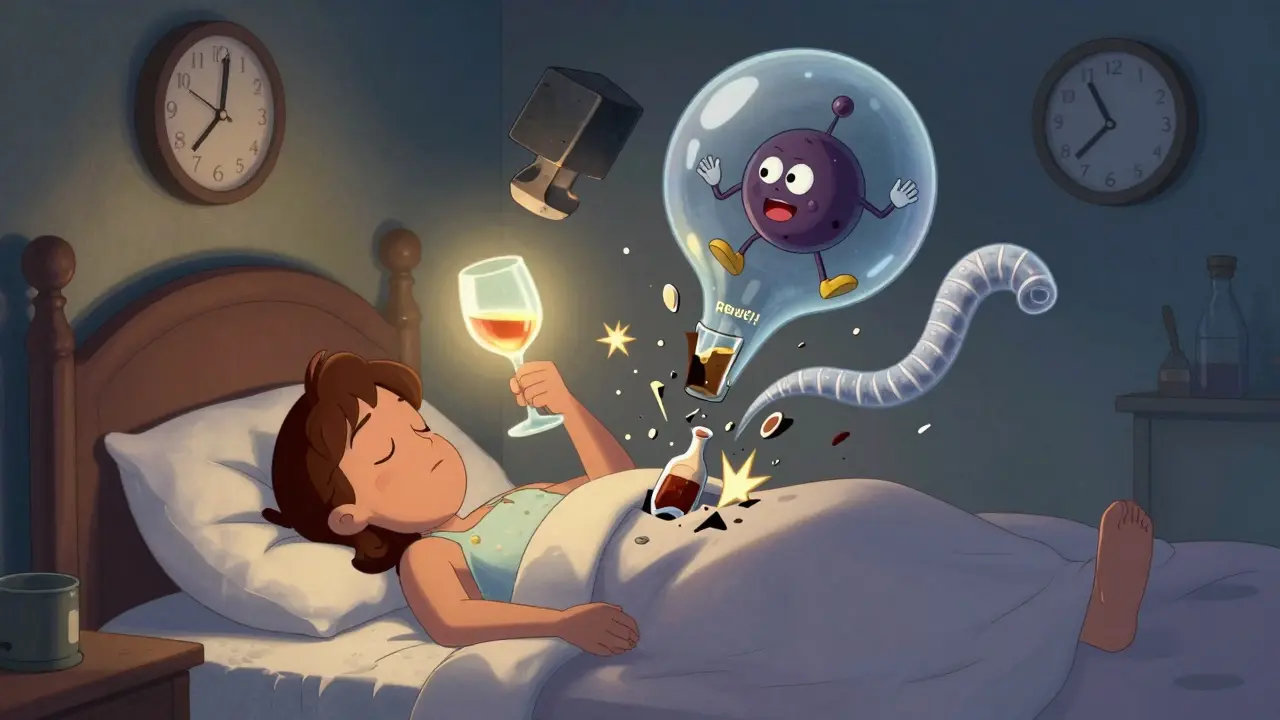
Many people reach for a glass of wine or a nightcap before bed, convinced it helps them unwind and fall asleep faster. But what if that drink is actually sabotaging your sleep - not just a little, but in ways you can’t even feel? The truth is, alcohol doesn’t improve sleep. It tricks your brain into thinking it does, then tears apart the restorative processes you need to wake up refreshed. If you’ve ever woken up at 3 a.m. wide awake after drinking, felt foggy the next morning, or noticed your snoring got worse, this isn’t coincidence. It’s biology.
How Alcohol Changes Your Sleep Architecture
Your sleep isn’t just one long stretch of darkness. It cycles through stages: light sleep, deep sleep, and REM sleep - the stage where dreams happen and your brain sorts memories and emotions. Alcohol messes with this cycle in a very specific way. Right after you drink, it boosts deep sleep (N3), the most physically restorative stage. That’s why you might feel drowsy and fall asleep quickly. But as your body metabolizes the alcohol - roughly one standard drink per hour - your brain starts to rebound. The deep sleep you got early gets replaced by lighter sleep and more wakefulness later in the night.
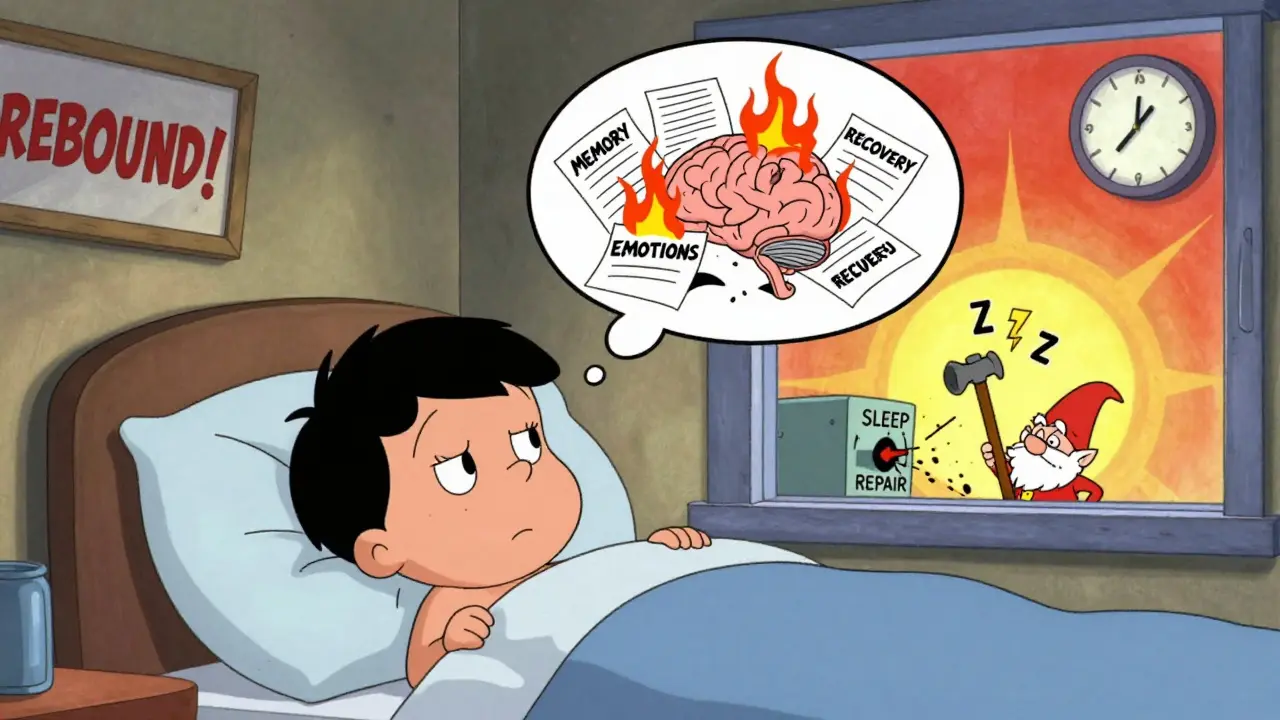
Studies using polysomnography - the gold standard for measuring sleep - show that even one drink can reduce REM sleep by 9.3% in the first half of the night. REM sleep is critical. It’s not just about dreaming. It’s how your brain processes stress, consolidates learning, and balances emotions. When you lose REM, you lose emotional resilience. That’s why people who drink before bed often report more nightmares, irritability, or anxiety the next day.
And here’s the kicker: by the time alcohol leaves your system - usually around 3 a.m. if you drank at 10 p.m. - your brain is still trying to recover from the chemical disruption. This triggers a surge in wakefulness, heart rate, and body temperature. The result? Fragmented sleep. You’re not just waking up once. You’re waking up multiple times, often without even realizing it. The National Sleep Foundation found that 67% of people who drink within two hours of bedtime experience at least one nighttime awakening, compared to just 39% of non-drinkers.
Alcohol and Sleep Apnea: A Dangerous Combo
If you snore or have been told you stop breathing at night, alcohol makes it worse. It relaxes the muscles in your throat - the same ones that keep your airway open while you sleep. When those muscles go limp, your airway collapses. That’s obstructive sleep apnea. Even one standard drink can increase your apnea-hypopnea index (AHI) by 20%. That means more pauses in breathing, more drops in oxygen, and more stress on your heart.
A 2022 meta-analysis in the Chest Journal found that drinking 2-4 drinks per day increases your risk of moderate-to-severe sleep apnea by 25%. With five or more drinks? Risk jumps to 51%. The American Thoracic Society recommends that anyone with sleep apnea avoid alcohol entirely within three hours of bedtime. Why? Because alcohol doesn’t just make apnea worse - it can reduce nighttime oxygen levels by 3-5 percentage points. That’s enough to strain your cardiovascular system, especially if you already have high blood pressure or heart issues.
And it’s not just for people with diagnosed apnea. Even healthy people who drink before bed show measurable increases in breathing disruptions. The muscles that keep your airway open don’t get a break. Over time, this can lead to chronic inflammation and worsening airway collapse - a silent, slow-motion health crisis.
Next-Day Effects: You’re Not Imagining the Fog
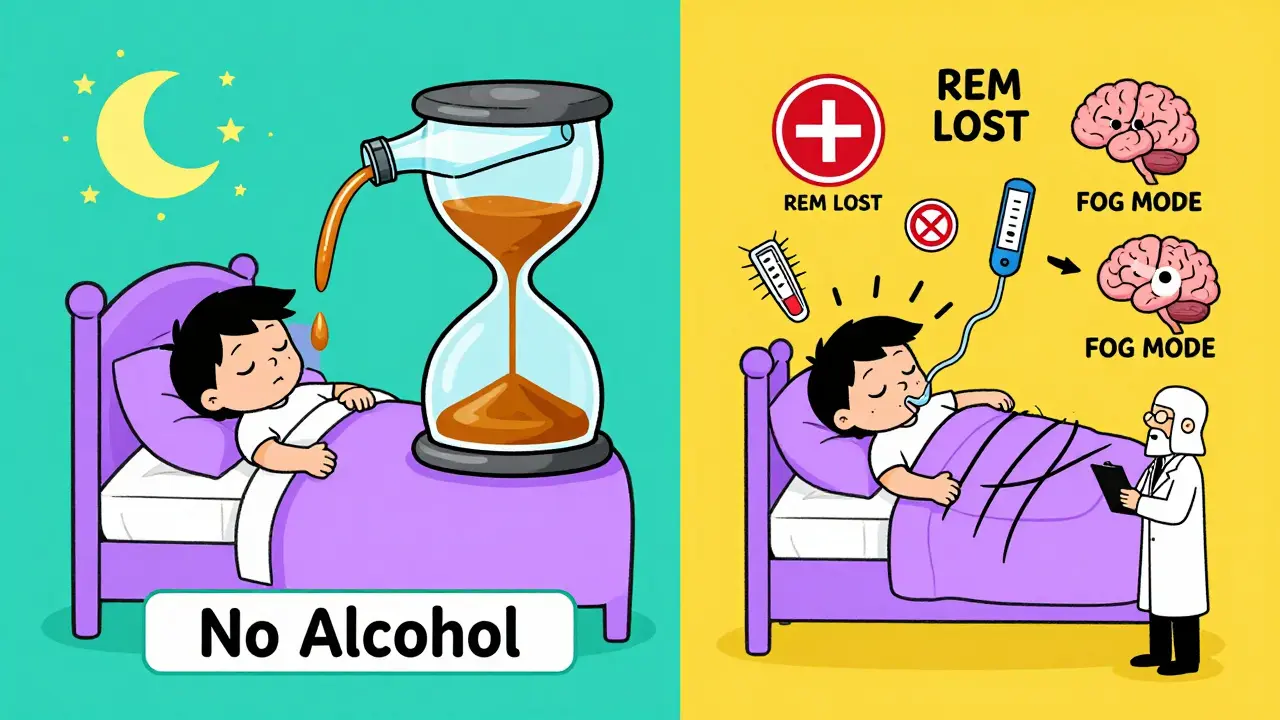
Most people think if they got 7 hours of sleep, they’re fine. But alcohol distorts sleep quality. You might have slept long enough, but you didn’t sleep well. A 2022 study in the Journal of Clinical Sleep Medicine found that after alcohol consumption, people lost 15.3% of their slow-wave sleep - the deepest, most restorative stage. That’s not just a number. That’s your brain’s chance to repair cells, clear toxins, and reset your immune system. Lose that, and you lose cognitive sharpness.
Here’s what that looks like in real life:
- 12.7% slower reaction time on tasks
- 9.4% reduction in working memory capacity
- 8.7% drop in cognitive performance, even if you didn’t feel tired
And it’s not just about focus. Your emotions take a hit too. Researchers at the University of Pittsburgh Medical Center found that after drinking, people showed 31.2% greater emotional reactivity to negative stimuli. That means a minor traffic jam, a critical email, or a child’s tantrum can feel like a personal attack. You’re not “in a bad mood.” Your brain is literally wired differently after alcohol-disrupted sleep.
Worse, most people don’t connect the dots. They think the foggy head, the irritability, the clumsiness - it’s just “one of those days.” But science shows it’s not. It’s the direct result of alcohol’s impact on sleep architecture. And it’s happening even with just one drink.
The Tolerance Trap: Why You Keep Drinking
Here’s the vicious cycle: You drink to sleep better. It works - at first. But after 3 to 7 days of regular use, your body builds tolerance. The sedative effect fades. You need more alcohol to get the same drowsiness. Then, as your tolerance grows, your sleep gets worse. You wake up more. Your REM sleep shrinks. You feel worse in the morning. So you drink again. And again.
Research from the University of Missouri shows this isn’t just psychological. It’s neurological. Alcohol disrupts adenosine, the brain chemical that naturally builds up during the day to make you sleepy. Normally, adenosine levels rise slowly, then drop during sleep. Alcohol floods your system with adenosine early, then crashes it later. Your brain doesn’t know how to reset. So it craves more alcohol to recreate that initial drowsiness.
This is why so many people with alcohol use disorder struggle with insomnia during recovery. Their brain has forgotten how to sleep without the chemical crutch. The National Institute on Alcohol Abuse and Alcoholism reports that 50-70% of people in early recovery experience severe sleep disturbances - and it can take 3 to 6 months just for sleep patterns to stabilize.
Long-Term Risks: More Than Just a Bad Night
One night of poor sleep? Annoying. But doing this every week? That’s a slow burn on your brain and body.
A 36-year longitudinal twin study found that heavy drinkers were over three times more likely to report poor sleep quality than non-drinkers. And the risk didn’t fade with age. In fact, the strongest link was seen in people in their 30s - the exact age when people often think they’re “too busy” to care about sleep.
And then there’s the long game. A 2023 study in Sleep Medicine Reviews found that regular alcohol use before bed increases your risk of chronic insomnia by 38%. That’s not a small increase. That’s a clinical diagnosis waiting to happen.
For older adults, the damage is even clearer. The American Academy of Neurology found that regular pre-sleep alcohol consumption accelerates cognitive decline by 23% over five years. That’s not just forgetfulness. That’s faster erosion of memory, reasoning, and decision-making - the very things that keep you independent as you age.
And let’s not forget the emotional toll. Poor sleep from alcohol doesn’t just make you tired. It makes you more anxious, more reactive, more prone to depression. The National Council on Aging links chronic REM deprivation to emotional instability and even reduced longevity. Your sleep isn’t just about rest. It’s about survival.
What Should You Do?
It’s not about perfection. It’s about awareness.
- If you drink, stop at least 3 hours before bed. That gives your body time to metabolize most of it.
- One drink is still one too many if you care about sleep quality. Even a single glass of wine reduces REM sleep and increases fragmentation.
- If you have sleep apnea, avoid alcohol entirely. It’s not a suggestion - it’s a medical recommendation.
- If you rely on alcohol to fall asleep, talk to a doctor. This isn’t weakness. It’s a sign your brain is out of balance.
There’s no such thing as a “good” nightcap. No dose of alcohol improves sleep. Not one. Not even a sip. The science is clear: alcohol disrupts sleep architecture, worsens apnea, fragments your rest, and leaves you worse off in the morning - even if you think you slept fine.
Try this: For one week, don’t drink within 3 hours of bedtime. Notice how you feel in the morning. Are you less foggy? Less irritable? Do you wake up less often? You might be surprised. Your brain has been waiting for this reset.
Does alcohol help you fall asleep faster?
Yes, alcohol can reduce sleep latency - the time it takes to fall asleep - especially in the first 1-2 hours after consumption. However, this initial sedation is misleading. As alcohol metabolizes, it causes sleep fragmentation, reduces REM sleep, and leads to more awakenings later in the night. The net effect is poorer overall sleep quality, even if you fall asleep quickly.
Can one drink affect sleep?
Yes. Even one standard drink (like a 5-ounce glass of wine) reduces REM sleep by 9.3% and increases sleep fragmentation by 11.7%, according to a 2021 review by the European Sleep Research Society. The effects are measurable, even at low doses, and impact emotional regulation and next-day cognitive performance.
Does alcohol worsen sleep apnea?
Yes. Alcohol relaxes throat muscles, increasing the risk of airway collapse during sleep. Each standard drink consumed before bed raises the apnea-hypopnea index (AHI) by about 20%. For people with existing sleep apnea, even one drink can reduce nighttime oxygen levels by 3-5 percentage points, increasing strain on the heart and lungs.
Why do I wake up at 3 a.m. after drinking?
Alcohol is metabolized at about one standard drink per hour. If you drink at 10 p.m., your blood alcohol level drops near zero by 3 a.m. This triggers a rebound effect: your brain, which was suppressed by alcohol, becomes overactive. This leads to increased wakefulness, elevated heart rate, and lighter sleep stages - all of which cause sudden awakenings you may not remember.
Does alcohol cause insomnia?
Yes. Regular alcohol use before bed increases the risk of chronic insomnia by 38%, according to a 2023 study in Sleep Medicine Reviews. This is especially true for middle-aged adults. Alcohol disrupts sleep homeostasis and creates a dependency cycle where the body needs alcohol to initiate sleep, making natural sleep harder over time.
How long does it take for sleep to recover after stopping alcohol?
For non-dependent individuals, sleep architecture can begin improving within days, but full recovery - especially REM sleep normalization - can take 3 to 6 months. For people with alcohol use disorder, sleep disturbances often persist during early abstinence, with 50-70% experiencing clinically significant insomnia. Recovery requires time, and in some cases, medical support.

Prateek Nalwaya
February 18, 2026So let me get this straight - we’re told alcohol helps us sleep, but science says it’s just a sneaky liar? I’ve been drinking a glass of wine every night for years thinking it’s my little ritual of peace. Turns out I’ve been sabotaging my brain’s cleanup crew. That 3 a.m. wake-up isn’t ‘stress’ - it’s my amygdala screaming for help. I’m cutting it out for a week and documenting everything. Who’s in?
Philip Blankenship
February 19, 2026Man, this hits different. I used to think I was just a light sleeper - turns out I was just drunk. One drink = 9% less REM? That’s like stealing a whole night of emotional processing. I’ve been waking up exhausted after 8 hours of sleep and blaming my job. No wonder I’ve been snapping at my kids over stupid stuff. I’m not ‘in a mood’ - my brain’s been on life support. I’m done. No more wine after 7 p.m. Ever. Even if it’s Friday. Even if it’s my birthday. Even if my therapist says I’m ‘allowed’.
Carrie Schluckbier
February 21, 2026Of course the government and Big Sleep™ want you to believe this. They’re terrified of people realizing alcohol isn’t the problem - it’s the sleep trackers, the blue light, the 5G towers, and the fluoride in the water. You think you’re waking up at 3 a.m. because of alcohol? Nah. That’s your body detoxing from the microchips they put in your vaccines. And don’t get me started on how the sleep study labs are funded by mattress companies. Wake up, sheeple.
Adam Short
February 22, 2026Y’all in the US act like this is some groundbreaking revelation. In the UK, we’ve known this since the 80s. My grandad drank a pint before bed every night - and woke up every hour like a clock. He called it ‘the bloody rhythm’. He never read a study, but he knew. Science just caught up. We didn’t need a 2023 meta-analysis. We had a grandfather with a snore that could wake the dead. And now you’re all shocked? Pfft.
Agnes Miller
February 23, 2026so i tried not drinking before bed for 3 days and honestly? i slept like a baby. no more 3am panic wakeups. no more brain fog. i thought i was just getting old but turns out my liver was running a rave in my brain. also i stopped snoring. my partner said ‘who are you and what did you do with my husband’ lol. small change. huge difference.
Kancharla Pavan
February 24, 2026You people are pathetic. You drink because you’re weak. You can’t handle life without chemical crutches. You think science is going to save you? Science is just a tool for the elite to control you. If you really wanted to sleep better, you’d stop scrolling, stop consuming, stop being a slave to capitalism. You’d meditate. You’d go to bed at 9 p.m. You’d live like your ancestors. But no - you want a study to tell you not to drink wine. Pathetic. Weak. Unworthy of rest.
PRITAM BIJAPUR
February 25, 2026Alcohol and sleep… it’s like trying to heal a wound with gasoline. 🌌💔 The brain isn’t a machine you can hack with chemicals. It’s a sacred orchestra - and alcohol? It’s the drunk conductor who kicks out the violins and turns up the bass until the whole thing collapses. We don’t need more studies. We need reverence. One sip isn’t ‘just a drink.’ It’s a ritual of surrender. What are you surrendering to? Fear? Exhaustion? The illusion that you’re in control? 🤔
Linda Franchock
February 27, 2026Oh honey. I’ve been a sleep coach for 12 years. I’ve seen thousands of clients. And 90% of them? They blame ‘stress’ or ‘kids’ or ‘work’. But when I ask ‘do you have a nightcap?’ - 8 out of 10 say yes. Then I say ‘stop for 7 days’ - and boom. Sleep improves. Mood lifts. They cry. Not from sadness - from relief. You didn’t need more sleep. You needed less alcohol. And now you’re mad because science agrees with me? 😘
Dennis Santarinala
February 28, 2026Wow. This is so well-researched. I feel like I’ve been living in a foggy dream, and now someone just turned on the lights. 🙏 I’m not even a heavy drinker - just one glass, sometimes. But now I realize: even that one glass is stealing my deep sleep, my emotional balance, my clarity. I’m going to try this for a week. And if I feel better? I’m telling everyone. Because this isn’t about quitting alcohol - it’s about reclaiming your brain. And that? That’s worth more than any drink.
Tony Shuman
March 1, 2026Yeah, right. Next you’ll tell me sugar causes diabetes and carbs make you fat. This is just woke science propaganda. I’ve been drinking before bed since college. I sleep fine. I wake up fine. I’m a successful engineer. My wife says I’m the most rested guy she knows. You think your study trumps 20 years of real life? You’re the one who’s sleep-deprived - from overthinking. Go touch grass.
John Haberstroh
March 3, 2026I love how this post didn’t just say ‘alcohol = bad.’ It showed the *mechanism*. Like, the adenosine crash, the REM suppression, the apnea spike - that’s the kind of detail that sticks. I used to think sleep was just ‘time in bed.’ Now I see it’s a biological ballet. And alcohol? It’s a bull in a china shop. One glass, and the whole thing falls apart. I’m not giving up wine forever - but I’m saving it for weekends. And only if I’m not planning to do anything important the next day. Like, you know, work or parenting.
James Lloyd
March 4, 2026One thing missing: the dose-response curve. A single glass of wine? Yes, measurable disruption. Two? Catastrophic. But here’s the nuance - occasional use (once a week, 1 drink) has near-zero impact on long-term sleep architecture. The real danger is daily use. That’s when tolerance builds, and the rebound effect becomes chronic. Don’t panic. Just don’t make it a habit. And if you’re using it to fall asleep? That’s a red flag. Not because of the alcohol - because of what you’re running from.
Digital Raju Yadav
March 5, 2026India has known this for centuries. Ayurveda says alcohol is tamasic - it dulls the mind. No need for polysomnography. Our ancestors didn’t need fMRI scans to know: if you want clarity, avoid intoxicants. You think your 2023 study is new? We wrote about this in the Charaka Samhita 2,500 years ago. You’re just catching up. And you’re still drinking? Shame.
Logan Hawker
March 6, 2026Look, I appreciate the data - but this feels like a corporate wellness pamphlet. You’re pathologizing a perfectly human behavior. People drink to unwind. To connect. To celebrate. To numb. And yes - sometimes it ruins sleep. But that’s not a reason to shame it. It’s a reason to talk about *why* we’re so exhausted we need chemical sedation. The real issue isn’t alcohol - it’s capitalism, burnout culture, and the fact that no one’s taught us how to rest. Fix that, and the wine becomes optional. Not evil.
Haley DeWitt
March 7, 2026Just tried it. One week no alcohol before bed. I didn’t realize how much I was relying on it until I didn’t have it. I laid there for 45 minutes one night. Felt anxious. Then… I just breathed. And fell asleep. No wine. No pills. Just me. And I woke up… actually rested. Like, I remembered my dreams. And didn’t hate my cat for staring at me. 🥹 Thank you for this. I’m not ‘cured’ - but I’m awake.